



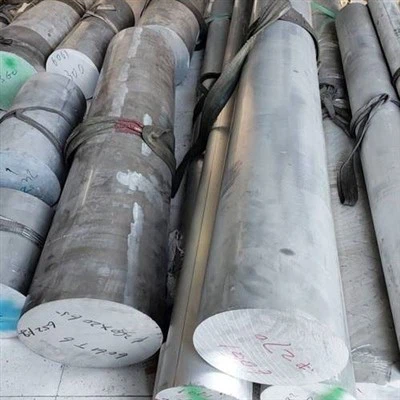
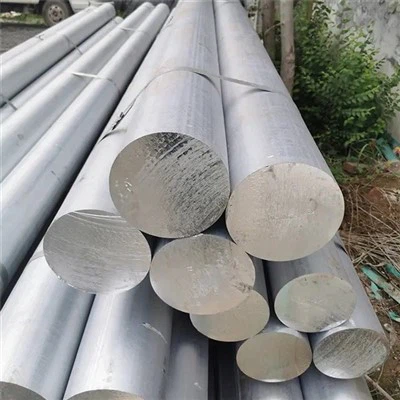
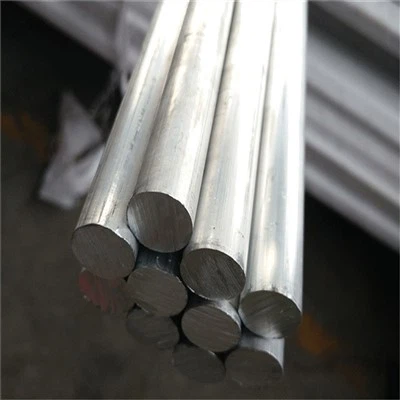
ASTM B221 6063-T5 Extruded Aluminum Round Bar
Customer service is online. Enter the chat to get the latest quotation.
 Spot stock
 Customize
 Factory direct sale
 7 days delivery
If a drawing says 6063 without a temper suffix, the enquiry usually comes back asking which one - and the choice is not cosmetic. T5 gets its strength from cooling at the press and aging in an oven, so it costs less; T6 adds a separate solution heat treatment first and delivers roughly 15–25 % more strength. On a bar that will be anodised and looked at, that extra strength is often bought and never used.
What is 6063-T5 aluminum round bar
6063 belongs to the aluminum-magnesium-silicon family and carries lower alloying content than 6061. That lean chemistry is the reason it behaves differently on a press: it flows more easily through a die, leaves a smoother surface out of the tool, and takes a brighter anodic film. The trade is strength - 6063-T5 is specified to a lower minimum than 6061.
T5 on extruded product means the bar leaves the press at extrusion temperature, cools from that temperature, and is then artificially aged. There is no separate solution heat treatment in the route. Two things follow for buyers: the aging response depends on the section having cooled fast enough at the press, and the absence of a second heat treatment is why T5 generally prices below the same bar in T6.
| Designation | Standard for extruded round bar | Route summary |
|---|---|---|
| 6063-T5 aluminum round bar | ASTM B221, EN 755-2, AMS-QQ-A-200/9 | Cooled from press temperature, then artificially aged |
| 6063-T52 aluminum round bar | ASTM B221, EN 755-2 | Cooled, stress relieved by stretching, then aged |
| 6063-T6 aluminum round bar | ASTM B221, EN 755-2 | Solution heat treated, quenched, then artificially aged |
| 6063 cold-finished bar | ASTM B211 | Drawn to drawing-grade tolerance rather than extruded tolerance |
Where the drawing calls for an h8/h9 fit rather than extruded tolerance, ask about the drawn route under ASTM B211 - it is a different route with different tolerance economics, and worth pricing before assuming extruded bar will machine to the fit.

Choosing between 6063-T5, T52 and T6 aluminum round bar
All three are the same alloy; the decision is about what happens after the press. Typical room-temperature results reported for 6063 extrusions:
| Temper | Tensile (MPa) | Yield (MPa) | Elongation | Brinell | Why it is chosen |
|---|---|---|---|---|---|
| O | 90–130 | up to 90 | 25–30 % | 25–35 HB | Annealed, for heavy forming before aging |
| T4 | 150–180 | 80–110 | 18–22 % | 45–55 HB | Naturally aged, formed before final age |
| T5 | 185–215 | 145–185 | 12–18 % | 60–75 HB | Default architectural temper: cost, finish, adequate strength |
| T52 | 170–200 | 130–160 | 14–18 % | 55–68 HB | Stretched first - added stability where material comes off asymmetrically |
| T6 | 215–245 | 170–215 | 15–20 % | 70–83 HB | Structural margins; higher documented minimums |
6063-T5 vs 6061-T6511 aluminum round bar
Both are stocked round bar and both machine, weld and anodise. They are not interchangeable on strength, and 6063 wins on everything downstream of the press:
| Property | 6063-T5 | 6061-T6511 | Read-across |
|---|---|---|---|
| Tensile strength, ASTM minimum | 186 MPa (27 ksi) | 262 MPa (38 ksi) | 6061 carries about 40 % more load |
| Yield strength, ASTM minimum | 145 MPa (21 ksi) | 240 MPa (35 ksi) | Design allowables differ accordingly |
| Elongation, ASTM minimum | 8 % | 8 % (per standard) | Comparable ductility requirement |
| Thermal conductivity, typical | 205–210 W/m·K | about 167 W/m·K | 6063 sheds heat better - heat sinks, LED housings |
| Relative extrusion speed | High (6063 extrudes readily) | Lower | Cycle time and die wear favour 6063 |
| Anodising result | Bright, uniform, best-in-class | Good, slightly greyer in clear anodise | The deciding factor on visible parts |
| Machinability | Fair to good | Good to excellent | 6061 is the better material for heavy CNC removal |
| Density | 2.70 g/cm³ | 2.70 g/cm³ | No weight difference |
Sizes and ASTM B221 tolerances for 6063-T5 aluminum round bar
Extruded bar works to stepped tolerance classes rather than a single h-grade band, which means the allowance widens as diameter grows. Representative standard-class figures per ASTM B221 and EN 755-9:
| Parameter | Standard-class allowance |
|---|---|
| Diameter, up to 10 mm | about ±0.10 mm |
| Diameter, over 10 to 50 mm | about ±0.15 to ±0.20 mm, stepped by size |
| Diameter, over 50 to 120 mm | about ±0.25 to ±0.30 mm, stepped by size |
| Diameter, over 120 mm | about ±0.50 mm |
| Straightness | typically 0.5–1.5 mm per metre |
| Twist | around 1.5° per metre |
| Cut length | +6.4 / 0 mm |
Chemical composition of 6063-T5 aluminum round bar
| Element | Limit | Why the limit matters here |
|---|---|---|
| Silicon, Si | 0.20 to 0.60 | Combines with magnesium as Mg2Si, the age-hardening phase |
| Magnesium, Mg | 0.45 to 0.90 | Sets the strength ceiling alongside silicon |
| Iron, Fe | 0.35 max | Kept low to protect surface brightness after anodising |
| Copper, Cu | 0.10 max | Low copper keeps the clear anodic film from reading grey |
| Manganese, Mn | 0.10 max | Restricted to keep extrusion resistance low |
| Chromium, Cr | 0.10 max | Trace level, no grain-control role at this level |
| Zinc, Zn | 0.10 max | Impurity ceiling |
| Titanium, Ti | 0.10 max | Grain refiner in the cast billet |
| Others | 0.05 each, 0.15 total | Per registration |
| Aluminum, Al | Balance | - |
Mechanical properties of 6063-T5 aluminum bar
| Requirement | ASTM B221, 6063-T5 | ASTM B221, 6063-T6 |
|---|---|---|
| Tensile strength, minimum | 186 MPa (27 ksi) | 207 MPa (30 ksi) |
| Yield strength, minimum | 145 MPa (21 ksi) | 172 MPa (25 ksi) |
| Elongation, minimum | 8 % | 8 % |
| Typical figure | Value | Typical figure | Value |
|---|---|---|---|
| Tensile strength | about 205 MPa | Shear strength | around 117 MPa |
| Yield strength | about 170 MPa | Elastic modulus | 69 GPa |
| Elongation | 12–18 % | Electrical conductivity | around 53 % IACS |
| Brinell hardness | 60–75 HB | Thermal conductivity | 205–210 W/m·K |
Standard minimums per ASTM B221; typical figures compiled from published 6063-T5 data and given for estimating only. Always design to the minimums and verify against the certificate for the specific heat and section.
Weight per metre of 6063-T5 aluminum round bar
Solid bar at 2.70 g/cm³ follows kg/m = 0.002123 × d² with d in millimetres; multiply kg/m by 0.672 for lb/ft.
| Diameter | kg/m | lb/ft | Diameter | kg/m | lb/ft |
|---|---|---|---|---|---|
| 10 mm | 0.212 | 0.143 | 80 mm | 13.59 | 9.13 |
| 20 mm | 0.849 | 0.571 | 100 mm | 21.23 | 14.27 |
| 25 mm | 1.327 | 0.892 | 120 mm | 30.57 | 20.54 |
| 40 mm | 3.397 | 2.283 | 150 mm | 47.77 | 32.10 |
| 50 mm | 5.308 | 3.567 | 200 mm | 84.92 | 57.07 |
Anodizing and finishing 6063-T5 aluminum round bar
This is where the alloy earns its place. Low iron and copper give an anodic film that reads bright and uniform, batch after batch, which is why 6063 is the default material for visible architectural metal:
Clear anodise - the benchmark finish; stays bright where 6061 reads slightly grey
Electrolytic colour - bronze, champagne and black built into the oxide itself, specified for UV stability on curtain wall work (AAMA 611 / 612 are the usual references)
Powder coating - takes pretreatment and film well; used where colour range matters more than metallic sheen
Mechanical finishes - polishing and brushing both work on the smooth as-extruded surface
Machining, bending and welding 6063-T5 aluminum bar
Machining
6063 cuts cleanly but lacks the chip-breaking crispness of 6061 - expect longer, stringier chips and plan evacuation accordingly. Carbide with coolant gives the best surface. Tool wear is lower than harder alloys, which partly offsets the slower chip control.
Bending and forming
T5 bends with care; published guidance puts the minimum radius around 3–5 times section thickness depending on geometry, with noticeable springback to be taken up in tooling. Where a bend is tight or post-form stability is critical, T4 formed and aged afterward, or T52 stock, are the common answers.
Welding
TIG and MIG both suit it, typically with 4043 filler for general work or 5356 where higher as-welded strength and a better anodised colour match are wanted. Preheat is not normally needed on light sections. As with every heat-treatable alloy, the heat-affected zone loses strength from the aging treatment, so joints are sized accordingly or the assembly is re-aged.

Applications of 6063-T5 aluminum round bar
Architectural and trim - window and door hardware, curtain wall components, balustrade infill and posts, decorative turnings
Heat sinks and LED housings - the higher thermal conductivity is the reason 6063 is picked over 6061 for dissipating parts
Furniture and shopfitting - frames, legs, rails, display structures where the finish is part of the product
Solar and enclosure framing - mounting rails and light structural members
General fabrication - spacers, handles, light brackets, irrigation and pipe fittings, fixtures and tooling bodies


Specification 6063-T5 aluminum round bar
|
Item |
Term |
|---|---|
| Diameters | 6–250 mm extruded; larger rounds against a press booking |
| Lengths | Stock lengths around 3 m and 6 m, or cut to your cutting list |
| Tolerance | ASTM B221 standard class; closer classes and whole-length straightness quoted on enquiry |
| Surface | Mill finish as standard; protective options where the surface will be inspected |
| Minimum quantity | Flexible - sample bars and container lots priced off the same basis |
| Delivery | 15–30 days after confirmation, checked against the press programme before you commit |
| Shipping terms · payment | EXW, FOB, CFR, CIF, DAP · T/T, L/C at sight |
| Packing | Steel-strapped bundles, separated or sleeved to protect the finish, export cases or pallets |
| Documentation | EN 10204 3.1 mill certificate issued on the heat; 3.2 and third-party inspection arranged on request |


About GNEE
GNEE has run its own aluminum extrusion and export operation since 2008, shipping into more than 100 countries. Round bar goes out two ways: from stock on the diameters that repeat most often, and as scheduled extrusion runs when the size, temper or length is outside that list.
Order size is negotiable. A couple of sample bars and a full container are quoted through the same process.
Schedule before commitment. Standard items leave in 15–30 days; the date is confirmed against the press programme at quotation stage so it does not move later.
Certificates by default. EN 10204 3.1 paperwork, heat-referenced, ships with the goods. Where the project contract requires independent verification, 3.2 and third-party inspection are arranged.
Engineers on the enquiry. Share the drawing and how the part is loaded, finished and joined. The team recommends alloy and temper from that, and says something early if the specification will not do what the drawing expects.

FAQ
Why is T5 the standard temper for architectural aluminum bar?
Because it is made in one route off the press - cool from extrusion temperature, then artificial aging - with no separate solution heat treatment and quench. That keeps cost down and leaves a surface that anodises as well as the alloy can deliver. Typical results sit comfortably above the ASTM B221 minimums of 186 MPa tensile and 145 MPa yield.
How much strength do I gain by stepping up to 6063-T6 aluminum bar?
On standard minimums, T6 lifts tensile from 186 to 207 MPa and yield from 145 to 172 MPa - roughly 15–20 % on paper. Published comparisons put T6 about 8–12 % above T5 on price. If those extra numbers never enter your load case, T5 is the cheaper bar.
When is 6063-T52 worth specifying instead of 6063-T5?
When material comes off asymmetrically in machining and the part has to stay put. T52 is stretched before aging to relieve internal stress, so distortion after a heavy cut is less likely. The stability comes at slightly lower strength than standard T5.
6063-T5 or 6061-T6511 round bar - which one should I buy?
Let the job decide. Anything visible, anodised or dissipating heat favours 6063: brighter finish, higher conductivity, easier extrusion. Anything carrying real load or going through heavy CNC removal favours 6061, whose minimum strength figures are about 40 % higher. When neither dominates, price the both and compare against the drawing.
Will 6063-T5 anodise brighter than 6061?
Yes, and consistently - the low iron and copper ceilings in the composition are the reason. Clear anodic films stay bright and uniform where 6061 tends toward a slightly grey tone. It is the reason curtain wall and trim work specifies 6063.
How should 6063-T5 aluminum round bar be welded?
TIG or MIG with 4043 filler for general fabrication, or 5356 where you want higher as-welded strength and a colour match after anodising. Preheat is rarely needed on light sections, and remember the heat-affected zone loses aging strength - size the joint for that or re-age the assembly.
What diameters do you stock and what are MOQ and lead time?
Routine extruded diameters run 6–250 mm, held as stock lengths near 3 m and 6 m, with cut lengths to your list. Minimum quantity is flexible and priced case by case; standard orders ship in 15–30 days, confirmed against the press schedule before order placement.
Does 6063 aluminum need an export licence from China?
No. Chinese dual-use controls cover the high-strength grades - 7075, 7050, 2024, 2014, 2017, 7A04, 2195, 7068, 7055 and 7150 - and GNEE does not export those. 6063 sits outside the controlled categories, so this bar ships as ordinary commercial cargo.
Request a quote for 6063-T5 aluminum round bar
Six details and you get a number instead of a form: diameter, temper (T5, T52 or T6), length or cutting list, quantity, any tolerance or straightness requirement beyond standard class, and how the part will be finished - anodised, powder coated or left bare. If heat dissipation matters, mention it; conductivity is usually the deciding argument for this alloy.
Get a quote for 6063-T5 aluminum round bar
Hot Tags: ASTM B221 6063-T5 Extruded Aluminum Round Bar, China ASTM B221 6063-T5 Extruded Aluminum Round Bar manufacturers
You Might Also Like


Send Inquiry