



Aluminum Profiles
GNEE Aluminum:Leading Aluminum Profiles Supplier In China
GNEE is a modern supply chain enterprise with aluminum processing, sales and distribution as its core industries. It is an integrated service provider of various high-quality aluminum alloy plates, bars and profiles for intelligent manufacturing, mechanical processing and other industries.
Quality Assurance
With advanced production technology and equipment and a multi-functional laboratory, we provide customers with reliable product quality assurance.
Wide Range Of Applications
Our products are used in many fields, such as construction, automotive industry, industrial and manufacturing processes, and packaging.
Wide Product Range
Our exports steel to more than 100 countries, cooperates with over 600 companies in worldwide, among which are 15 shipyards, 143 project engineering companies, 23 boiler machinery manufacturers.
Professional Team
Our professional sales team provide customers with perfect first-class service; Our strict procurement quality control team carefully select high quality raw materials; Our advanced science and technology team improve production and reduce costs for customers.
Introduction of Aluminum Profiles
Aluminum profile, it is different section shapes aluminum products through aluminum extrusion process. From raw material-aluminum ingot, after hot melting, get aluminum billets, and then finish aluminum extrusion process through porthole die or flat die, can get different shape aluminum products. At this moment, the surface is mill finished and it is aluminum metal natural color. The surface treatment can be done for aluminum profile in anodized(anodized silver, anodized bronze, anodized champagne, anodized black and anodized gold and some other special order), electrophoresis and powder coated color(RAL color) after different processes. Now with the development of aluminum metal surface treatment, fluorocarbon painting or wood grain (marble grain) heating transferring can be done on the aluminum profile surface.


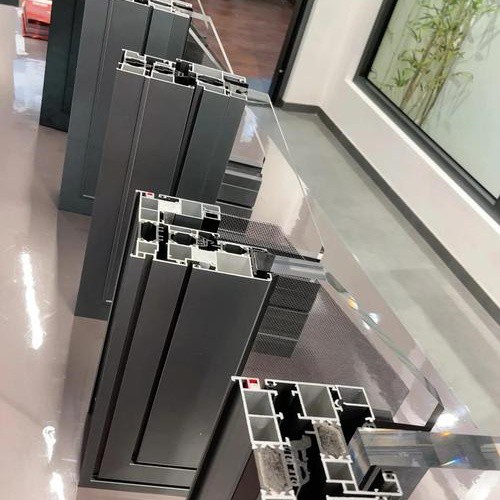


Advantages Of Aluminum Extruded Profiles
Less machining: Because the aluminum alloy can be extruded into any complex section, therefore, as long as the design is reasonable, extruded aluminum alloy profile material can also be easily assembled, thus reducing the need for machining.
Some shapes can only be obtained by extrusion and cannot be achieved by other processes.Aluminum extrusion die low cost: compared with other competitive materials rolling molding, casting, forging, aluminum extrusion die cost is lower.
High structural efficiency: Aluminum extruded profiles can achieve maximum structural efficiency.
Use name profiles where you need to increase strength, and remove aluminum profiles where you don't.
Light weight: Extruded aluminum profiles are light, strong and durable. Because of the difference in performance between aluminum and competing materials, the aluminum structure that achieves the same result weighs only about half as much as the other metal structures, and the other metals are not as easy to work.
The surface treatment is versatile and corrosion resistant: With powder or electrophoretic coating, the designer can achieve any desired color.
Also include natural silver or color anodized film.
Low maintenance: Aluminum is a naturally durable metal and the above surface treatment enhances its durability.
Types of Aluminum Profiles
Square Profile
This is a unique aluminum profile related to hollow-beam options. Square aluminum components satisfy similar needs to hollow beams, with the main disparity being their ability to guarantee more stability. These profiles are available as support pillars, columns, and wall load special bearings. Square beams are crafted either non-seamlessly or otherwise based on the manufacturing process.
The manufacturing process is not only time-consuming but also relatively straightforward. In fact, it only mandates flattening aluminum sheets and integrating the corners making standard squares. Furthermore, their smoothening involves passing piercing points (high pressure) within its middle part for optimal smoothing.
Hollow Beam
As the name suggests, a hollow beam profile is essentially a hollow aluminum beam that doesn't have specific cross-sections. Hollow beams are part of modular installations, particularly in constructional design. A hollow beam is available in various shapes boasting unique sub-classifications for each. They are typically available in various forms, including square-shaped, rectangular beams or hollow bottom/top.
The outcome is usually distinct beams that can be used as part of building support frameworks, bridges, and other industrial application types. Hollow beams are significantly useful in offering horizontal support, particularly where heavy loads are involved.
SD Aluminum Profile
The use of aluminum profiles extends from small to large-scale project applications, and one of the common applications is window framing purposes. Besides being flexible and lightweight, aluminum is also corrosion resistant, among the primary factors contributing to its widespread use to create stable window frames.
An aluminum SD profile makes for high-quality sliding window frames. Since windows are frequently exposed to environmental elements like rain, high temperatures, and dust, it is essential to create robust window frames. With this in mind, SD aluminum does just that since it features remarkable sliding functionality, rigidity, and resistance to different weathering forms, rendering it a fantastic choice.
Door Section
The door section profile, also called the ED section, represents aluminum profiles utilized in heavy-duty glass building doors. ED sections are part of the complete push door application mechanism and usually function as a complete system. You can find glass doors boasting push mechanisms in different commercial spaces.
Aluminum door sections feature a notable classic design that doubles down on the overall functionality and form. You can uniquely secure the glass material with aluminum ED sections, preventing it from toppling or falling unexpectedly.
RCW Profile
An RCW profile is currently among standard high-rise structures' most prominently used aluminum profiles. They are usually applied to mullions or curtain walls. Ideally, RCW profiles are not used for their ability to offer structural function but rather offer a solid barrier to help prevent environmental elements from entering buildings.
Typically, curtain walls are available in varied size options and are generally aluminum-framed. There is a need for these profiles to have the necessary elements to ensure proper sealing of unwanted items from entering a building space's interior. This is among the primary reasons why RCW aluminum profiles are regularly fitted with other standard materials that help prevent the occurrence of leakages.
T-Section
As the name suggests, the t-section aluminum profiles are t-shaped (aluminum) extrusion products that offer support in multiple directions. These aluminum profile structures contain vertical webs, horizontal flanges, and spans. T-section structures can be commonly found in corners, not to mention being part of truss networks. These aluminum profiles are easily interlinked with standard profiles like the square and hollow beam profiles. Moreover, you can also enhance durability and support level by attaching fittings to the T-section profiles.
Louver Profile
Louvers are unique aluminum profile arrangements where slats are joined at regular horizontal intervals at a given angle. Louvers come in various forms, including door shutters and window blinds, and because of their structure, they are primarily used for ventilation and natural lighting passage. Also, louver profiles keep debris from penetrating a building.
Properties And Characteristics Of Aluminum Profiles

Lightweight
Aluminum is a lightweight material, making aluminum profiles lightweight as well. This can reduce the overall weight of a structure or system, making it easier to transport, handle, and install.

Strong
Despite its lightweight nature, aluminum is a strong material that provides excellent stability and support. This makes aluminum profiles well suited for use in applications where stability and strength are important.

Durable
Aluminum is a highly durable material that is resistant to corrosion and weathering. This makes aluminum profiles ideal for outdoor applications or in environments where exposure to the elements is a concern.

Versatile
Aluminum profiles can be manufactured in a wide range of shapes, sizes, and alloys, making them well suited for a wide range of applications.

Conductive
Aluminum is an excellent conductor of electricity, making it ideal for use in electrical applications.

Recyclable
Aluminum is a highly recyclable material, making it an environmentally friendly choice for many applications.

Easy to work with
Aluminum profiles can be easily cut, drilled, and machined to meet the specific needs of a particular application.

Cost-effective
Aluminum is a cost-effective material that provides a good balance of strength, durability, and affordability.
What Is The Important Role Of Aluminium Profiles In The Processing?
Extruded aluminum is more malleable than other processing methods such as rolling or forging. For some materials that must be processed by rolling or forging, such as alloys such as 7075, it is also necessary to extrude the billet first, which can improve the structure and improve the plasticity.
Extrusion can not only make the section of the profile into different shapes, but also produce different and more complex section planes according to the different molds, increase the use efficiency, reduce the cost of the product, and improve the economic benefits.
The extrusion processing has great flexibility, and the profiles extruded by different dies are also different.
The precision of aluminium extruded products is very high. The higher the quality of the mold, the greater the precision and the lower the loss.
Aluminium extruded products have higher strength and better performance than aluminum alloy products that made by other methods.
Strength
Strength or durability refers to the ability of the aluminum profile to withstand pressure, damage, wear and tear that arises from the day-to-day use of the part as intended. It also refers to the ability of the part to withstand pressure and heat treatment. The maximum tensile strength is the amount of stretch or pulling the profile can take before its mechanical properties are permanently altered.
Generally, pure aluminum 1100 has the lowest strength, while the heat-treated alloy series of 2024 and 7075 are progressively higher in strength. The 5052 and 6061 offer medium to high mechanical strength.
Hardness
Hardness is different from the aluminum profile strength and is a factor in the aluminum profile’s chemical composition. The state of the aluminum profile also has a profound influence on the hardness of the profile.
The hardness matrix decreases from the 7 to 2,4,6,5,3 and 1 series in that order.
Corrosion Resistance
Corrosion resistance speaks to the ability of an aluminum profile to withstand the chemical changes to its structure arising from exposure to chemical and rust conditions.
In this case, the best corrosion resistance is seen in the 1 series. Next is the 5 series, then comes the 3, 6, 2 and 7 series in that order. In clearer terms, the Alloys 1100, 5052, and 6061 have excellent to very good mechanical properties, the 3003 and 6063 have decent corrosion resistance, while the 2 series is generally poor.
Weldability
Weldability refers to how easily an aluminum profile can be welded. The weldability of most aluminum profiles is generally very good. However, profiles of alloys 2024, 7075, and 2011 are inferior. Alloys 3003 and 1100 have excellent welding performances. The 5 series of aluminum profiles are particularly designed for welding.
Machinability
Machinability performance entails the ease of forming and machining an aluminum profile. This includes cutting, forming, and turning in some instances. Generally, the machinability of each aluminum profile may be affected by heat treatment or annealing. Annealed parts are very machinable and formable, while heat-treated aluminum materials are more challenging to machine.
Finishing
Aluminum profiles may be coated, anodized, polished and more to obtain the desired feel, look and finish. Depending on the end-use and environmental conditions where the part may be deployed, the aluminum profile for extrusion may need specific chemical and surface treatments to deliver on performance expectations.
End-use
By research and experience, certain aluminum profiles are more suitable for some industries than others. For instance, the Aluminium alloy 2011 and 1100 are broadly used in general machining and metal spinning, while the 2024 and 7075 are deployed in metal spinning and aerospace industries respectively.
Our Factory
Common Problems of Aluminium Profile