

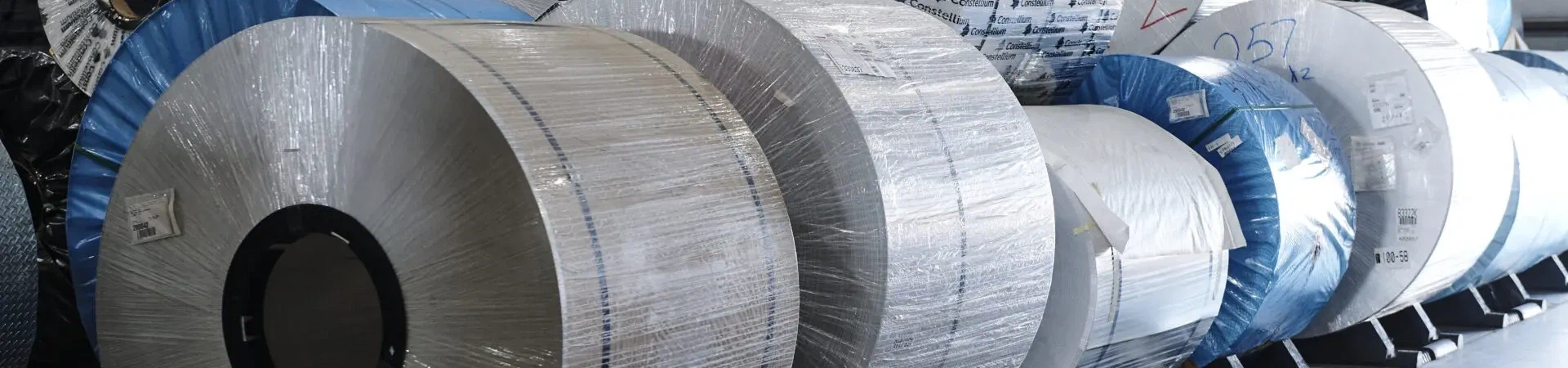


7050 Aluminum Strip
Customer service is online. Enter the chat to get the latest quotation.
 Spot stock
 Customize
 Factory direct sale
 7 days delivery
What is 7050 aluminum strip
7050 aluminum strip is coiled 7050 sheet, slit to a narrow width and supplied on a coil rather than cut into plates. It is one of the highest-strength aluminium alloys available in coil form - in T6 the tensile strength runs about 570–620 MPa, roughly 80 % higher than 6061-T6. Where 7050 differs from 7075 is zirconium in place of most of the chromium: that gives it better resistance to stress corrosion cracking in the overaged tempers, which is why aircraft builders favour it for thick structural sections.
We quote the range we actually run and can hold to tolerance: 0.20–4.00 mm thick, 20–600 mm wide. That is narrower than a mill's full rolling capability on purpose. Outside that band, 7050 in narrow widths runs into practical limits on edge quality, flatness and coil shape, and stops making economic sense for either side. Send the drawing anyway - we will tell you straight whether it is a coil job or a plate job.
Export control screening for 7050 aluminum strip
7050 sits inside a controlled alloy category. Whether a given order can ship is decided order by order.
7050 appears among the high-strength aluminium alloy categories China controls as dual-use items. Control entry 1C202.a describes tube and solid cylindrical bar with a tensile strength of 460 MPa or more and an outside diameter above 75 mm - both conditions together.
The product here is strip and coiled sheet, 0.20–4.00 mm by 20–600 mm. That is not the tube or solid cylindrical bar form in 1C202.a, and both dimensions sit far below the 75 mm threshold.
This page is a product range and a first screening - not a licence determination, and not a statement that any size ships without screening. China's current catalogue has applied since 1 January 2026. Final classification depends on the actual HS code, measured parameters, end-use and end-user, and is made at declaration. Send those details with your enquiry; we screen before quoting.
Specifications of 7050 aluminum strip
ASTM B209/B209M covers flat sheet, coiled sheet and plate, and 7050 with its standard tempers falls within the alloys it covers - strip supplied to this range is B209 material. The table below is the range we quote against.
| Item | Specification |
|---|---|
| Alloy | 7050 (UNS A97050, EN AW-7050, AlZn6MgCuZr) |
| Temper | O, T6, T7451, T7651 |
| Thickness | 0.20–4.00 mm |
| Width | 20–600 mm |
| Coil ID | 300 / 505 mm |
| Coil OD | Up to 1600 mm |
| Coil weight | 2–7 tons |
| Surface | Mill finish |
| Edge | Slit edge / mill edge |
| Form | Aluminum strip / coil |
| Standard | ASTM B209 / B209M |
| Custom size | Available |
Length is supplied as coil or cut to length. Cut lengths, tighter width bands and non-standard tempers are produced to order against a drawing or a written specification.


Choosing between O, T6, T7451 and T7651 aluminum strip
Temper choice on 7050 strip is a trade between peak strength and resistance to stress corrosion cracking. 7050 is supplied in the overaged T7451 and T7651 tempers more than any other alloy, because that is where it earns its place in aircraft structure.
| Temper | What it is | Where it is used |
|---|---|---|
| O | Annealed, softest condition. For forming and bending before heat treatment. | Forming, blanking and drawing prior to ageing |
| T6 | Solution heat treated and artificially aged to peak strength. Tensile about 570–620 MPa. | General high-strength strip; maximum strength where coating or indoor service applies |
| T7451 | Overaged (T74). Trades some strength for the highest stress corrosion resistance of the 7050 tempers. | Sustained load in humid or saline service; the aerospace default for 7050 |
| T7651 | Intermediate overaging between T6 and T7451. | Where exfoliation resistance matters and less strength is given up than in T7451 |
Chemical composition of 7050 aluminum strip
| Element | Content (wt %) | Role in the alloy |
|---|---|---|
| Zinc (Zn) | 5.7–6.7 | Principal hardening element; forms the MgZn₂ precipitates that carry the strength |
| Magnesium (Mg) | 1.9–2.6 | Combines with zinc for the age-hardening response |
| Copper (Cu) | 2.0–2.6 | Raises strength and fatigue resistance; lowers general corrosion resistance |
| Zirconium (Zr) | 0.08–0.15 | Refines the grain structure - the element that gives 7050 its better stress corrosion resistance than 7075 |
| Iron (Fe) | 0.15 max | Impurity, held low to protect toughness |
| Silicon (Si) | 0.12 max | Impurity |
| Manganese (Mn) | 0.10 max | Impurity |
| Titanium (Ti) | 0.06 max | Grain refiner |
| Chromium (Cr) | 0.04 max | Trace; 7050 relies on zirconium rather than chromium for grain control |
| Others, each / total | 0.05 max / 0.15 max |
Registered limits per ASTM B209 / B209M and EN 573-3. Heat analysis is reported on the EN 10204 3.1 certificate against the heat number. The Chinese GB designation for this alloy is confirmed per order - ask if your drawing calls for a GB grade.
Mechanical properties of 7050 aluminum strip by temper
The values below are representative published datasheet ranges for the supplied tempers. They are not a thickness-stepped minimum table, and typical results run across or above these bands - design and inspect against the mill certificate for the heat supplied.
| Temper | Tensile (MPa) | Yield (MPa) | Elongation (%) |
|---|---|---|---|
| T6 | 572–641 | 503–572 | 8–10 |
| T7451 | 552–620 | 483–540 | 10–12 |
| T7651 | 552–621 | 483–552 | 10–12 |
O temper is the soft annealed condition (typical tensile up to about 290 MPa) and is supplied for forming before heat treatment; confirm the exact figure against the heat certificate. All figures above are indicative and certificate-governed.
Thickness, width, coil weight and yield of 7050 aluminum strip
Thickness and width tolerances for 7050 strip follow ANSI H35.2(M)-2000. 7050 is named in the standard's aerospace alloys list, so its thickness tolerances come from Table 3.1b - tighter than the ordinary-alloy table. The values below apply to widths up to 1000 mm, which covers this range.
| Thickness (mm) | Thickness tolerance (mm) |
|---|---|
| 0.20–0.25 | ±0.035 |
| 0.25–1.00 | ±0.040 |
| 1.00–2.00 | ±0.050 |
| 2.00–2.50 | ±0.065 |
| 2.50–3.20 | ±0.08 |
| 3.20–4.00 | ±0.11 |
Slit width tolerance, ANSI H35.2(M) Table 3.5 (slit coiled sheet, mm plus and minus):
| Thickness (mm) | Width ≤150 mm | 150–250 mm | 250–600 mm |
|---|---|---|---|
| 0.20–3.20 | ±0.25 | ±0.5 | ±1 |
| 3.20–4.00 | ±1 | ±1 | ±1 |
Thickness values per ANSI H35.2(M)-2000 Table 3.1b (aerospace alloys, width up to 1000 mm); width values per Table 3.5. Tolerances apply at ambient mill temperature - allow for a dimensional change of 0.24 mm per metre per 10 °C. Tighter bands are agreed before rolling.
Coil weight and yield
Weight per metre: kg/m = thickness (mm) × width (mm) × 0.00283, at a density of about 2.83 g/cm³ for 7050.
| Strip size | kg/m | Metres per ton | Max length at OD 1600 / ID 505 | Approx. coil weight at that OD |
|---|---|---|---|---|
| 1.0 × 100 mm | 0.283 | 3,534 | 1,810 m | ~0.5 t |
| 1.0 × 300 mm | 0.849 | 1,178 | 1,810 m | ~1.5 t |
| 3.0 × 600 mm | 5.094 | 196 | 603 m | ~3.1 t |
| 4.0 × 600 mm | 6.792 | 147 | 453 m | ~3.1 t |
So read the 2–7 ton coil weight figure carefully: coil weight is set by OD, ID and width, not by thickness. At 1600 mm OD, a 600 mm wide coil holds about 3 tons whatever the thickness; a 100 mm wide coil holds roughly half a ton. Narrow strip therefore ships as lighter coils, or as several coils to make up the order. We confirm the achievable single-coil weight for your width before quoting, rather than quoting a range the geometry cannot deliver.

Forming, machining and joining 7050 aluminum strip
Forming
Form 7050 in the O temper and heat treat afterwards where geometry allows. In T6 the bend capacity is limited, and tight radii crack. Where a bend is unavoidable in T6, open the radius and keep the bend line across the rolling direction.
Machining
7050 machines well in the aged tempers - short chips, clean cuts. Carbide tooling with coolant is the normal setup; 300–400 m/min with feeds around 0.05–0.2 mm per tooth is a typical starting point. Expect more tool wear than on 6061.
Joining
7050 is not a welding alloy. Fusion welding cracks in the heat-affected zone and destroys the strength you paid for. Riveting, adhesive bonding and mechanical fastening are the normal routes for strip assemblies.
Corrosion protection and stress corrosion cracking in 7050 aluminum strip
The copper and zinc that give 7050 its strength also make general corrosion moderate - better than 7075, but it is not a marine-grade alloy on its own. Two failure modes matter in service:
Stress corrosion cracking - cracking under sustained tensile stress in a corrosive environment. This is where 7050 earns its reputation: the zirconium grain refinement means T7451 and T7651 resist SCC far better than 7075 in the same tempers, which is why airframe builders specify them.
Exfoliation corrosion - layered attack along grain boundaries. T7451 and T7651 rate well under ASTM G34; the overaged tempers are the answer, not the peak-aged T6.
Protection for bare strip is anodising, conversion coating plus paint, or alclad where the specification allows. Tell us the service environment - if a part sits outdoors or near salt water in T6 with no coating, we will say so before it becomes a claim.
Applications of 7050 aluminum strip
7050 strip is chosen where a narrow width of very high strength is needed and the part is stamped, formed or machined from coil rather than cut from plate:
Aerospace - structural clips, brackets, stiffeners, shims, splice plates, fuselage and wing-section backing stock
Mould and tooling - jig and fixture stock, injection-mould backing plates, prototype tooling
Defence and transport - structural members, brackets and load paths where strength-to-weight is critical
Precision engineering - spring clips, high-strength shims, instrument mounts
High-stress hardware - fastener stock, latches, hinges, load-bearing straps

Ordering 7050 aluminum strip
| Item | Terms |
|---|---|
| Thickness × width | 0.20–4.00 mm × 20–600 mm; custom sizes on request |
| Coil ID / OD | 300 or 505 mm ID; OD up to 1600 mm |
| Tolerance | ANSI H35.2(M) standard class - thickness per Table 3.1b for 7050; tighter bands agreed before rolling |
| Minimum order quantity | Flexible - trial coils and full container loads quoted on the same terms |
| Lead time | 15–30 days from order confirmation, confirmed against the rolling schedule before you commit |
| Incoterms / payment | EXW, FOB, CFR, CIF, DAP · T/T, L/C at sight |
| Packing | Coil eye horizontal or vertical as agreed, wrapped and strapped to a pallet or in a seaworthy wooden case, with edge protection |
| Certification | EN 10204 3.1 with heat number, chemical analysis and mechanical test results; 3.2 and third-party inspection arranged on request |
Export screening: 7050 sits in a controlled alloy category, so we screen product form, dimensions, end-use and end-user before quoting (see the screening note above). This page is a first screening, not a licence determination.
About GNEE
Exporting since 2008. GNEE has shipped aluminium flat-rolled products to more than 100 countries.
We quote the range we can hold. The 0.20–4.00 mm by 20–600 mm band on this page is our sellable range, not a theoretical mill capability. Narrower promises on paper turn into wide coils and scrap on your floor.
Small quantities are normal. Trial coils, sample lengths and full production runs are quoted on the same terms. Order what the job needs.
Delivery you can plan around. 15–30 days from confirmation, and we check it against the actual rolling schedule before you commit, not after.
Paperwork that clears inspection. EN 10204 3.1 mill certificate with every shipment, traceable to the heat. 3.2 and third-party inspection arranged where the job requires it.
Compliance screened before quotation. For controlled alloy categories such as 7050, our team screens the product form, dimensions, end-use and end-user before issuing a price - so you are not given a quote that cannot ship.

Request a quote for 7050 aluminum strip
Send thickness, width, temper, quantity, edge condition, any tolerance beyond standard class, and destination port. For 7050 we also need end-use and end-user - the alloy sits in a controlled category and we screen before quoting.
Unsure between T6, T7451 and T7651? Describe the service environment and the load case - sustained or intermittent, indoor or coastal - and we will tell you which temper the job calls for.
To request a quote, email info@gneealu.com with the details above, or use the enquiry form on our contact page.
FAQ
What thickness and width does GNEE quote for 7050 aluminum strip?
0.20–4.00 mm thick, 20–600 mm wide. We publish a narrower range than a mill can physically roll, because 7050 in very thin or very wide narrow-band sizes hits practical limits on edge quality, flatness and coil shape. Outside that band, ask - we will say whether it is a coil job or a plate job.
Does ASTM B209 cover 7050 aluminum strip?
Yes. ASTM B209/B209M covers flat sheet, coiled sheet and plate, and 7050 with its standard tempers is within the alloys the specification covers. Strip is coiled sheet supplied slit to width, so it is B209 material.
What is the difference between 7050-T6, T7451 and T7651 strip?
Representative datasheet ranges: T6 572–641 MPa tensile and 503–572 yield; T7451 552–620 and 483–540; T7651 552–621 and 483–552. T7451 and T7651 are overaged - they give up some strength for much better stress corrosion and exfoliation resistance, which is why they are the aerospace default for 7050. T6 is for maximum strength with coating or indoor service.
Why is 7050 often chosen over 7075?
Both are high-strength Al-Zn-Mg-Cu alloys, but 7050 uses zirconium instead of most of the chromium. That grain refinement gives 7050 better resistance to stress corrosion cracking in the overaged tempers, so it is preferred for thick aircraft structural sections that carry sustained load.
What coil size can you supply?
Coil ID 300 or 505 mm, OD up to 1600 mm. Single-coil weight depends on OD, ID and width - at full OD a 600 mm wide coil holds about 3 tons, a 100 mm coil roughly half a ton, so narrow strip ships as lighter or multiple coils. We confirm the achievable weight for your width before quoting.
Does 7050 aluminum strip need corrosion protection?
Usually yes. 7050 has moderate general corrosion resistance - better than 7075, but not a marine alloy on its own. Anodising, conversion coating plus paint, or alclad are the usual answers. If the part carries sustained load outdoors or near salt water, specify T7451 or T7651 rather than relying on coating alone.
What are the MOQ and lead time?
MOQ is flexible and trial coils are accepted. Lead time is 15–30 days from order confirmation, checked against the rolling schedule before you commit.
Is 7050 aluminum strip subject to Chinese export control?
7050 is within the high-strength aluminium alloy categories China controls as dual-use items. Control entry 1C202.a covers tube and solid cylindrical bar meeting a 460 MPa tensile threshold and greater than 75 mm outside diameter together - strip and coiled sheet are not that product form. This range is a product specification and a first screening, not a licence decision. China's current catalogue has applied since 1 January 2026, and final classification depends on HS code, measured parameters, end-use and end-user at declaration. Send those details with your enquiry.
Hot Tags: 7050 aluminum strip, China 7050 aluminum strip manufacturers
Previous
6082 Aluminum StripYou Might Also Like


Send Inquiry