





Aluminum Perforated Pipe
Customer service is online. Enter the chat to get the latest quotation.
 Spot stock
 Customize
 Factory direct sale
 7 days delivery
GNEE supplies perforated aluminum pipe and tube - round, square, rectangular, and oval sections with holes punched or laser-cut to pattern. The perforation turns a standard extrusion into a part that ventilates, filters, screens, or dampens sound while keeping aluminum's low weight and corrosion resistance. Common alloys are 1100, 3003, 5052, 6061, 6063, and 6082; we keep standard sizes in stock and cut or punch to drawing, with EN 10204 3.1 mill test certificates on every lot.
To request a quote, send the shape, alloy, outer diameter, wall thickness, length, hole pattern, hole size, open area, and finish. We confirm the specification and lead time before production and return a written quote with MOQ, price, and documentation. Request a quote for perforated aluminum pipe.
What is perforated aluminum pipe
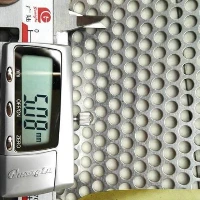
A perforated aluminum pipe is a tube with a uniform pattern of holes across its surface. Most are made by punching or laser-cutting holes into an extruded aluminum tube; some larger or thin-wall sizes are made by perforating flat aluminum sheet and then rolling and welding it into a tube. The holes are defined by shape, diameter, spacing, and arrangement, and those four variables decide how the pipe performs in ventilation, filtration, acoustic, or decorative service.
Hole patterns of perforated aluminum pipe
Holes are laid out in-line or staggered (45° / 60°); staggered layouts usually give higher open area at the same hole size. Open area is set by hole diameter and pitch and is calculated against your flow or filtration target. Typical ranges by shape:
| Hole pattern | Hole diameter | Open area | Typical use |
|---|---|---|---|
| Round | 2–10 mm | 23–69% | Most common; ventilation, air and liquid filtration, acoustic panels. |
| Square | 5–15 mm | 30–50% | Clean, uniform look; architectural facades, screening, partitions, lampshades. |
| Slotted | 2–8 mm (slot width) | 20–45% | Directional airflow, drainage, water and oil filtration. |
| Hexagonal | 3–10 mm | 30–60% | Balances open area and strength; equipment guards, noise barriers. |
| Oval / star / fish-scale | 3–15 mm | 15–40% | Decorative facades, landscape, and interior finishes. |
Perforated zones can run full-length or leave plain margins at the ends or edges for welding and clamping; tell us the margin width when the tube joins a frame.


Specifications of perforated aluminum pipe
| Parameter | Typical range / value |
|---|---|
| Shape | Round, square, rectangular, oval |
| Alloy & temper | 1100, 3003, 5052, 6061, 6063, 6082; H14 / H34 / T5 / T6 |
| Outer diameter | 6–300 mm standard (larger by request) |
| Wall thickness | 0.4–15 mm standard |
| Length | Up to 6000 mm; longer by request |
| Hole diameter | 2–15 mm standard |
| Open area | 20–69% (set by hole size and pitch) |
| Filtration precision | 2–2000 µm (by hole size) |
| Perforated margin | Full perforated or plain margin at ends / edges |
| Hole arrangement | In-line or staggered (45° / 60°) |
| Standards | ASTM B221, EN 755, GB/T 6892 |
| Surface finish | Mill finish; anodized Type II/III, powder coat, polishing, brushing |


Larger outer diameters, wall thicknesses, hole diameters, or non-standard shapes are- send your drawing and we confirm punch tooling and tolerance.
Alloy and mechanical properties of perforated aluminum pipe
| Alloy (temper) | UTS MPa | Yield MPa | Elong % | Common use |
|---|---|---|---|---|
| 1100 (H14) | 110 | 105 | 12 | Decorative, low-strength, high corrosion resistance |
| 3003 (H14) | 150 | 145 | 8 | General ventilation, cladding, formability |
| 5052 (H34) | 260 | 215 | 10 | Marine-leaning, filtration, outdoor |
| 6063 (T5) | 175 | 130 | 8 | Architectural screens, anodized facades |
| 6063 (T6) | 215 | 170 | 8 | Architectural, brighter anodize |
| 6061 (T6) | 310 | 276 | 12 | Structural frames, guards, brackets |
| 6082 (T6) | 310 | 270 | 12 | Structural, marine-leaning |
Values are typical for the temper shown per ASTM B221 / EN 755; exact lot values are listed on the EN 10204 3.1 MTC. Composition follows the relevant ASTM / EN grade; 6061 is Al–Mg–Si–Cu, 3003 and 1100 are lean-alloy, 5052 is Al–Mg. Pick the alloy against strength, corrosion, and anodize requirements rather than by habit.
Applications of perforated aluminum pipe
Ventilation and HVAC: air movement in ducts, units, and enclosures with controlled open area.
Filtration: air and liquid screening where a light, corrosion-resistant medium is needed; particle size is set by hole diameter and pitch.
Acoustic and sound control: noise barriers and panels that absorb or diffuse sound.
Architectural screens and facades: cladding, sunshades, and interior partitions with a chosen hole pattern.
Drainage and leach fields: subsoil and land drainage where water passes but soil stays out.
Equipment guards and shields: protective covers that still allow airflow to components.
Automotive and transport: exhaust and muffler parts, trim, and ventilation tubing.
Agricultural and storage: ventilation walls in silos and warehouses to keep air moving.


Manufacturing and fabrication of perforated aluminum pipe
How the holes are made. Holes are punched with CNC tooling or cut by laser into an extruded tube; for large or thin-wall sizes we perforate sheet and roll it into a tube. The perforated tube is then finished by straight welding or spiral welding, or by straight / spiral lock seam, depending on diameter and pressure need.
Cutting and bending. Tubes cut square or miter on cold saw or band saw; wide-radius bends are possible in softer tempers (O, H14, T4). T6 bends only to wide radii.
Welding. 6061 and 6082 weld with ER4043 or ER5356; 5xxx and 3xxx weld with matching or ER5356 filler. Plan post-weld finish where the hole pattern must stay visually consistent.
Temperature. Aluminum keeps its strength and ductility at low temperature, which suits cold-service screening. Above about 200 °C strength falls, so for sustained high-heat service tell us the condition and we check the spec.
Mixed-metal joints. Aluminum is anodic to steel and copper, so use dielectric isolation washers or sleeves at mixed-metal connections.
Processing services for perforated aluminum pipe
Custom hole patterns: shape, diameter, pitch, and arrangement designed to your flow, filtration, or decorative target.
Cutting to length: square or miter cuts to dimension.
CNC machining: drilling, tapping, notching, and end forming per drawing.
Bending: wide-radius bends, mainly in softer tempers.
Surface treatment: anodizing (Type II/III), powder coating in RAL / PANTONE, polishing, brushing.
Welding and assembly: straight / spiral welding, lock seam, spot, seam, or arc welding and sub-assembly to reduce your downstream labor.
Send the finished-part drawing and we quote material and processing together.
Inspection and testing of perforated aluminum pipe
Every lot is checked before shipment so the pipe leaves on-spec and on-pattern:
Alloy verification: per-lot XRF / PMI confirms the ordered alloy (e.g., 6061 vs 6063) and separates it from similar extrusions.
Hole accuracy: hole diameter, pitch, and open area measured against the drawing; pattern alignment checked along the tube.
Dimensional check: outer diameter, wall thickness, length, and straightness measured to ASTM B221 / EN 755 limits.
Surface and finish: deburred hole edges, no obvious scratches or deformation; anodize / powder checked for coverage.
Documentation: EN 10204 3.1 mill test certificate travels with the order; 3.2 and third-party inspection arranged on request.
Test methods follow ASTM E1251 / E572 (spectrometry), ASTM B557 (tensile), ASTM E10 (hardness), and ASTM B221 / EN 755 (dimensions).
Packaging of perforated aluminum pipe
Bundling: tubes strapped into bundles with end caps to protect cut faces and hole edges.
Protection: moisture-barrier (VCI / PE) wrap keeps the surface clean and dry in transit.
Crating: wooden crate or pallet used where length or handling needs extra support.
Marking: each bundle shows alloy, temper, size, hole pattern, lot / heat number, and purchase order for traceability.

About GNEE
Supplying aluminum since 2008. GNEE exports wrought aluminum products to more than 100 countries.
Common sizes held, specials produced to order. Standard 6061, 6063, 6082, 5052, and 3003 tubes and profiles are stocked; non-standard diameters, walls, hole patterns, and tempers are run against your drawing.
Small and large orders both accepted. Minimum order quantity is flexible - trial quantities and full containers are quoted on the same terms, so quote the amount you actually need.
Lead time 15–30 days from order confirmation for standard specifications, confirmed against the current production schedule before you commit.
Documentation with every shipment. EN 10204 3.1 mill test certificate is standard; 3.2 and third-party inspection can be arranged on request.
Material selected for the job. Our sales engineers read drawings and ask about flow, load, environment, and finish before recommending alloy and temper, and will flag a specification that does not fit the service condition.
Request a quote for perforated aluminum pipe
Send your requirement - shape, alloy and temper, outer diameter, wall thickness, length, hole pattern, hole diameter, open area, finish, quantity, and standard (ASTM B221, EN 755, or GB/T 6892). We return a written quote covering exact dimensions and tolerances, surface finish, packaging, MOQ, unit price, and the 15–30 day lead time. Terms are FOB or CIF with payment by T/T or L/C; EN 10204 3.1 MTC ships with the order and 3.2 / third-party inspection is available on request.
FAQ
1. What hole patterns can you make on aluminum pipe?
Round, square, slotted, hexagonal, oval, and decorative fish-scale or star patterns. Holes are laid out in-line or staggered (45° / 60°), and open area is set by hole diameter and pitch against your flow or filtration target.
2. Which alloy should I choose for perforated aluminum pipe?
For architecture and anodized facades, 6063 (T5/T6) gives a clean look; for structural guards and frames, 6061-T6 or 6082-T6; for formability and cladding, 3003-H14; for marine-leaning or outdoor filtration, 5052-H34. Send the service condition and we recommend temper and finish.
3. What outer diameter and hole sizes are available?
Standard perforated aluminum pipe covers OD 6–300 mm, wall 0.4–15 mm, hole diameter 2–15 mm, length to 6000 mm, open area 20–69%. Larger diameters, walls, holes, or non-standard shapes are - send your drawing and we confirm tooling and tolerance.
4. Can perforated aluminum pipe be anodized or powder coated?
Yes. Type II / Type III anodizing and powder coating in RAL / PANTONE are standard. Anodize tone varies by alloy (6063 anodizes brighter than 6061), so tell us if a run mixes alloys or must match an existing color.
5. How is the perforation made and how accurate is it?
Holes are CNC-punched or laser-cut into extruded tube, or the sheet is perforated then roll-welded (straight or spiral weld, or lock seam) into tube for large or thin-wall sizes. Hole diameter, pitch, and open area are measured against the drawing on each lot, and the pattern alignment is checked along the tube.
6. What filtration precision can perforated aluminum pipe reach?
Filtration precision runs about 2–2000 µm depending on hole diameter, shape, and open area. Send the particle or mesh size you need to block or pass and we size the holes and pitch to match.
Request a quote for perforated aluminum pipe - send shape, alloy, OD, wall, length, hole pattern, hole size, open area, finish, quantity, and standard, and GNEE returns a quote with MTC and lead time.
Hot Tags: Aluminum Perforated Pipe, China Aluminum Perforated Pipe manufacturers
You Might Also Like


Send Inquiry