






Hexagonal Hole Perforated Aluminum Panel
Customer service is online. Enter the chat to get the latest quotation.
 Spot stock
 Customize
 Factory direct sale
 7 days delivery
As a hexagonal hole perforated aluminum panel supplier, GNEE reviews customer drawings and confirms material and processing requirements against available production capabilities. Send a CAD, PDF or DXF drawing, or just describe the application, and the technical team confirms hole diameter, pitch, arrangement, edge margin and finish.
Request a quote for hexagonal hole perforated aluminum panel
Overview of Hexagonal Hole Perforated Aluminum Panel
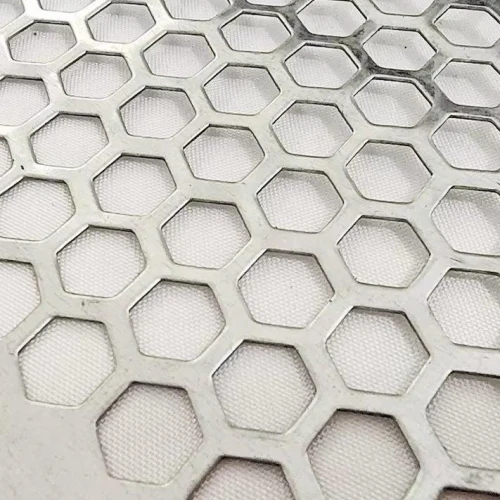
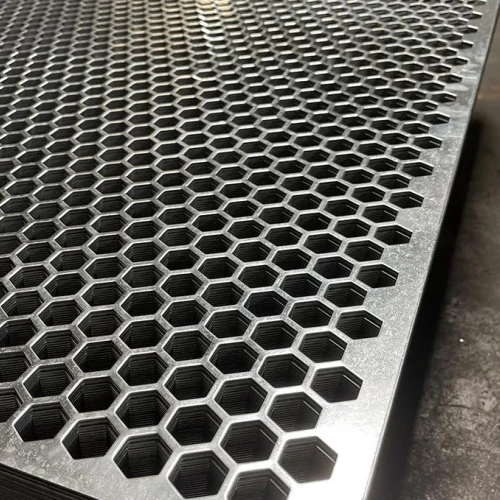
A hexagonal hole aluminum panel starts as solid aluminum sheet or plate. Regular hexagonal openings are formed by perforating, so the panel keeps a continuous aluminum body while gaining a controlled honeycomb of holes. Unlike round or square holes, the hexagonal shape reads as a structured, organic surface and packs openings efficiently for a given pitch. GNEE supplies the aluminum base material and performs the perforation and follow-up processing to the drawing.
| Product | Material | Main characteristics |
|---|---|---|
| Hexagonal hole aluminum sheet (plain panel) | 3003 / 5005 / 5052 / 6061 | Solid alloy sheet before perforation |
| Hexagonal hole perforated aluminum panel | 3003 / 5005 / 5052 / 6061 | Honeycomb openings for screening, cladding and ventilation |
| Hexagonal hole perforated aluminum plate | 5052 / 6061 | Cut-to-size or fabricated panel for structural and industrial use |
Aluminum Alloy and Temper for Hexagonal Hole Panels
Hexagonal hole perforated panels are produced from the common architectural and industrial aluminum alloys. The alloy is chosen for formability, corrosion resistance, anodizing response and strength, then perforated to the drawing. The points below explain the alloy options and how they sit beside each other for a perforated panel.
Aluminum Alloy Options for Hexagonal Hole sheets
3003 (Al-Mn, 3xxx) is the general-purpose choice for formability and cost; 5005 (Al-Mg, 5xxx) is selected where anodizing response and a consistent decorative finish matter; 5052 (Al-Mg, 5xxx) is chosen for higher strength and good corrosion resistance; 6061 (Al-Mg-Si, 6xxx) is used where structural strength from heat treatment is required. The exact temper is fixed per order against the drawing and finish route.
Hexagonal Hole Panel Alloy Comparison
| Alloy | Series / type | Indicative base tensile (MPa) | Why chosen for hexagonal hole panels |
|---|---|---|---|
| 3003 (H14 / H24) | 3xxx, Al-Mn, non-heat-treatable | ≈ 145 | Formability, corrosion resistance, cost-effective decorative and ventilation use |
| 5005 (H34) | 5xxx, Al-Mg, non-heat-treatable | ≈ 160 | Anodizing response for consistent architectural finish |
| 5052 (H32) | 5xxx, Al-Mg, non-heat-treatable | ≈ 215 | Higher strength and good corrosion resistance for façades and outdoor use |
| 6061 (T6) | 6xxx, Al-Mg-Si, heat-treatable | ≈ 310 | Higher strength and machinability for structural or framed panels |
Tensile values are indicative for the base unperforated sheet at typical tempers; guaranteed minimums come from the EN 10204 3.1 MTC. The perforated panel's remaining strength is reduced by the open area and ligament width, not the base alloy alone.
Specification of Hexagonal Hole Perforated Aluminum Sheet
The table below lists the parameters that define a hexagonal hole perforated aluminum panel order. GNEE supplies the aluminum and performs the listed processing; where a value is shown as a typical range, the exact figures are fixed from the drawing and production review. The panel thickness you need is confirmed together with the hole layout, because the two are linked by stiffness.
| Parameter | Options / Details |
|---|---|
| Product | Hexagonal hole perforated aluminum panel / sheet / plate |
| Aluminum alloy | 3003 / 5005 / 5052 / 6061 |
| Temper | H14 / H24 / H32 / H34 / O / T6 (selected per order) |
| Thickness | 0.5–6.0 mm typical for panel work (plate sizes fixed from drawing) |
| Sheet width | 1000 / 1220 / 1250 / 1500 mm typical; other widths by arrangement |
| Sheet length | 2000 / 2440 / 3000 mm typical, or cut to length |
| Hole shape | Hexagonal (honeycomb); DIN 24041 code SK/SKv (hexagonal), dedicated tooling; round (R), square (Q) and slotted (L) standard patterns are also produced on the same line |
| Hole diameter | Inscribed-circle diameter, from ~1 mm upward; minimum relates to sheet thickness |
| Hole pitch | Center-to-center distance, set per drawing |
| Hole arrangement | Triangular (hexagonal) pitch / custom |
| Open area | Approximate - up to ~60% for typical d/p (inscribed-circle diameter d, coefficient ~100); confirmed per drawing |
| Edge margin | 10–20 mm typical, subject to drawing and tooling |
| Surface finish | Mill finish / Anodized / Powder coated / PVDF |
| Standard | ASTM B209/B209M, EN 485-2, EN 573-3, EN 1396 or GB/T 3880 (selected per order) |
| Processing | Perforating, cutting, deburring, leveling and surface finishing |
| HS code | 7606.12 (rectangular alloy perforated aluminum sheet; subject to destination customs final classification) |
The values above are typical reference ranges for the product family; the exact alloy, temper, thickness, dimensions, hole geometry and tolerances are fixed from the drawing and production review. ASTM B209/B209M covers the base flat-rolled material; post-perforation hole, pitch, edge and flatness tolerances are agreed from the drawing. Hexagonal holes are a special pattern, so tooling and minimum sizes are confirmed per project.
Aluminum Alloy and Temper We Supply for Hexagonal Hole Panels
GNEE supplies hexagonal hole panels in 3003-H14/H24, 5005-H34, 5052-H32 and 6061-T6 as standard aluminum options. 3003 is the general-purpose and most cost-effective route; 5005 is chosen where anodizing response matters; 5052 is used for coastal or humid sites because of its better corrosion resistance; 6061 is considered where the panel needs higher strength or a longer unsupported span. The exact temper is fixed per order against the drawing.
Hexagonal Hole Panel Thickness, Width and Length We Supply
Typical panel thickness is 0.8–3.0 mm for architectural use, with thicker plate available where added support is needed. Standard widths run 1000 / 1220 / 1250 / 1500 mm, and lengths reach 3000–6000 mm or are cut to length and fabricated into modules. Folded returns and defined margins are added where the frame or fixing detail requires them.
Hexagonal Hole Geometry of Perforated Aluminum Panel
A hexagonal hole panel is defined by the hole diameter (inscribed circle, d) and the pitch (p). The hexagonal shape gives a structured honeycomb and packs openings efficiently. The achievable pattern is confirmed against available tooling and the drawing; because hexagonal holes are a special pattern, tooling and minimum sizes are reviewed per project.
Hexagonal Hole Diameter and Pitch of Perforated Aluminum Panel
Three terms define a hexagonal hole layout:
Hole diameter (d): the inscribed-circle diameter of the hexagonal opening.
Pitch (p): the center-to-center distance between two adjacent holes - measured from hole center to hole center.
Ligament width: the minimum solid metal width between adjacent holes; the minimum in every direction is confirmed from the drawing.
Open Area of Hexagonal Hole Perforated Aluminum Panel
Open area is the percentage of the panel surface occupied by holes. For a regular hexagonal (honeycomb) pitch, the open area is:
Open Area (%) ≈ 100 × (d / p)² - d is the inscribed-circle diameter; approximate
where d is the hole's inscribed-circle diameter and p is the center-to-center pitch. For a regular hexagon defined by its inscribed-circle diameter d, the open area is approximately 100 × (d / p)²; the value 90.69 × (d / p)² is the coefficient for 60° staggered round holes and is not used for hexagonal openings. Both apply only to regular repeating geometry; panels with solid margins, non-perforated zones or irregular spacing are calculated from the actual perforated area.
| d (mm) | p (mm) | Arrangement | Open area (calc.) | Note |
|---|---|---|---|---|
| 2 | 4 | Triangular (hexagonal) pitch | 25.0% | Calculation example |
| 3 | 5 | Triangular (hexagonal) pitch | 36.0% | Calculation example |
| 4 | 6 | Triangular (hexagonal) pitch | 44.4% | Calculation example |
| 5 | 8 | Triangular (hexagonal) pitch | 39.1% | Calculation example |
The table is a calculation example using the formula above, not a statement of GNEE's stocked patterns. Hexagonal holes are a special pattern, so the achievable diameter, pitch and open area are confirmed per project.

How Hexagonal Hole Perforation Affects Panel Strength
A higher open area reduces both the remaining material and the ligament width, which lowers the panel's stiffness and changes how it behaves under load and during forming. For a hexagonal hole aluminum panel, the final thickness and hole layout should be assessed together with hole diameter, pitch, ligament width, panel dimensions and support conditions. The flatness after perforation and any later bending also tie back to these same parameters.
Processing of Hexagonal Hole Perforated Aluminum Panel
GNEE provides the processing chain for custom hexagonal hole panels: base-material selection, cutting, perforating, deburring, leveling, inspection and surface finishing. Provide the drawing and GNEE confirms the layout, cut size and finish as part of the order. Because hexagonal holes are a special pattern, tooling and maximum dimensions are confirmed per project.
Sheet Preparation for Hexagonal Hole Aluminum Panel
The base aluminum sheet or plate is verified for alloy and temper and cut to the starting size before perforation. Confirm the base material standard (ASTM B209/B209M, EN 485-2, EN 573-3 or GB/T 3880) so the certificate matches the order.
Perforating Hexagonal Holes in Aluminum Sheet
Hexagonal patterns are produced by CNC punching using dies matched to the hole diameter and pitch, or by laser cutting for fine holes, complex outlines or custom patterns outside standard tooling. For aluminum, hole diameter versus sheet thickness, ligament width and margins are checked for manufacturability before production.
Deburring and Leveling of Hexagonal Hole Panel
Perforating can leave burrs on the die side and may cause panel bowing. Deburring and roller leveling restore edge quality and flatness; state your acceptance limits for burr height and flatness deviation on the technical query.
Cutting and Edge Finishing of Hexagonal Hole Panel
Cut-to-size and edge processing are provided as part of the order. State the required cutting method, maximum processed dimension and dimensional tolerance so GNEE can confirm the achievable limits for your order.
Surface Finishes for Hexagonal Hole Perforated Aluminum Panel
Aluminum accepts the common finishes, but the achievable appearance depends on the alloy and the processing sequence (pre- vs post-perforation). The finish route, film thickness and hole-edge appearance are confirmed per order.
Mill Finish on Hexagonal Hole Aluminum Panel
The original rolled surface, supplied as-standard. Confirm surface appearance and protection requirements, especially for bright or decorative uses.
Anodized Finish for Hexagonal Hole Aluminum Panel
Anodizing integrates the finish into the oxide layer and gives a consistent, durable appearance. 5005 anodizes more uniformly than 3003 or 5052; confirm the achievable film thickness, color consistency and hole-edge coverage from a sample.
Powder Coating for Hexagonal Hole Aluminum Panel
Powder coating adds a durable color layer. Confirm coating thickness, color, adhesion and surface uniformity for the project.
PVDF Coating for Hexagonal Hole Aluminum Panel
PVDF (fluorocarbon) coating is specified where exterior weatherability is required, such as façades and long-life outdoor screens. Confirm the coating system, film thickness and weathering requirement.
Applications of Hexagonal Hole Perforated Aluminum Panel
Hexagonal hole perforated aluminum panels are used where a honeycomb visual, light weight and corrosion resistance are needed together. GNEE supplies the aluminum sheet material and the perforation processing confirmed as available; For complete curtain-wall, acoustic or filtration systems, share the overall specification and GNEE supplies the matching perforated aluminum panel and processing. Confirm the grade, temper, finish and detailing for the specific exposure.
Architectural Façade and Cladding in Hexagonal Hole Aluminum
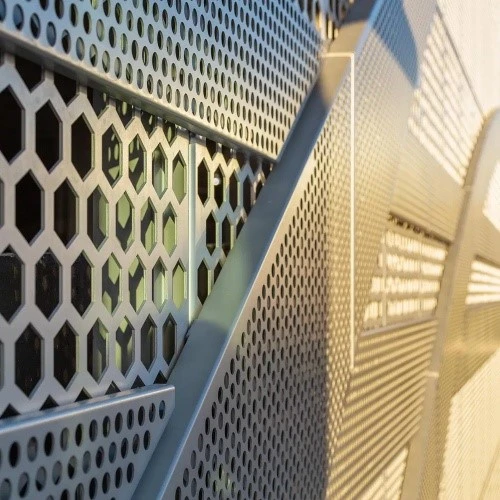
Used for building façades and decorative cladding where the honeycomb pattern gives a structured, organic appearance and controlled transparency. Buyers specify panel size, open area, alloy and finish.
Decorative Screens and Feature Panels in Hexagonal Hole Aluminum
Used for interior and exterior feature screens, ceiling features and branding panels where the hexagonal aperture reads as a designed surface rather than a plain grid.
Ventilation and Equipment Covers in Hexagonal Hole Aluminum
Used for ventilation covers and equipment airflow panels where the open area sets the airflow. Specify hole diameter, pitch and target open area; the actual airflow follows from the panel geometry.
Industrial Enclosures in Hexagonal Hole Aluminum
Used for machine enclosures and protective guards where panel rigidity, opening layout and edge quality matter. The honeycomb aperture gives an even, structured opening for many industrial settings.
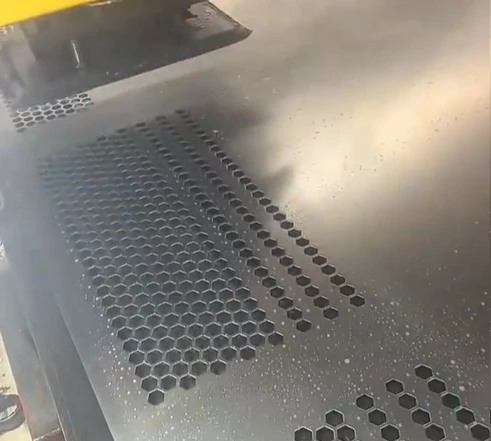
Other hex perforated metal Materials Available Beyond Aluminum
In addition to hexagonal hole perforated aluminum panels, GNEE can also supply hexagonal perforated sheet in other materials, including stainless steel, carbon steel, copper and weathering steel (Corten). Different materials offer different combinations of corrosion resistance, mechanical strength, weight and cost; the suitable option depends on the application environment, required material grade, sheet thickness, hole pattern and fabrication requirements. Send us your drawings or specifications to discuss material options and product availability.
| Material | Key selection considerations |
|---|---|
| Aluminum | Lightweight and corrosion-resistant options for architectural and industrial applications |
| Stainless steel | Corrosion resistance and durability for demanding environments |
| Carbon steel | Mechanical strength and cost considerations for industrial applications |
| Copper | Electrical conductivity, appearance and application-specific requirements |
| Weathering steel (Corten) | Stable rust-toned layer for certain architectural and landscape structures |
Stainless steel, carbon steel, copper and weathering steel are supplied by GNEE according to material grade, thickness, pattern and processing requirements; they are not produced on the same aluminum line and use their own material standards and tolerances. Specific grades, specifications, fabrication and quality documents are confirmed per project.
Hexagonal Hole Panel Inspection and Certification
Every order is supplied with an MTC to EN 10204 3.1 confirming alloy and temper, together with dimensional and visual inspection of thickness, hole diameter, pitch, flatness and edge quality. The base material is verified against the selected standard (ASTM B209/B209M, EN 485-2, EN 573-3 or GB/T 3880) so the certificate matches the order. Specific non-destructive or mechanical tests are confirmed per project requirement.
Hexagonal Hole Panel Packaging and Delivery
Panels are protected with interleaved paper or a surface protection film, fitted with edge guards, and packed for seaworthy export on wooden pallets or in cases. Each package is labeled per order with alloy, thickness, dimensions and purchase reference. The packing method is adjusted for panel size, coating and transit route to protect the visible face.
Hexagonal Hole Panel Standards and HS Code
The base aluminum sheet follows ASTM B209/B209M, EN 485-2, EN 573-3, EN 1396 or GB/T 3880, selected per order. As a perforated aluminum product the panels are typically classified under HS code 7606.12 (rectangular alloy perforated aluminum sheet); final classification is subject to the destination customs authority. Hexagonal holes are standardized as DIN 24041 code SK/SKv and use the same w, t, c, s and A0 dimension system; they require dedicated tooling and are often produced as a custom or made-to-pattern perforation.
About GNEE
GNEE is a source manufacturer of aluminum perforated panels (established 2008) and has supplied aluminum products to overseas buyers, with exports to 100+ countries and regions. For perforated aluminum panels, GNEE provides material supply and custom processing to drawings, with EN 10204 3.1 mill test certificates and pricing benchmarked to SMM. MOQ is flexible for both trial and volume orders, with typical lead time of 15–30 days and quotation reply within 24 hours of a complete inquiry.
Request a Quote for hex perforated metal
Planning a project and need hexagonal hole perforated aluminum panels? Share your alloy and temper, sheet thickness, panel width by length, hole diameter (inscribed circle), pitch, open area or target, edge margin, surface finish, quantity and application, or simply a CAD / PDF / DXF drawing. GNEE returns a written quote covering exact dimensions and tolerances, finish, packaging, MOQ, unit price and the 15–30 day lead time. Terms are FOB or CIF with payment by T/T or L/C; EN 10204 3.1 MTC ships with the order and 3.2 / third-party inspection is available on request.
Commercial terms
MOQ flexible - small trial orders negotiable; full-container (FCL), bulk and long-term contract orders all accepted.
Lead time: 15–30 days from order confirmation for standard specs.
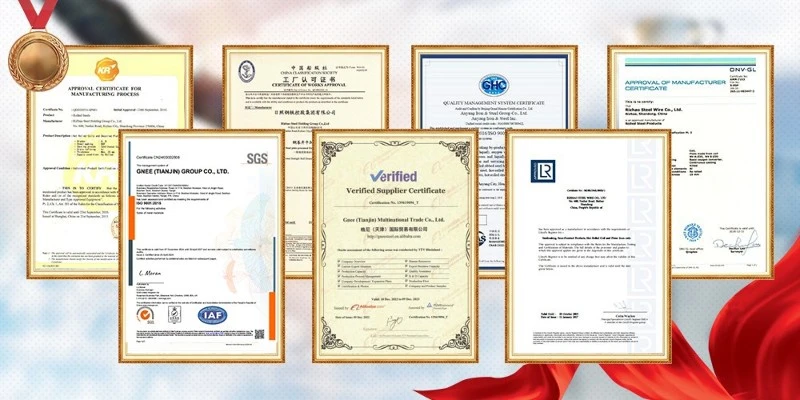
EN 10204 3.1 MTC with every lot; ISO 9001 certified; 3.2 and third-party inspection on request.
Prices are quoted per order against the SMM aluminum index; unit price depends on alloy, thickness, hole layout and finish.
Reply within 24 hours of a clear inquiry.
Request a quote for hexagonal hole perforated aluminum panel
If you do not have all the technical parameters, upload your drawing or share the application. Our team reviews the available information and confirms the specifications that need clarification.
FAQ
Q: What is a hexagonal hole perforated aluminum panel?
A: It is an aluminum sheet or panel punched with a regular hexagonal (honeycomb) opening pattern. The hexagonal layout gives a structured honeycomb visual and an efficient open-area distribution. Alloy, thickness, hole diameter, pitch, open area and panel dimensions are specified per drawing or standard pattern.
Q: How is the open area of a hexagonal hole perforated aluminum panel calculated?
A: For a regular hexagonal pitch, open area is approximately 100 times (d divided by p) squared percent; the 90.69 coefficient is for 60° staggered round holes and is not used for hexagonal openings, where d is the hole's inscribed-circle diameter and p is the center-to-center pitch. The formula applies to regular repeating geometry; panels with solid margins or mixed zones are calculated from the actual perforated area.
Q: Is hexagonal a standard DIN 24041 hole code?
A: DIN 24041 (2022 edition) defines the perforation code system around R (round / Rundloch), Q (square / Quadratloch), L (slotted, elongated / Langloch) and SK / SKv (hexagonal / Sechsecksloch). Hexagonal holes are standardized as SK/SKv in the 2022 edition; because they require dedicated tooling they are often produced as a custom or made-to-pattern perforation. The same w, t, c, s and A0 dimension system as DIN 24041 applies.
Q: Which aluminum alloy is used for hexagonal hole perforated panels?
A: 3003-H14 or H24 is common for formability and cost, 5005-H34 where anodizing response matters, 5052-H32 where higher strength and corrosion resistance are needed, and 6061-T6 where structural strength is required. The alloy is selected per order against the application and finish route.
Q: What are hexagonal hole perforated aluminum panels used for?
A: They are used for decorative and functional screens, façade cladding, feature panels and ventilation where a honeycomb visual and an efficient open-area distribution are wanted. The pattern reads as a structured, organic surface from a distance.
Q: Can you supply hexagonal hole perforated sheets in stainless steel, carbon steel, copper and weathering steel (Corten)?
A: Yes. In addition to aluminum, GNEE can assist with hexagonal or other hole patterns in stainless steel, carbon steel, copper and weathering steel (Corten), subject to grade, thickness, pattern and processing requirements. Share your drawing to discuss the suitable material.
Q: What information is needed for a hexagonal hole perforated aluminum panel quotation?
A: Provide alloy and temper, sheet thickness, panel width by length, hole diameter (inscribed circle), pitch, open area or target, edge margin, surface finish, quantity and application, or simply a CAD, PDF or DXF drawing. A drawing can replace most fields.
Hot Tags: hexagonal hole perforated aluminum panel, China hexagonal hole perforated aluminum panel manufacturers
You Might Also Like


Send Inquiry