



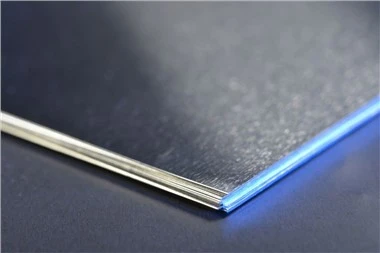
5005 Aluminum Plate Sheet
Customer service is online. Enter the chat to get the latest quotation.
 Spot stock
 Customize
 Factory direct sale
 7 days delivery
Product introduction of 5005 aluminum
5005 (EN AW-5005, UNS A95005) is a non-heat-treatable 5xxx-grade aluminum–magnesium alloy. With about 0.5–1.1% magnesium as its main alloying element, it sits in the medium-strength range of the 5xxx family - stronger and harder than the 1xxx and 3xxx series, yet more formable and easier to anodize uniformly than the higher-magnesium 5052 or 5083. Because it is not strengthened by heat treatment, its properties come only from cold work, so it is supplied in annealed (O) and strain-hardened (H1x, H3x) tempers rather than T-tempers.
The characteristics that make 5005 a common commercial choice are:
Uniform, bright decorative anodizing that color-matches 6063 extrusions - its most widely used property.
Good atmospheric and coastal corrosion resistance, suitable for building exteriors in seaside locations.
Good weldability with standard MIG (GMAW) and TIG (GTAW) processes.
Moderate strength with excellent formability in the softer tempers.
It is most often specified for architectural cladding, signage, appliance panels and light decorative trim - applications where appearance and formability matter more than load-bearing strength. Strength is tuned by temper: from soft, deep-drawing O to fully hard H18/H38.

Chemical composition of 5005 aluminum alloy
Values below are the specification limits per ASTM B209 and EN 573-3. 5005 is essentially pure aluminum with 0.5–1.1% magnesium as the main alloying element.
| Element | Content (%) |
|---|---|
| Aluminum (Al) | Remainder |
| Magnesium (Mg) | 0.50 – 1.10 |
| Silicon (Si) | ≤ 0.30 |
| Iron (Fe) | ≤ 0.70 |
| Copper (Cu) | ≤ 0.20 |
| Manganese (Mn) | ≤ 0.20 |
| Chromium (Cr) | ≤ 0.10 |
| Zinc (Zn) | ≤ 0.25 |
| Others (each / total) | ≤ 0.05 / ≤ 0.15 |
Equivalent designations: UNS A95005 · EN AW-5005 (AlMg1) · ISO 6361 5005 · GB/T 3190 nearest grade 5A05 (composition differs - confirm by drawing).
Mechanical properties of 5005 aluminum plate and sheet
5005 is strain-hardenable, not heat-treatable. The table shows ASTM B209 minimum values for sheet and plate up to 6 mm; thicker gauges and plate carry the same tempers with thickness-dependent minima. Confirm exact values against the Mill Test Certificate (MTC).
| Temper | Tensile strength (MPa) | Yield strength, min (MPa) | Elongation, min (%) |
|---|---|---|---|
| O (annealed) | 105 – 145 | 35 | 12 – 22 |
| H12 | 125 – 165 | 95 | 2 – 8 |
| H14 | 145 – 185 | 115 | 1 – 6 |
| H16 | 165 – 205 | 135 | 1 – 3 |
| H18 | > 185 | - | 1 – 3 |
| H32 | 115 – 160 | 85 | 3 – 9 |
| H34 | 135 – 180 | 105 | 2 – 8 |
| H36 | 160 – 200 | 125 | 1 – 4 |
| H38 | > 180 | - | 1 – 4 |
H14 (half-hard) is a common choice where moderate strength and good formability are both needed, such as signage and appliance panels. H34 is slightly stronger and is the usual pick for anodized cladding and roofing. Other tempers (H22, H24, H26, H112) are available on request; confirm mechanical values with our quotation.
Physical properties of 5005 aluminum
| Property | Typical value |
|---|---|
| Density | 2.70 g/cm³ |
| Melting range | 632 – 655 °C |
| Modulus of elasticity | ~69.5 GPa |
| Thermal conductivity | ~201 W/(m·K) |
| Coefficient of thermal expansion | ~23.5 × 10⁻⁶/K |
| Electrical conductivity | ~52 % IACS |
| Hardness (H34) | ~47 HB |
Specifications and tolerances of 5005 aluminum plate and sheet
| Item | Typical range / option |
|---|---|
| Thickness | 0.5 – 6.0 mm (sheet/coil); plate up to ~50 mm on request |
| Width | up to 2650 mm; common widths 1000 / 1219 / 1250 / 1500 mm |
| Length | up to 12000 mm, or cut-to-length / coil as required |
| Common stock sizes | 1000×2000, 1219×2438, 1250×2500, 1500×3000 mm |
| Temper | O, H12, H14, H16, H18, H32, H34, H36, H38 (H22 / H24 / H26 / H112 on request) |
| Surface finish | Mill finish, brushed, anodized (clear / colored), coated (PE / PVDF), stucco embossed, bright polished |
| Surface protection | PE / PVC film, paper interleaving to prevent scratches |
| Standards | ASTM B209, EN 485-2, EN 573-3, ISO 6361 |
| Tolerance | Thickness and flatness per ASTM B209 / EN 485-2; thicker gauges carry wider tolerance |
Packaging. 5005 sheets and plates are packed on ISPM-15 fumigated wooden pallets with edge protection, waterproof kraft and stretch film, desiccant inside for sea freight, and PE film or paper interleaving between sheets to avoid scratches during transit.
Applications of 5005 aluminum plate and sheet
5005 is chosen where appearance, formability and corrosion resistance matter more than maximum strength. It performs well in atmospheric and coastal (marine-air) environments, which is why it is widely used for building cladding and road signs in seaside locations.
Architecture
Roofing, wall cladding, corrugated sheet, curtain walls, building panels and fascias.
Signage
Road signs, nameplates, display panels and anodized identification plates.
Equipment
Food and chemical equipment, HVAC components, appliance panels and furniture.
General
Packaging and can bodies, pipe and tube, and automotive decorative trim (non-structural).

Welding and fabrication of 5005 aluminum
Welding: excellent with standard MIG (GMAW) and TIG (GTAW). When the weld will be anodized, use 5356 filler for the most consistent color match; 4043 is fine where appearance is not critical. Strength retention after welding is good.
Forming: good in O, H32 and H34 - suitable for bending, drawing and spinning. Higher tempers (H36/H38) form less and are used where minimal forming is needed.
Machining: fair to poor. Harder tempers (H34, H38) machine better than soft ones; use sharp carbide tools and coolant to avoid stickiness. Not suited to high-speed chip removal like 2xxx/7xxx alloys.
Heat treatment: none - 5005 is not strengthenable by heat treatment; only cold work raises strength.
Anodizing and surface options for 5005 aluminum
5005 is among the most suitable alloys for decorative anodizing. It produces a clear, bright oxide film that closely matches the color of 6063 architectural extrusions, which is why it is a default choice for anodized facades and trim.
Special Anodizing Quality (AQ): for critical color, specify AQ at order - standard 5005 can show light streaks after anodizing.
Finishes: natural/clear anodize, colored anodize (silver, champagne, bronze, black), brushed, polished, stucco embossed, or PVC/PE film protected mill finish.
Painting/coating: accepts fluorocarbon (PVDF) and polyester coil coating where a specified color is required.
Processing services for 5005 aluminum
Besides supplying mill-format coil and plate, GNEE offers processing to help you receive parts closer to finished size:
Cut-to-length & slitting: shear or slit coil/sheet to your required dimensions.
CNC & punching: cut, pierce and chamfer panels for signage and cladding kits.
Bending & forming: brake-press bending of H32/H34 sheet; we advise temper and bend radius by thickness.
Welding: MIG/TIG assembly using 5356 filler when the part will be anodized.
Anodizing & surface: clear/colored anodizing including Special Anodizing Quality, plus brushing, coating and protective film.
Tell us your drawing or finish requirement and we will quote the alloy, temper, size and processing together.

About GNEE
GNEE has supplied aluminum products since 2008 and now exports to 100+ countries and regions.
Common tempers and sizes are kept in stock; both small and large orders are accepted with a flexible MOQ.
Standard lead time is 15–30 days; each order ships with an EN 10204 3.1 Mill Test Certificate, and third-party inspection (e.g. SGS) can be arranged.
Our technical team helps select the right alloy, temper and finish for your application and provides drawings-based quotations.

Request a quote for 5005 aluminum
MOQ: flexible - small trial orders are accepted. Lead time: 15–30 days for stock and common specifications. Payment: T/T, L/C. Incoterms: FOB, CIF, EXW. Packaging: seaworthy export packing on wooden pallets with edge protection and moisture barrier.
Certification: material conforms to ASTM B209 / EN 485-2 / EN 573-3; Mill Test Certificate (EN 10204 3.1) is provided with each shipment. 5005 is a non-controlled 5xxx alloy and is not subject to export-licence screening.
Send your size, temper, quantity and finish requirement to GNEE for a quotation, or include a drawing so we can confirm feasibility and tolerance.
FAQ
What is 5005 aluminum used for?
5005 is used where a consistent anodized finish and good formability matter more than high strength: building roofing, cladding and curtain walls, road signs and nameplates, food and chemical equipment, furniture, HVAC parts, packaging and can bodies, appliance panels, and automotive decorative trim.
Is 5005 aluminum good for anodizing?
Yes. 5005 is among the most suitable alloys for decorative anodizing: it gives a clear, bright film that color-matches 6063 extrusions well. For critical color, specify Special Anodizing Quality (AQ) at order, because light streaks can occur on standard material.
Can 5005 aluminum be heat treated?
No. 5005 is non-heat-treatable. Its strength comes only from cold work (strain hardening), so tempers run O, H12-H18 and stabilized H32-H38. There is no T-temper.
Which tempers are available for 5005 sheet and plate?
Common tempers are O, H12, H14, H16, H18, H32, H34, H36 and H38. For most architectural and anodized work H32 or H34 is preferred; O is chosen when extensive forming is needed before welding.
How does 5005 compare with 5052?
5052 is stronger and better for demanding structural use. 5005 offers more uniform anodizing, easier forming and usually lower cost, so it is preferred for appearance-led architectural and signage work rather than heavy-load structures.
What welding wire should be used when 5005 is anodized after welding?
Use 5356 filler for the most consistent color uniformity after anodizing. 4043 is acceptable where appearance is not critical. 5005 welds well with standard MIG (GMAW) and TIG (GTAW).
Is 5005 a marine-grade aluminum?
5005 has good corrosion resistance in atmospheric and coastal (marine-air) environments, and is commonly used for building cladding and road signs in seaside locations. If your part will see continuous seawater immersion or heavy marine structural loads, tell us the exact service condition so we can confirm the suitable grade and temper.
What is 5005-H14 and when is it used?
H14 is the half-hard temper: strain-hardened to about half the strength of fully hard H18. It keeps good formability while giving moderate strength, so it is a common choice for signage, appliance panels, interior trim and light parts that need bending or stamping. H34 is slightly stronger and is the usual pick for anodized cladding.
Hot Tags: 5005 aluminum plate sheet, China 5005 aluminum plate sheet manufacturers, 5 series Aluminum Plate, 5052 Aluminum Plate, 5083 aluminum alloy, 5083 Aluminum Plate, Fatigue strength
Previous
5754 Aluminum Plate SheetYou Might Also Like


Send Inquiry