



5052 H114 Aluminum Tread Plate
Customer service is online. Enter the chat to get the latest quotation.
 Spot stock
 Customize
 Factory direct sale
 7 days delivery
The most expensive mistake buyers make with aluminum tread plate is specifying it by total height instead of base thickness. Aluminum tread plate is ordered and measured on the flat base metal. A plate called "3 mm five-bar" has about 3 mm of base plus about 1 mm of raised pattern. If your load calculation was done on 3 mm of metal and the supplier delivers 2 mm of base with 1 mm of pattern, the plate is a third lighter than the drawing assumed.
What is 5052-H114 aluminium checker plate
5052 is a non-heat-treatable aluminum-magnesium alloy with roughly 2.5% magnesium and 0.25% chromium. It sits in the middle of the strength range, welds cleanly, forms well, and resists corrosion in wet, salty and food-handling environments. That combination is why it is the default alloy for tread plate that will be walked on in the wet.
The H114 part is where most confusion starts. H114 is not an Aluminum Association temper and it is not H14. It is a designation defined in GB/T 3618, the Chinese standard for aluminum tread plate, and it means the pattern was rolled into annealed (O temper) base material. The embossing pass itself does the work hardening, which is why H114 is lightly hardened rather than a full strain-hardened temper.
Two practical consequences follow from that. First, H114 keeps useful formability - you can still bend, roll and cut it, which H194 cannot promise. Second, its strength is a modest step above O, not a jump: GB/T 3618 sets 180 MPa minimum tensile for H114 against a 150 MPa maximum for O.
| Designation | Base material before embossing | Min. tensile strength (MPa) | Formability |
|---|---|---|---|
| O | Annealed, not embossed-hardened | ≤ 150 | Best |
| H114 | Fabricated from temper O | ≥ 180 | Good - bends and rolls |
| H194 | Fabricated from temper H18 (full hard) | ≥ 195 | Limited - flat work only |
Source: GB/T 3618 temper designations for aluminum tread plate. H12, H14, H22, H24, H32 and H34 applied to the base material before embossing are supplied by agreement, not as standard stock.

Pattern types and pattern dimensions
GB/T 3618 numbers the standard patterns. Five-bar (also called willow-leaf) is the most widely used because the ribs sit at 60–80° to one another, which gives grip in several directions instead of one.
| GB/T 3618 code | Pattern | Usual tempers | Base thickness (mm) | Pattern height (mm) |
|---|---|---|---|---|
| 1 | Lentil / bean shape | H234 | 2.0 – 4.0 | 1.0 |
| 2 | Five-bar | O, H114 | 1.5 – 4.5 | 1.0 |
| 3 | Three-bar | H234 | 1.5 – 4.5 | 1.0 |
| 4 | Compass / pointer | O, H114 | 1.5 – 4.5 | 1.0 |
| 5 | Four-bar | O, H234 | 2.0 – 4.0 | 1.0 |
| 6 | Three-bar, fine | O, H114, H194 | 1.0 – 4.5 | 0.3 |
| - | Crescent | H114, H234, H194 | 1.0 – 4.0 | 0.7 |

Pattern height and pitch
| Pattern | Height (mm) | Pattern pitch / length (mm) |
|---|---|---|
| Small five-bar | 1.0 ± 0.4 | 35 ± 3.0 |
| Big five-bar | 1.0 ± 0.4 | 45 ± 3.0 |
| Diamond (pointer) | 1.0 ± 0.4 | 33 ± 2.0 |
Pattern height tolerance is comparatively wide. If your design has a clearance limit, state it on the order rather than relying on the standard tolerance.

Specifications of 5052 H114 Aluminum Tread Plate
| Item | Range / options |
|---|---|
| Alloy | 5052 |
| Temper | H114 (also O, H22, H32) |
| Base thickness | 1.2 – 8.0 mm standard; up to 10.0 mm on request |
| Width | 1000 – 1600 mm standard; up to 1900 mm |
| Length | 2000 – 6000 mm standard; up to 12000 mm (sheet) |
| Stock size | 1220 x 2440 mm - 1.2, 1.5, 2.0, 2.5, 3.0, 3.5, 4.0, 5.0, 6.0 mm |
| Pattern height | 1.0 mm nominal; min 0.6 mm on thin gauges, min 0.8 mm from 2.0 mm up |
| Surface finish | Mill finish, bright or matte |
| Protection | PE/PVC peel-off film on request; paper interleaf between sheets |
| Coil form | Available, 508 mm inner diameter |
| Cut to length | Yes |
| Standards | GB/T 3618; base material GB/T 3880, ASTM B209, EN 485-2, EN 573-3 |
Chemical composition
| Element | Content (%) |
|---|---|
| Silicon (Si) | ≤ 0.25 |
| Iron (Fe) | ≤ 0.40 |
| Copper (Cu) | ≤ 0.10 |
| Manganese (Mn) | ≤ 0.10 |
| Magnesium (Mg) | 2.2 – 2.8 |
| Chromium (Cr) | 0.15 – 0.35 |
| Zinc (Zn) | ≤ 0.10 |
| Titanium (Ti) | - |
| Others, each / total | 0.05 / 0.15 |
| Aluminum (Al) | Remainder |
Per ASTM B209 / EN 573-3 limits for 5052. The magnesium figure matters for two reasons: it sets the strength, and at 2.2–2.8% it stays below the roughly 3% level where 5xxx alloys start to be restricted for elevated-temperature service.
Mechanical properties
Tread plate is specified against GB/T 3618, and the values below are the acceptance gates in that standard, not design values.
| Temper | Tensile strength (MPa) | Elongation after break (%), min | Bending factor, min |
|---|---|---|---|
| O | ≤ 150 | 14 | 3 |
| H114 | ≥ 180 | 3 | 3 |
| H194 | ≥ 195 | 3 | 8 |
Typical mill values for 5052-H114
| Property | Typical value | Basis |
|---|---|---|
| Tensile strength | 220 – 240 MPa | EN 485 / ASTM B209 range, thickness dependent |
| Yield strength (0.2%) | 145 – 165 MPa | EN 485 / ASTM B209 range, thickness dependent |
| Tensile / yield / elongation, single mill sheet | 228 MPa / 193 MPa / 12% | One published mill data sheet-indicative only |
| Hardness | approx. 60 HB | Same single mill sheet-indicative only |
The GB/T 3618 elongation gate of 3% is a minimum acceptance figure on the base material. It is not the number to use when you are checking whether a bend radius will work - use the typical values above, and test a sample if the bend is tight.
Physical properties
| Property | Value |
|---|---|
| Density | 2.68 g/cm³ |
| Melting range | 607 – 650 °C |
| Elastic modulus | approx. 70 GPa |
| Coefficient of thermal expansion | 23.8 × 10⁻⁶ /K (20–100 °C) |
| Thermal conductivity | approx. 138 W/m·K |
| Electrical conductivity | approx. 35% IACS |
| Response to heat treatment | Non-heat-treatable; strengthened by cold work only |
Typical values for 5052. Not specification limits.
Weight per square metre
Weight is calculated on base thickness: kg/m² = base thickness (mm) × 2.68. Actual weight runs slightly higher because the raised pattern adds metal, so treat these figures as the floor of the range.
| Base thickness (mm) | Flat-plate weight (kg/m²) | Indicative weight incl. pattern (kg/m²) |
|---|---|---|
| 1.5 | 4.02 | approx. 4.5 – 4.8 |
| 2.0 | 5.36 | approx. 5.9 – 6.2 |
| 2.5 | 6.70 | approx. 7.2 – 7.6 |
| 3.0 | 8.04 | approx. 8.6 – 9.0 |
| 4.0 | 10.72 | approx. 11.4 – 11.9 |
| 5.0 | 13.40 | approx. 14.1 – 14.7 |
| 6.0 | 16.08 | approx. 16.9 – 17.6 |
Applications
5052-H114 tread plate is bought for one job: a walking or standing surface that stays grippy when wet, and does not rust while doing it. The applications below are where it is actually used.
Transport flooring and steps
Bus, coach and rail carriage floors and step treads
Truck and trailer beds, loading ramps, tail-lift platforms
Fire truck and ambulance footplates, running boards, toolboxes
Tank truck top walkways and door steps (EN 14286 supply chains)
Marine
Small craft deck plating, cabin soles, cockpit floors
Gangways, dock plates, boarding ramps, fish-hold covers
Workboat deck panels and hatches
Cold chain and food handling
Cold room and freezer floors, refrigerated truck linings
Food processing walkways and wash-down areas
Building and industrial
Stair treads, pedestrian ramps, mezzanine and platform flooring
Machine platforms, equipment bases, inspection walkways and catwalks
Warehouse and workshop floors, lift car floors
Decorative and protective wall panels, kick plates


Welding and fabrication
5052 is one of the easier alloys to weld and fabricate, which is a large part of why it is used for vehicle floors and platforms.
Welding: MIG and TIG both run cleanly. Standard filler is 5356; 5183 and 5556 are also used. Avoid 4xxx fillers such as 4043 - the silicon reacts with magnesium to form Mg2Si, which reduces ductility and gives a poor colour match if the part is later anodised.
Heat-affected zone: welding locally anneals the material, so the light hardening from embossing is lost near the weld. Size the joint using O-temper properties, not H114 properties.
Cutting: shear, laser, plasma and waterjet all work. Nesting is less efficient than flat sheet because the pattern sets the orientation.
Bending: H114 retains enough ductility to bend and roll, unlike H194. Bend with the pattern on the inside of the bend where you have a choice, and expect springback to differ between directions because the ribs stiffen the plate along their length.
Fixing: mechanical fastening and adhesive bonding are both common. Use isolators between aluminum and steel to avoid galvanic corrosion in wet locations.
Surface finish and corrosion
5052 forms a stable oxide film, and at 2.2–2.8% magnesium it stays below the roughly 3% level where 5xxx alloys are restricted for elevated-temperature service and become prone to sensitisation. In practice that means it holds up in marine atmospheres, cold rooms, wash-down areas and road-salt exposure without a coating.
Mill finish is standard, supplied bright or matte, and is what most flooring uses.
Protective film: PE or PVC peel-off film is worth specifying if the plate will be fabricated further, because the raised pattern is awkward to repair once scratched.
Anodising is possible and improves wear life, but the pattern makes the finish less uniform than on flat sheet.
Painting needs a suitable etch or conversion primer; bare 5xxx does not hold paint well without preparation.
Tread plate is normally left bare. If it is going into a chloride environment against steel, isolate the two metals.

Ordering: MOQ, lead time, packing, certification
| Item | Term |
|---|---|
| MOQ | Flexible. Small quantity orders accepted; stock sheets ship in detachable bundles |
| Stock | 1220 x 2440 mm in 1.2 / 1.5 / 2.0 / 2.5 / 3.0 / 3.5 / 4.0 / 5.0 / 6.0 mm |
| Lead time | About 15–30 days from order confirmation for standard sizes |
| Custom size | Up to about 1900 mm wide and 12000 mm long; cut-to-length available |
| Material certificate | EN 10204 3.1 mill test certificate with every order |
| Third-party inspection | Can be arranged on request (SGS, BV, TUV and similar) |
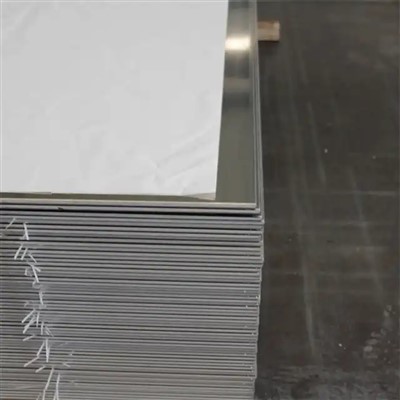
| Packing - sheet | Plastic film and brown paper, paper interleaf between sheets, wooden pallet or case |
| Packing - coil | Steel banded, reinforced edge protectors, plastic film, woven belt and moisture-resistant paper, on wooden or steel pallet |
| Incoterms | EXW, FOB, CIF - confirmed with the order |
| Export control | 5052 is not a controlled category. No export licence review required |


FAQ
What does the H114 temper mean on aluminum tread plate?
H114 is a tread-plate designation defined in GB/T 3618, not a standard Aluminum Association H-temper. It means the pattern was rolled into annealed (O temper) base material, and the embossing pass itself provides the light work hardening. It is not the same as H14. The related designation H194 means the pattern was rolled into H18 (full-hard) stock, which is stronger but far less formable.
Is tread plate thickness measured with or without the pattern?
Thickness is specified and measured on the base (flat) material, not over the raised pattern. A 3.0 mm five-bar plate has roughly 3.0 mm of base metal plus about 1.0 mm of pattern height. Ordering by total height instead of base thickness is the most common way to end up with a plate thinner than the load calculation assumed.
What is the difference between five-bar and diamond tread plate?
Five-bar (also called willow-leaf) has five raised ribs arranged at 60–80° to each other, giving grip in several directions; GB/T 3618 lists small five-bar at 35 mm pattern pitch and big five-bar at 45 mm pitch. Diamond, also called one-bar or pointer, is a single repeating diamond at about 33 mm pitch and is often chosen when appearance matters more than maximum grip.
Can 5052 tread plate be used on a boat deck?
Yes for deck plating, cabin floors, gangways and steps. 5052 resists marine atmospheres well and its magnesium content of 2.2–2.8% sits below the roughly 3% level where 5xxx alloys become prone to sensitisation. It is not used for seawater hull plating below the waterline, where 5083, 5086 or 5383 is specified to meet classification society requirements.
Can 5052-H114 tread plate be welded?
Yes. 5052 welds readily by MIG or TIG, and 5356 is the standard filler, with 5183 and 5556 also used. 4xxx fillers such as 4043 are normally avoided on 5xxx base metal because silicon reacts with magnesium to form Mg2Si, which lowers ductility and gives a poor colour match if the part is anodised. The heat-affected zone loses some of the light work hardening from the embossing pass, so allow for that near welds.
Which tread plate alloy should I use: 5052, 3003 or 6061?
3003 is the low-cost option for dry indoor use such as toolboxes and decorative panels, with a minimum tensile strength well below 5052. 5052-H114 is the standard choice where moisture, salt or cleaning chemicals are present, with a minimum tensile strength of 180 MPa. 6061 is heat treatable and reaches higher strength, and is chosen when the plate carries structural load rather than just providing a walking surface.
What sizes are in stock and what is the minimum order quantity?
Standard stock is 1220 x 2440 mm in 1.2, 1.5, 2.0, 2.5, 3.0, 3.5, 4.0, 5.0 and 6.0 mm base thickness. MOQ is flexible and small quantity orders are accepted, shipped in detachable bundles. Non-standard sizes can be produced up to about 1900 mm wide and 12000 mm long, with cut-to-length service. Lead time is about 15 to 30 days from order confirmation.
Is 5052 aluminum subject to Chinese export control?
No. 5052 is not among the high-strength aluminum categories listed under the export control regulations of the People's Republic of China for dual-use items. Those categories cover grades such as 7075, 7050, 2024, 2014, 2017, 7A04, 2195, 7068, 7055 and 7150, which GNEE does not export. 5052-H114 tread plate can be shipped without an export licence review.
Send the six things we need and you get a price, not a questionnaire: pattern type, base thickness, sheet or coil, size or cut lengths, quantity, and destination port. If you are unsure whether five-bar or diamond suits the job, tell us what walks on it and what gets spilled on it, and we will answer from the application rather than from a stock list.
5052-H114 is not a controlled alloy, so there is no licence step between your enquiry and your shipment.
Get a quote for 5052-H114 tread plate
Hot Tags: 5052 H114 Aluminum Tread Plate, China 5052 H114 Aluminum Tread Plate manufacturers
You Might Also Like




Send Inquiry