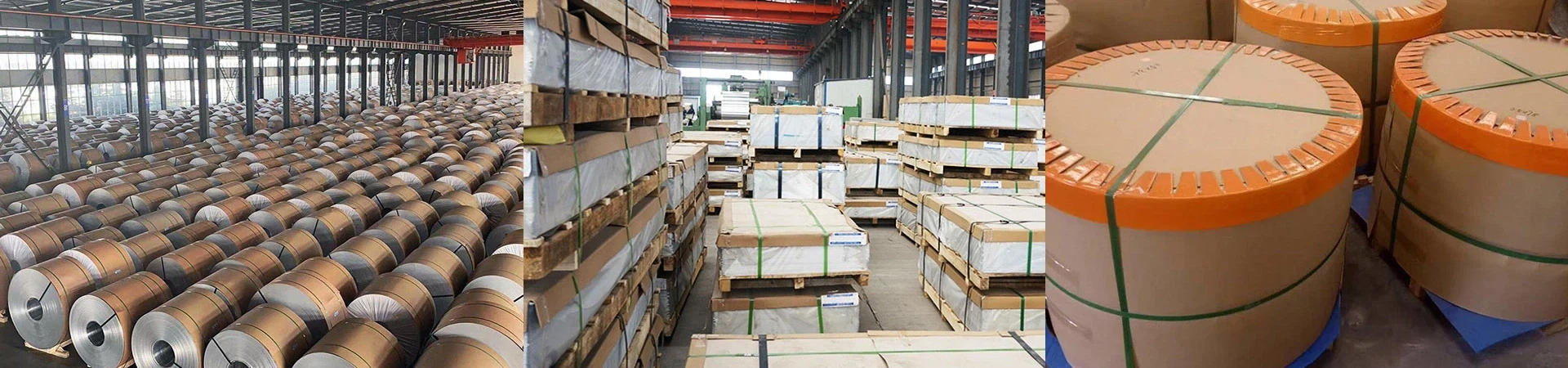
Corrugated aluminum trailer panels are a high-quality material that combines lightweight qualities, corrosion resistance, and structural strength. They are commonly used in the production of freight trailers, containers, and specialty vehicle bodywork.
Corrugated aluminum sheets are a popular choice for trailer side panels, roof panels, and interior linings because of their lightweight nature, corrosion resistance, and high strength. Corrugated aluminum trailer panels are widely employed in current trailer construction due to their lightweight, corrosion-resistant, and high-strength properties.

Common Aluminum Alloys and Specifications for Corrugated Trailer Panels
3003-H14
The most widely used alloy for trailer panels.
Offers good rust resistance, excellent strength, and outstanding formability.
Ideal for general-purpose applications where moderate strength and corrosion resistance are required.
5052-H32
Contains a higher magnesium content, making it stronger than 3003.
Provides excellent corrosion resistance and is particularly well-suited for marine and coastal environments.
Commonly used in refrigerated truck bodies and transportation panels.
6061-T6
A high-strength, heat-treated alloy, often used for structural components.
Provides superior mechanical strength, though it is less formable than 3003 and 5052.
Suitable for load-bearing parts and frameworks.
Alloy Overview
3003: General-purpose alloy, cost-effective, easy to process.
5052: Superior corrosion resistance, suitable for refrigerated or marine applications.
6061: High strength for structural and heavy-duty applications.
Specification Range
Thickness:
0.6–1.0 mm for body skin panels
1.2–2.0 mm for stiffeners or structural frames
Corrugation Parameters:
Trapezoidal corrugation height: 15–30 mm
Wavelength: 50–100 mm
Corrugation can be adjusted based on span to optimize stiffness and strength.
Corrugated Aluminum Trailer Panels Specifications
| Parameter | Common Specifications | Remarks |
| Length | 76 inches, 96 inches, 110 inches, 120 inches | 96 inches (8 feet) is the most common standard length |
| Width | 49 inches, 54 inches, 82 inches, 102 inches | 49 inches is the standard width; auto transport trailers typically use 102 inches width |
| Thickness | 0.019 inches to 0.125 inches | Common thickness ranges from 0.032 inches to 0.090 inches |
| Corrugation specifications | 2.5-inch corrugation (0.5-inch corrugation height, 24-inch coverage width) | The most common design, 4-inch corrugation (32-inch coverage width), is suitable for heavy-duty applications |
Corrugated Aluminum Trailer Panels Length Specifications
The standard length specifications for corrugated aluminum trailer panels mainly include:
76-inch (approx. 193 cm) Corrugated Aluminum Trailer Panels
96-inch (approx. 244 cm) Corrugated Aluminum Trailer Panels
110-inch (approx. 279 cm) Corrugated Aluminum Trailer Panels
120-inch (approx. 305 cm) Corrugated Aluminum Trailer Panels
These length specifications can meet the needs of different types of trailers, ranging from smaller cargo trailers to large auto transport trailers. 96 inches (approx. 244 cm) is the most common standard length.
Corrugated Aluminum Trailer Panels Width Specifications
The standard width specifications for corrugated aluminum trailer panels mainly include:
49-inch (approx. 124 cm) Corrugated Aluminum Trailer Panels
54-inch (4'6", approx. 137 cm) Corrugated Aluminum Trailer Panels
82-inch (approx. 208 cm) Corrugated Aluminum Trailer Panels
102-inch (8'6", approx. 259 cm) Corrugated Aluminum Trailer Panels
49-inch (approx. 124 cm) Corrugated Aluminum Trailer Panels is the most common standard width, while 102 inches (8'6", approx. 259 cm) is used for large cargo trailers or special trailers.
Corrugated Aluminum Trailer Panels Thickness Specifications
The thickness specifications of corrugated aluminum trailer panels vary depending on the application scenario and load requirements:
0.019-inch (approx. 0.48 mm) Corrugated Aluminum Trailer Panels
0.032-inch (approx. 0.81 mm) Corrugated Aluminum Trailer Panels
0.040-inch (approx. 1.02 mm) Corrugated Aluminum Trailer Panels
0.050-inch (approx. 1.27 mm) Corrugated Aluminum Trailer Panels
0.063-inch (approx. 1.60 mm) Corrugated Aluminum Trailer Panels
0.090-inch (approx. 2.29 mm) Corrugated Aluminum Trailer Panels
0.125-inch (approx. 3.18 mm) Corrugated Aluminum Trailer Panels
Corrugated Aluminum Trailer Panels Surface Treatment Options
Anodizing is a moderately priced process that provides salt spray protection for up to 500 hours and is ideal for inland settings.
Micro-arc oxidation: hardness of HV1500, salt spray resistance of over 5000 hours, excellent for coastal or chemical situations.
Powder coating is available in a variety of colors (including silver-gray and white), has good weather resistance, and is ideal for applications with high aesthetic criteria.
Corrugated Aluminum Trailer Panels: Material Properties and Core Advantages
Balance of Lightweight and High Strength
Corrugated aluminum panels have a density of just 1/3 of steel (approximately 2.7 g/cm³), yet their wave-shaped structural design significantly enhances their bending stiffness. For instance, a 0.8mm thick 5052 aluminum alloy corrugated sheet can match the load-bearing capacity of a 1.2mm thick steel plate over the same span.
This structural advantage results in a 10-15% reduction in trailer self-weight, directly lowering fuel consumption and enhancing towing efficiency. This makes aluminum especially suited for cold-chain transport and urban distribution, where fuel economy is a critical factor.
Excellent Corrosion Resistance
The natural aluminum oxide film on the surface (approximately 0.1-0.2 μm thick) provides resistance to general atmospheric corrosion.
After treatments like anodizing or micro-arc oxidation, the oxide layer can grow to 25-50 μm, with salt spray resistance (NSS) exceeding 1000 hours without rust.
In high-salt coastal environments, PVDF fluorocarbon coatings or nano-sealing treatments are recommended, extending the service life of the panels to over 20 years.
Ease of Processing and Maintenance
Aluminum alloys are highly ductile, making them easy to cold bend, stamp, and weld. For example, 6061-T6 alloy can achieve weld seam strength greater than 90% of the base material through TIG welding, with relatively low welding deformation.
Routine maintenance is minimal, requiring only periodic cleaning. Unlike steel, which needs frequent rustproof coatings, aluminum reduces life-cycle maintenance costs significantly.
Corrugated Aluminum Trailer Panels Applications
Typical applications for corrugated aluminum trailer panels
Refrigerated Truck: 5052 aluminum alloy corrugated panels paired with a polyurethane foam insulation layer lower body weight by 30% compared to steel while also resisting refrigerant corrosion.
Curtain Side Trailer: Aluminum corrugated side panels enable speedy loading and unloading of cargo, and when combined with high-strength aluminum alloy guide rails, single loading/unloading times are reduced by 40%.
Dump Truck: 6061-T6 corrugated panels treated with micro-arc oxidation maintain surface integrity under sand and gravel impact, prolonging service life by two times that of regular steel plates.

Selection Considerations for Corrugated Aluminum Trailer Panels
| Consideration | Description |
| Thickness | Common thickness range: Side panels/roof panels are generally 0.8mm - 1.2mm, floors need to be thicker (such as 2 mm - 3 mm or more). Too thin is prone to deformation; too thick increases weight and cost. |
| Strength | Choose according to trailer type and load requirements. For heavy-duty trailers or those requiring lateral pressure resistance, select higher-strength alloys (such as 5052) or thicker plates. |
| Surface Treatment | Mostly mill finish (natural color), but anodizing or coating (such as powder coating) can also be chosen to enhance corrosion resistance or obtain specific colors. |
| Installation Method | Confirm the corrugation pitch, which must match the trailer frame. Usually fixed with riveting or special clips. |