

Mobile phone battery cases are produced by high-speed progressive stamping and deep drawing, so the sheet has to survive severe deformation without cracking, earing or excessive springback. Because the case sits directly around the cell, the material also has to cushion and protect the internal structure of the battery throughout the whole service life of the handset.
Six Requirements a Battery Case Material Must Meet
Stamping performance: good plasticity, a low flexural strength ratio, low anisotropy, stable mechanical properties and small property scatter from coil to coil.
Strength and hardness: enough load-bearing capacity to protect the internal structure of the battery under impact and vibration.
Corrosion resistance: stable performance in humid, salty and mildly acidic environments so that the expected battery service life is reached.
Weldability: reliable joining for tabs, seals and case assemblies.
Surface quality: a fine, uniform finish free from scratches, inclusions and rolling marks, because the case surface is often visible.
Consistency: tight thickness tolerance and stable temper so that stamping tools run without interruption.
Why 3003 Aluminium Alloy Is the Preferred Grade
3003 is an aluminium-manganese alloy that combines moderate strength with high plasticity, good welding performance and good corrosion resistance. It has a low weight-to-strength ratio, forms easily, and keeps uniform mechanical properties across a coil. Those characteristics make it a standard material for deep-drawn products, and 3003 sheet and strip have become a common choice for mobile phone battery shells and other small drawn enclosures.
Unlike heat-treatable alloys, 3003 is strengthened only by cold working, so the temper is controlled at the rolling mill rather than in a furnace after forming. That is an advantage for battery case production: the strip arrives with the final properties already set, and the stamping and cleaning steps do not change them.
Typical Properties of 3003 Sheet and Strip
| Property | Typical value |
|---|---|
| Alloy system | Al-Mn aluminium-manganese, non-heat-treatable |
| Manganese (Mn) | 1.0-1.5 % |
| Copper (Cu) | 0.05-0.20 % |
| Silicon (Si) / Iron (Fe) | 0.60 % max / 0.70 % max |
| Zinc (Zn) | 0.10 % max |
| Density | 2.73 g/cm3 |
| Tensile strength, O temper | 95-135 MPa |
| Proof stress | 115 MPa minimum |
| Brinell hardness | 40 |
| Elongation (50 mm) | 8 % minimum |
| Thermal conductivity | 190 W/m.K |
| Reference standards | ASTM B209, GB/T 3190, EN 573-3, JIS H4000 |
Temper and Surface Selection for Stamped Shells
Soft and quarter-hard tempers are the usual starting point. O temper gives the highest elongation and is used where the draw is deepest; H12, H14 and H24 raise strength and hardness at the cost of some ductility, which suits shallower shells that must resist denting. Because 3003 is not heat-treatable, annealing is carried out at about 413 C at the mill when a soft temper is required.
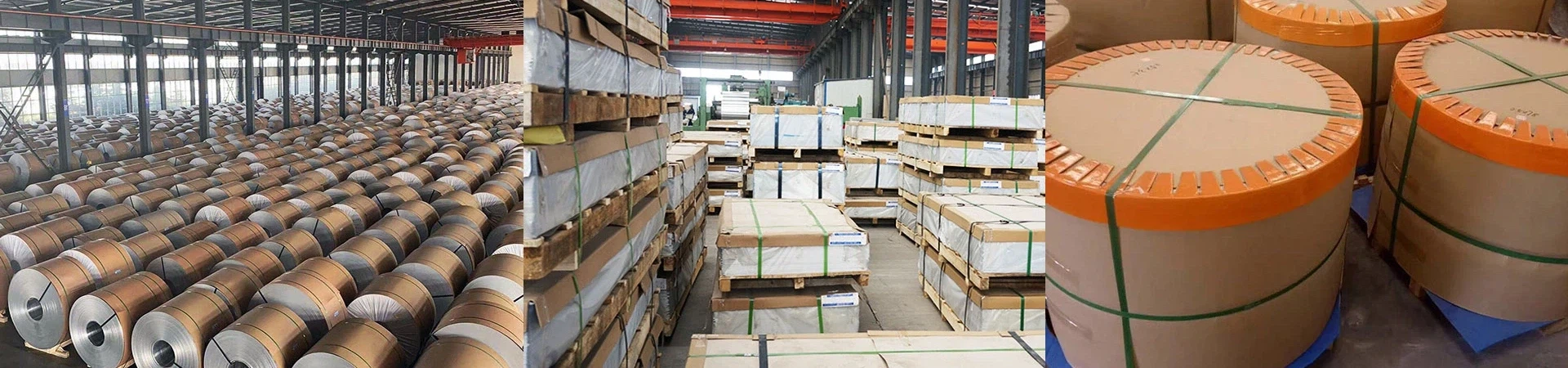
Surface condition matters as much as temper. Coils are normally supplied with a protective film or paper interleaving so that the visible faces reach the press without handling marks. Bright, polished, hairline, brushed, sandblasted, embossed and etched finishes are all available, and PVC or paint coatings can be applied when the case design requires a decorative outer face.
Forming, Joining and Cleaning Practice
3003 can be formed, drawn, bent and blanked with conventional tooling, and it welds well by the usual resistance and fusion methods. Two process notes are worth observing. First, the alloy cannot be strengthened by heat treatment, so any annealing step is for softening only. Second, deep cold deformation can promote intergranular corrosion and a rough surface, and anodising 3003 does not produce a uniform colour, so most battery case lines rely on the mill finish rather than an anodised layer.
FAQ
Q: Is 3003 aluminium alloy heat treatable?
No. 3003 is a non-heat-treatable Al-Mn alloy. Its strength is raised only by cold working, and any heat treatment is used to soften the material.
Q: Which tempers are used for mobile phone battery cases?
O, H12, H14 and H24 are the common tempers. O temper suits the deepest draws, while H14 and H24 give higher hardness for shallower shells that need dent resistance.
Q: Why is 3003 chosen instead of 1060 for battery shells?
1060 contains at least 99.60 % aluminium and is very soft. 3003 contains 1.0-1.5 % manganese, which raises strength and hardness while keeping good deep-drawing formability and corrosion resistance.
Q: How is 3003 corrosion performance described?
It is comparable to industrial pure aluminium and is good in the atmosphere, fresh water, seawater, food, organic acids, gasoline and neutral salt solutions.
Q: Should 3003 battery shells be anodised?
Anodising 3003 does not give a uniform colour, so it is generally avoided. Most cases keep the mill finish or a coated finish instead.
Q: In what forms is 3003 supplied?
As sheet, strip, coil and foil, in mill finish or with protective film and paper interleaving, cut to length or in coil for continuous stamping lines.


