

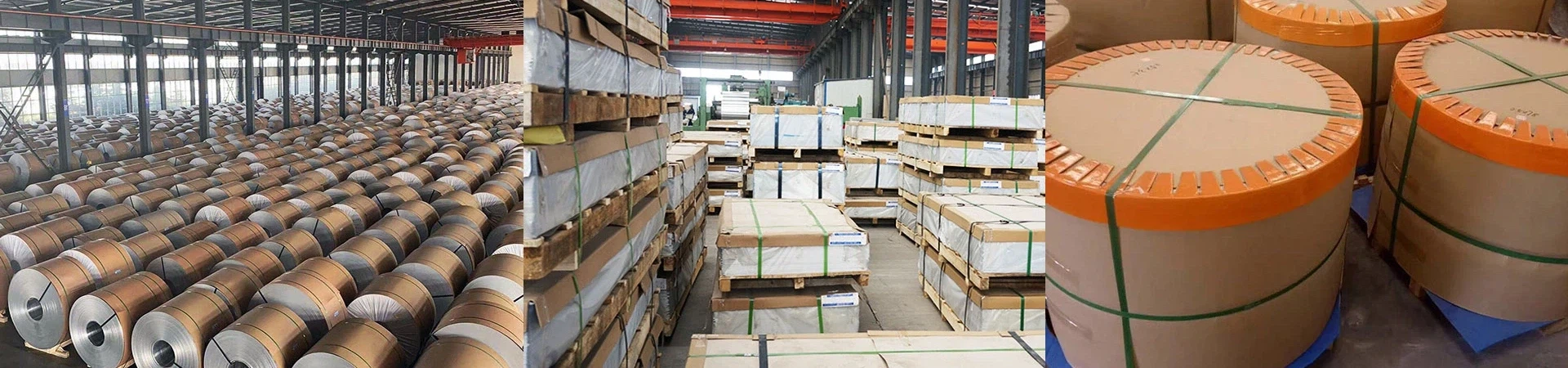
What Is an Aluminum-Plastic Composite Panel?
An aluminum-plastic composite panel, usually shortened to ACP, is a three-layer decorative and structural panel. A thermoplastic core is bonded between two thin aluminum skins, and the outward-facing aluminum surface carries a protective and decorative coating. The two commercial families are panels for interior decoration and panels for building curtain walls, and they differ in coating system, skin thickness and fire performance.
The standard panel module is 1220 mm x 2440 mm with an overall thickness of 3 mm to 5 mm. Outdoor curtain wall grades are often custom cut, and panel length can reach 6000 mm. The aluminum skin, supplied as foil or thin sheet, is the material that decides the stiffness, flatness and weather resistance of the finished panel.
Why 3004 Aluminum Foil Is Chosen for ACP Skins
3004 is an Al-Mn alloy in which manganese is the main alloying element and magnesium is added as a secondary element. It cannot be strengthened by heat treatment: strength comes from work hardening, so the foil keeps a useful balance of strength and formability at every temper. Compared with 1xxx series foil, 3004 offers clearly higher strength, while its corrosion resistance stays close to that of the 1xxx family, which makes it a medium-strength alloy with good corrosion resistance.
Good shape and flatness after rolling, which limits wave and buckle on the laminated panel
Smooth, clean surface with few pinholes, supporting uniform coating and a low rejection rate
Higher strength than 1xxx foil at the same gauge, so a thinner skin can be used without losing panel rigidity
Good welding performance and cold-forming response for slitting, bending and roll forming
Stable behaviour during the lamination cycle, so the skin does not distort when the core is bonded
Chemical Composition
Composition limits for 3004 follow the wrought aluminium composition tables of ASTM B209 and GB/T 3190. Values are mass percent; single figures are maximums unless a range is given.
| Element | Si | Fe | Cu | Mn | Mg | Zn | Others each / total | Al |
|---|---|---|---|---|---|---|---|---|
| 3004 | 0.30 | 0.70 | 0.25 | 1.0-1.5 | 0.8-1.3 | 0.25 | 0.05 / 0.15 | Remainder |
The manganese and magnesium additions together account for the strength advantage over 1xxx and 3003 material, while the low copper content keeps the alloy suitable for outdoor architectural exposure.
Typical Specifications of 3004 Aluminum Foil Roll for ACP
| Parameter | Typical range |
|---|---|
| Alloy | 3004 |
| Temper | O, H14, H16, H18, H22, H24 |
| Thickness | 0.08-0.50 mm (8-50 wires) |
| Width | 100-1600 mm |
| Inner diameter | 150 mm / 405 mm / 505 mm |
| Surface | Mill finish, or coated for direct bonding |
| Standard | ASTM B209 / GB/T 3880 |
Skin thickness is commonly quoted in wires, where one wire equals 0.01 mm, so the usual ACP range of 8 to 50 wires corresponds to 0.08 mm to 0.50 mm. Interior decorative boards sit at the low end of the range, while exterior and curtain wall boards use the heavier skins and are frequently supplied in lengths up to 6 m.
Mechanical Behaviour and Corrosion Resistance
3004 foil has moderate strength with good ductility, so it can be cold worked, bent and joined without cracking. The alloy resists oxidation and the attack of mildly acidic, alkaline and salt-bearing media, which is why it performs well on facades, roofs, wall panels and vehicle body panels. The same properties support use in food packaging containers, beverage cans, pharmaceutical packaging, battery shells and electrolytic capacitors, where a clean and consistent surface is required.
Because the alloy is non-heat-treatable, temper selection controls the final properties. Soft O temper is chosen when maximum forming is needed, quarter-hard to half-hard tempers give the stiffness required by curtain wall skins, and the harder tempers are used where the skin must resist handling damage before lamination.
Frequently Asked Questions
Q: What is the difference between 3004 and 3003 foil for ACP skins?
3004 contains magnesium in addition to manganese, while 3003 is essentially an Al-Mn alloy. The magnesium addition raises strength and improves corrosion resistance, so 3004 is preferred for exterior and curtain wall panels.
Q: What thickness of 3004 foil is used for interior and exterior panels?
Interior decorative boards normally use the lightest skins, around 8 to 20 wires (0.08-0.20 mm), while exterior and curtain wall boards use thicker skins up to 50 wires (0.50 mm) to resist wind load and handling damage.
Q: Can 3004 foil be strengthened by heat treatment?
No. 3004 is a non-heat-treatable alloy, so its strength is developed by cold work. Properties are set by the temper designation, from soft O through the H1x and H2x strain-hardened tempers.
Q: Is 3004 foil suitable for outdoor architectural use?
Yes. Its corrosion resistance is close to that of 1xxx series aluminium and it has good resistance to oxidation, mild acids, alkalis and salt-bearing atmospheres, provided that a suitable coating system is applied.
Q: Which formats can 3004 foil be supplied in?
The alloy is supplied as coil or foil roll in thicknesses from 0.08 mm to 0.50 mm and widths from 100 mm to 1600 mm, with mill finish or coated surface, trimmed edges and the inner diameter required by the customer's laminating line.
Q: How is the foil delivered for composite panel production?
Coils are wound on the specified core, protected against moisture and edge damage, and identified per coil so that alloy, temper, gauge and width can be matched to each panel production order.


