

6061-Aluminum-Coil-vs-5052-Aluminum-Coil.pdf
6061 Aluminum Coil vs 5052 Aluminum Coil: Unveiling the Key Differences
In contemporary manufacturing, aluminum alloys are notable for their remarkable strength-to-weight ratio, resistance to corrosion, and adaptability.
Aluminum alloys 6061 and 5052 are two of the most often used grades among the many that are available; they are frequently provided in coil form for a variety of manufacturing procedures.
Even though they are both superior materials, they have unique qualities that make them appropriate for various uses.
By thoroughly examining the differences between 6061 and 5052 aluminum coils, this comparison will enable you to make an informed choice for your unique requirements.
For engineers, designers, and fabricators, it is essential to comprehend the basic distinctions in their composition, mechanical characteristics, workability, and appropriateness for end use.
Let's examine the differences between these two workhorse alloys.

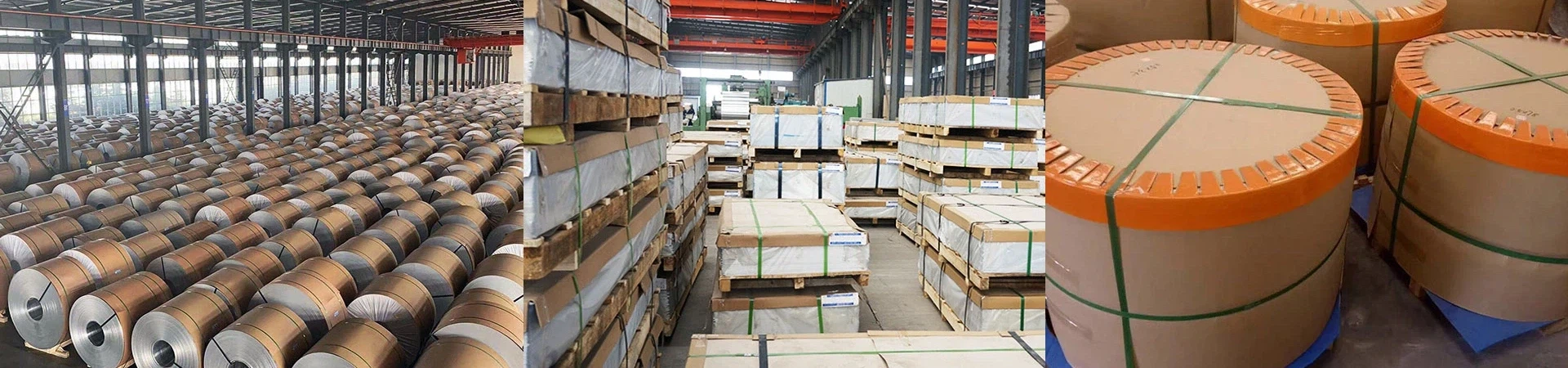
Packaged 6061 Aluminum Coil
Understanding the Alloy Series: 6xxx vs 5xxx
Series 6xxx (such as 6061): These alloys can be heated. Silicon (Si) and magnesium (Mg) are their main alloying elements.
Through solution heat treatment and subsequent aging (precipitation hardening), they can obtain notable strength improvements because to the presence of magnesium silicide (Mg₂Si).
It is well known that 6061 aluminum coil is strong, machinable, and weldable.
Series 5xxx (such as 5052): These alloys cannot be heated. Magnesium (Mg) is their main alloying ingredient.
Their main sources of strength are solid solution strengthening and strain hardening, often known as cold working.
Particularly in maritime applications, 5052 aluminum coil is renowned for its exceptional corrosion resistance, high fatigue strength, and outstanding formability.
Many of the differing qualities we shall describe are primarily caused by this fundamental variation in heat treatability.
Chemical Composition: 6061 Aluminum Coil vs 5052 Aluminum Coil
| Element | 6061 Aluminum (%) | 5052 Aluminum (%) | Significance of Element |
|---|---|---|---|
| Silicon (Si) | 0.40 – 0.8 | 0.25 max | Lowers melting point, improves fluidity, and forms Mg₂Si in 6061 for hardening |
| Iron (Fe) | 0.7 max | 0.40 max | Impurity can reduce ductility if high |
| Copper (Cu) | 0.15 – 0.40 | 0.10 max | Increases strength; can reduce corrosion resistance if not controlled |
| Manganese (Mn) | 0.15 max | 0.10 max | Improves strength, grain refinement |
| Magnesium (Mg) | 0.8 – 1.2 | 2.2 – 2.8 | Key strengthening element in both: forms Mg₂Si in 6061, major strengthener in 5052; enhances corrosion resistance |
| Chromium (Cr) | 0.04 – 0.35 | 0.15 – 0.35 | Improves corrosion resistance, controls grain structure |
| Zinc (Zn) | 0.25 max | 0.10 max | Minor additions for various effects |
| Titanium (Ti) | 0.15 max | 0.15 max | Grain refiner |
| Other (each) | 0.05 max | 0.05 max | |
| Other (total) | 0.15 max | 0.15 max | |
| Aluminum (Al) | Remainder | Remainder | Base metal |
Key Takeaways from Composition:
Magnesium Dominance in 5052: The main strengthening mechanism (solid solution strengthening) of 5052 aluminum coil is its much greater magnesium concentration, which also helps to explain its exceptional corrosion resistance.
Magnesium and Silicon in 6061: The aluminum coil's excellent strength is due to the balanced presence of magnesium and silicon, which enables the development of magnesium silicide (Mg₂Si) precipitates during heat treatment.
Mechanical Properties: Strength, Formability, and Durability
The way an alloy behaves under stress and strain is determined by its mechanical characteristics.
The distinctions between 6061 and 5052 are most noticeable at this point, especially when taking typical tempers into account.
Common Tempers:
6061-T6 Aluminum Coil: Solution heat-treated and then artificially aged. This is the most common high-strength temper for 6061.
6061-O Aluminum Coil: Annealed (fully soft) condition, offering maximum formability for 6061.
5052-H32 Aluminum Coil: Strain-hardened and then stabilized (by a low-temperature thermal treatment) to a quarter-hard temper. Good balance of formability and strength.
5052-H34 Aluminum Coil: Strain-hardened and then stabilized to a half-hard temper. Higher strength than H32, with slightly reduced formability.
5052-O Aluminum Coil: Annealed, maximum formability for 5052.
| Property | 6061-T6 | 6061-O | 5052-H32 | 5052-O | Unit |
|---|---|---|---|---|---|
| Ultimate Tensile Strength | 310 (45,000) | 124 (18,000) | 228 (33,000) | 193 (28,000) | MPa (psi) |
| Yield Strength | 276 (40,000) | 55 (8,000) | 193 (28,000) | 70 (10,000) | MPa (psi) |
| Elongation at Break | 12-17 | 25-30 | 12-18 | 25-27 | % in 50mm |
| Hardness (Brinell) | 95 | 30 | 60 | 47 | HB |
| Shear Strength | 207 (30,000) | 83 (12,000) | 138 (20,000) | 117 (17,000) | MPa (psi) |
| Fatigue Strength | 97 (14,000) | 48 (7,000) | 117 (17,000) | 83 (12,000) | MPa (psi) @5×10⁸ cycles |
Analysis of Mechanical Properties:
Strength: When compared to any temper of 5052, 6061-T6 aluminum coil unquestionably shows better tensile and yield strength.
For structural applications where load-bearing capability is crucial, this makes it perfect. 6061-O that has been annealed is much weaker.
Formability (Elongation): 5052 aluminum coil has superior formability, as seen by its greater elongation values when compared to 6061-T6, particularly when it is in the O temper (annealed) or H32 temper.
It can withstand more rigorous shaping and bending processes without breaking. 6061-T6 is somewhat less formable than 6061-O, which has high formability.
Hardness: In any temper, 6061-T6 is much harder than 5052, which reflects its strength.
Fatigue Strength: 5052 aluminum coil, particularly in its work-hardened tempers like H32 and H34, often has a greater fatigue strength.
For parts that are susceptible to vibrations and cyclic loads, this makes it the ideal option.
Corrosion Resistance: Withstanding the Elements
Because a protective coating of aluminum oxide forms on their surface, 6061 and 5052 aluminum coils both provide good to outstanding corrosion resistance.
But there are subtleties:
5052 Aluminum Coil: Shows exceptional resistance to corrosion, especially in marine or saltwater conditions.
This improved performance is a result of its increased magnesium content and lower copper concentration.
Because of this, 5052 aluminum coil is a popular choice for marine hardware, boat hulls, and applications that are subjected to saltwater or corrosive chemicals.
In the majority of climatic circumstances, 6061 aluminum coils offer considerable corrosion resistance.
Though it adds strength, its copper concentration may make it somewhat more prone to some forms of corrosion than 5052, particularly if the protective oxide layer is weak.
Additional surface protection (such as anodizing or painting) is frequently advised for 6061 in settings with high levels of corrosion.
Workability and Fabrication: 6061 Aluminum Coil vs 5052 Aluminum Coil
The cost and efficiency of manufacturing depend heavily on how easily an alloy can be produced, machined, and connected.
Formability: 5052: Outstanding. Particularly when in the annealed (O) or H32 tempers, it is easily bent, drawn, stamped, and spun. In contrast to 6061, it has a reduced spring-back propensity.
6061: Excellent in the O-annealed temper. However, because of its high strength and hardness, its formability is much diminished in the usual T6 temper.
Larger bend radii and more powerful machinery are frequently needed for forming 6061-T6.
If high strength is needed after forming, 6061 is frequently formed in the O temper and then heat treated to T6.
Excellent machinability for 6061-T6. It enables rapid cutting speeds and smooth surface finishes while producing tiny, manageable pieces.
Its prominence in machined components is mostly due to this.
5052: Good to fair. Compared to 6061-T6, it is a little gummier, which, if not machined with the right equipment and conditions, may result in bigger, stringier chips and possibly a somewhat worse surface quality.
Weldability: 5052: Outstanding. Common procedures like as MIG (GMAW) and TIG (GTAW) may easily weld it, usually utilizing 4043 or 5356 filler wire.
Good strength and ductility are retained in the heat-affected zone (HAZ).
6061: Excellent. It may also be welded using MIG and TIG, and 4043 or 5356 filler wires are frequently suggested.
However, because the heat treatment advantages are lost locally, welding 6061-T6 would drastically diminish the strength in the HAZ.
In essence, the HAZ will return to its partially or fully annealed form.
To regain some strength, post-weld heat treatment could be required, although this can be difficult and expensive.
5052 could be a preferable option if welding is the main factor and strong as-welded strength is required without post-weld heat treatment, or if the design has to take into account the 6061's HAZ's decreased strength.
Heat Treatment: 6061 Aluminum Coil vs 5052 Aluminum Coil
One essential distinction is this:
The 6061 aluminum coil may be heated. This indicates that solution heat treatment, followed by quenching and aging (natural or artificial), can greatly improve its strength.
This technique results in the T6 temper. This makes it possible to manufacture components in a softer condition (O temper) and then harden them for usage later.
The 5052 aluminum coil cannot be heated. Cold working (strain hardening) is the main method used to achieve its strength, producing tempers such as H32, H34, etc.
It will become softer after annealing (O temper). Precipitation hardening procedures have little effect on it.
6061 Aluminum Coil Applications:
Because of its excellent machinability, weldability, and strength (particularly in T6 temper), 6061 is frequently used for:
Trusses, frames, foundation plates, and platforms are examples of structural elements.
Fittings, couplings, hydraulic valve bodies, and camera lens mounts are examples of machined components.
Aerospace parts (although crucial flying components frequently employ more specific metals)
Automobile components: suspension parts and chassis components
Cycle frames
The scaffolding
Tubing and pipes for structural uses
5052 Aluminum Coil Applications:
5052's exceptional formability, high fatigue strength, and superb corrosion resistance-particularly in maritime environments-make it perfect for:
Sheet metal work: cabinets, braces, enclosures, and chassis
maritime hardware, fuel tanks, masts, and boat hulls are examples of maritime uses.
Tanks, pressure vessels (for specific chemicals), and pipes are used in the chemical industry.
Automobile parts: Body panels, oil lines, and fuel tanks
Appliances and kitchenware
Nameplates and road signs
Tubes that are hydraulic

5052 Aluminum Coil for Pressure Vessels
Cost Considerations
On a per-pound basis, 5052 aluminum coil is often somewhat less costly than 6061 aluminum coil. However, a number of variables may affect the ultimate cost:
Temper: Certain tempers have an impact on cost.
Quantity: Better prices are usually obtained for larger purchases.
Market Fluctuations: Changes in the global commodities market might affect the price of aluminum.
Costs of Processing: The better machinability of 6061 may compensate for its somewhat higher material cost by reducing tool wear and machining time if extensive machining is needed. On the other hand, 5052 aluminum's superior formability may result in reduced total fabrication costs if complicated forming is required.
Obtaining up-to-date bids based on the particulars of your project is always advised.
6061 Aluminum Coil vs 5052 Aluminum Coil at a Glance
| Feature | 6061 Aluminum Coil | 5052 Aluminum Coil | Key Differentiator |
|---|---|---|---|
| Primary Alloying Elements | Magnesium (Mg), Silicon (Si) | Magnesium (Mg) | Si in 6061 allows for heat treatment |
| Heat Treatable? | Yes | No (Strain Hardened) | Major impact on strength potential and processing |
| Strength (Typical) | Higher (especially 6061-T6) | Moderate | 6061-T6 is significantly stronger |
| Formability | Good (O temper); Fair (T6 temper) | Excellent (especially O, H32 tempers) | 5052 is much easier to form |
| Machinability | Excellent (T6 temper) | Fair to Good | 6061-T6 machines better |
| Weldability | Good (strength loss in HAZ for T6) | Excellent (better strength retention in HAZ) | 5052 often preferred if high as-welded strength is key |
| Corrosion Resistance | Good | Excellent (especially marine) | 5052 excels in harsh environments |
| Fatigue Strength | Fair to Good | Good to Excellent | 5052 generally better under cyclic loads |
| Typical Applications | Structural, machined parts, automotive | Sheet metal, marine, chemical, automotive | Reflective of their core strengths |
| Cost (General) | Slightly higher | Generally lower | Varies with market and processing |
Making the Right Choice: 6061 Aluminum Coil vs 5052 Aluminum Coil
Choose 6061 Aluminum Coil:
The main prerequisites are high strength and stiffness (e.g., structural components).
The component will be heavily machined.
Weld HAZ strength loss can be avoided or minimized by design, or post-weld heat treatment can be used.
Either further protection will be added, or moderate corrosion resistance is adequate.
Choose 5052 Aluminum Coil:
Deep lines and intricate forms require exceptional formability.
It is essential to have superior corrosion resistance, particularly in chemical or marine settings.
When parts are subjected to cyclic stress, high fatigue strength is crucial.
Priority one is good as-welded strength without post-weld heat treatment.
There is little to no machining needed.
If you are unclear which alloy is appropriate for your project, think about speaking with a materials expert or a knowledgeable aluminum supplier.
Depending on your unique design specifications, operational environment, and production procedures, they can offer insightful information.
Conclusion
Both 5052 and 6061 aluminum coils are outstanding materials, each having an own set of advantages and skills.
By using its heat-treatable properties, 6061 excels in applications requiring high strength, structural integrity, and machinability.
On the other hand, 5052 is a champion for sheet metal production and harsh environmental exposures because to its exceptional formability, great corrosion resistance (especially in maritime environments), and robust fatigue strength.
You may choose the aluminum coil that will provide the best performance, lifespan, and affordability for your application with confidence if you are aware of these basic variations in their chemical composition, mechanical response, workability, and corrosion behavior.
Making the best decision starts with a thorough grasp of the requirements of your project and weighing them against the unique benefits that each of these adaptable aluminum alloys has to offer.


