6063 aluminum extrusion is the default choice for architectural, decorative and heat-sink profiles: it extrudes fast, holds thin multi-cavity sections, and anodizes to a clean, even film. The confusion begins when a drawing goes out and the reply is one question - 6061 or 6063?
The two differ in the composition table, and that difference shows up in strength, press yield, machinability and the look of the finished surface.
What makes 6063 aluminum extrusion the default profile alloy
6063 belongs to the Al-Mg-Si family, the 6xxx series, and it is heat treatable. A cast billet is heated, pushed through a die, cooled, straightened, cut to length and aged.
What wins the profile market is deformation resistance. 6063 flows easily under the ram, so thin walls and multi-cavity hollows come out at good press speed with high yield per billet. The same die in 6061 needs more pressure, runs slower and scraps more metal.

Chemical composition of 6063 aluminum extrusion
| Element | 6063 range (%) | 6061 range (%) | What it does in the alloy |
|---|---|---|---|
| Mg | 0.45 – 0.90 | 0.80 – 1.20 | Main strengthener, forms Mg2Si |
| Si | 0.20 – 0.60 | 0.40 – 0.80 | Forms the strengthening phase, improves metal flow |
| Fe | ≤ 0.35 | ≤ 0.70 | Impurity; coarse iron phases damage anodized appearance |
| Cu | ≤ 0.10 | 0.15 – 0.40 | Adds strength, grays the anodized film |
| Mn | ≤ 0.10 | ≤ 0.15 | Impurity control |
| Cr | ≤ 0.10 | 0.04 – 0.35 | Impurity control in 6063; refines structure in 6061 |
| Zn | ≤ 0.10 | ≤ 0.25 | Impurity control |
| Ti | ≤ 0.10 | ≤ 0.15 | Grain refinement in the billet |
| Al | Balance | Balance | Matrix |
Ranges to GB/T 3190 and EN 573-3; ASTM B221 applies the same limits. Confirm against the edition named on your purchase order.
Mg2Si is 63.4% magnesium and 36.6% silicon by weight, about 1.73 to 1. Uncombined silicon is left slightly over that ratio to lower the eutectic melting point and improve metal flow, and how far a billet maker pushes it is a commercial choice inside the range - the first reason two certificates both reading 6063 can age to different strengths.
The second reason is iron. Iron in solid solution is harmless; iron tied up in coarse intermetallic phases does not anodize, leaving gray patches and uneven dye pickup. Mills supplying appearance parts buy toward the bottom of the iron range, and an appearance specification should carry an upper iron limit.
T5 and T6 tempers of 6063 aluminum extrusion
| Temper | Process route | Tensile Rm | Yield Rp0.2 | Elongation A | Hardness |
|---|---|---|---|---|---|
| 6063-T5 | Cooled after extrusion, then aged; no separate solution treatment | ≥ 160 MPa | ≥ 110 MPa | ≥ 8% | HV ≥ 58 / Webster ≥ 8 |
| 6063-T6 | Solution treated, quenched, then aged | ≥ 205 MPa | ≥ 180 MPa | ≥ 8% | HV 70 – 80 (indicative) |
Values to GB/T 6892. ASTM B221 sets slightly lower tensile minimums (152 MPa for T5, 207 MPa for T6).
T5 is the temper most profiles leave the plant in: no separate solution treatment, lower cost, lower internal stress, so the profile stays flat after milling and bends or rolls without cracking. T6 buys strength with an extra thermal cycle and pays for it with higher residual stress and more movement in machining.
One limit applies to both. Past roughly 120 °C in continuous service, aging keeps going, the Mg2Si particles coarsen and strength falls away. A 6063 heat sink works because the metal pulls heat out of the part fast, not because the alloy sits comfortably at temperature.

Physical and thermal properties of 6063 aluminum
| Density | 2.70 g/cm3 | Elastic modulus | 69 GPa |
|---|---|---|---|
| Thermal expansion | 23.4 × 10⁻⁶/°C | Melting range | 615 – 655 °C |
| Thermal conductivity | 200 – 209 W/(m·K) | Electrical conductivity | 50 – 53% IACS |
Thermal conductivity is where 6063 pulls 20 to 25% ahead of 6061, which is why LED housings, inverter cases and heat-sink fin profiles are drawn in 6063 rather than in the stronger alloy.
Standards and equivalent grades of 6063 aluminum extrusion
| System | Designation | Standard that applies |
|---|---|---|
| AA / UNS | 6063 / A96063 | ASTM B221 (extruded bar, profile and tube) |
| EN | EN AW-6063, AlMg0.7Si | EN 573-3 composition, EN 755-2 mechanical, EN 755-9 tolerances |
| JIS | A6063 | JIS H 4100 |
| GB | 6063 | GB/T 3190 composition, GB/T 6892 industrial profiles, GB/T 5237 architectural |
| ISO | AlMg0.7Si | ISO 209 |
The standard has to match the form. An extruded profile or tube is an ASTM B221 item; a tube cold drawn to a tighter diameter is ASTM B210 or EN 754-2, and the mechanical values differ slightly between the two routes. Quoting a drawn tube against an extruded standard is a mix-up that surfaces at inspection.
Profiles are bought by weight, and weight per meter comes from the section: cross-section area in mm2 times 2.70 gives grams per meter - the figure the mill prices and the die has to fill.
Price and lead time for 6063 aluminum extrusion
A 6063 profile price is built from three parts: the aluminum base tracked to SMM (Shanghai Metals Market), an extrusion charge per kilogram that rises as walls thin or the section gets complex, and finishing. A new die is one-off tooling, kept against the customer's profile for repeat runs. Anodizing is quoted per square meter of surface, not per kilogram, so a finish requirement goes into the inquiry from the start.
Both ends of the order scale are workable: small trial quantities, and full container loads or long-term contracts. Lead time runs 15–30 days from confirmed drawing and die, shipments carry a mill test certificate to EN 10204 3.1, and terms are FOB or CIF, T/T or L/C.
6063 vs 6061 aluminum extrusion
| Property | 6063-T6 | 6061-T6 |
|---|---|---|
| Tensile strength | ≥ 205 MPa | ≥ 260 MPa |
| Yield strength | ≥ 180 MPa | ≥ 240 MPa |
| Elongation | ≥ 8% | 8 – 10% (wall dependent) |
| Thermal conductivity | 200 – 209 W/(m·K) | About 167 W/(m·K) |
| Thin multi-cavity extrusion | High press speed, good yield | Higher flow stress, lower yield, slower press |
| Anodized appearance | Clear and uniform, near-zero copper | Gray cast and shadowing risk from 0.15–0.40% Cu |
| Machining | Soft and gummy, built-up edge | Chips break cleanly, longer tool life |
| Relative cost | Baseline | About 10 – 15% higher (indicative, market dependent) |
The question worth asking is not which alloy is better but what the part has to do. Visible parts, complex hollows, thin walls and fin profiles point to 6063. Load-bearing frames, machine parts and work that goes straight onto a machining center point to 6061, where 60 MPa more yield strength and a cleaner chip justify the premium. Where a part needs both, a 6063 profile with a local insert or a heavier rib usually costs less than switching the whole section.
Why 6063 aluminum extrusion anodizes
Three things in the metal decide the result. Copper is capped at 0.10%, so no second-phase particle etches at a different rate and no gray cast appears in the film. Iron is kept low, so coarse stringers leave no streaks. And in T5 the precipitated Mg2Si is fine and evenly dispersed, so the surface responds consistently through pre-treatment.
The rest is process, not alloy. Film thickness is graded AA10, AA15, AA20 and AA25, the number being average thickness in micrometers; sealing is judged by the mass-loss method of GB/T 8753, with 30 mg/dm2 the usual industry pass limit.
One warning on color matching: the same dye bath reads differently on 6061 and 6063. An approval sample must come from production alloy and temper, or the chip means nothing when the batch arrives.
Fabrication of 6063 aluminum extrusion: cold drawing, CNC and welding
- Extrusion - billet heating, press, cooling, straightening, cutting, aging. Wall thickness and corner radius are die questions, and the die is built to the drawing.
- Cold drawing - the extruded tube is pulled through a die to bring OD and wall closer to nominal and improve surface and concentricity; the mechanical route is ASTM B210.
- CNC machining - drilling, milling, slotting, tapping, end machining. 6063 cuts soft and builds up on the tool edge, so sharp geometry and chip evacuation matter more than in 6061.
- Anodizing - clear, dyed and hard films.

Welding is straightforward with ER4043 or ER5356 filler, but the heat-affected zone comes out near the annealed condition, so a welded T6 assembly is no longer T6 at the joint. Structural welds are re-aged afterwards, or designed for the reduced joint strength.
Forms, dimensions and tolerances of 6063 aluminum extrusion
| Form | Range | Standard |
|---|---|---|
| Custom extruded profile | Per drawing; minimum wall confirmed at die review | ASTM B221 / EN 755-9 |
| Extruded round tube | OD 3 – 800 mm, wall 0.5 – 50 mm | ASTM B221 |
| Cold-drawn tube | Tighter OD and wall than extruded, per drawing | ASTM B210 |
| Square, rectangular, angle and round bar | Per drawing or catalog section | ASTM B221 |
| Length | Up to 6000 mm, or cut to length | - |
| HS code | 7604.21 (hollow) / 7604.29 (other); final classification at destination customs | - |
Tolerances follow EN 755-9, which separates normal and precision grades for wall thickness, twist, straightness and angularity. A section routine on one grade can be difficult on the other, so the grade belongs on the drawing.
Applications of 6063 aluminum extrusion
- Windows, doors and curtain wall - architectural profiles to GB/T 5237, anodized or powder coated.
- Heat sinks and LED housings - fin profiles where conductivity and thin-wall extrusion both count.
- Photography and lighting support - tripod legs, light stands and selfie-pole tubes with a visible anodized finish.
- Luggage and furniture - telescopic handle tubes, frames, display stands, shelving uprights.
- Office equipment - precision tubes for copier and printer roller assemblies, where diameter stability matters more than strength.
- Rail and bus interiors, electronics - handrails, luggage trim, bezels and extruded cases.
Inspection and testing of 6063 aluminum extrusion
Chemical composition is checked by spectrography against the heat, and mechanical properties by tensile test on each lot - tensile, yield and elongation to the values in the temper table above. Hardness is read with a Webster or Vickers instrument as a fast lot check.
Dimensional inspection covers wall thickness, cross-section, straightness and twist against the drawing. On anodized parts, film thickness is measured, sealing is checked by mass loss, and color is compared with the approved sample under fixed light. Every bundle carries its heat and lot number, and third-party inspection by SGS, BV or TÜV can be arranged.
Packaging of 6063 aluminum extrusion
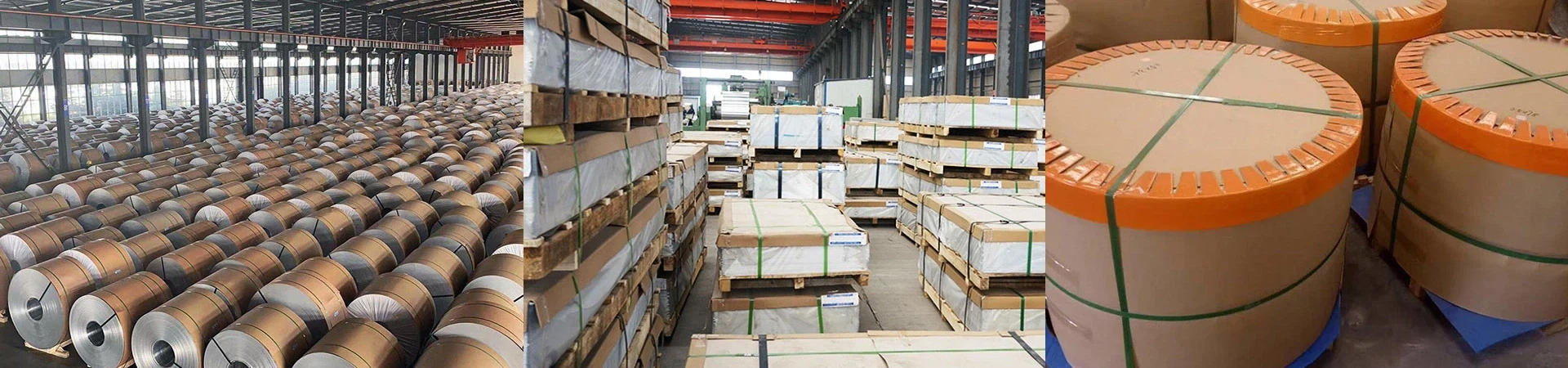
Anodized profiles are the fragile part of the shipment, not the metal. Bundles are wrapped in PE film or moisture-barrier paper, with protective tape on visible faces and foam or paper interleaving so edges cannot rub.
Bundles are strapped over corner protectors onto ISPM 15 heat-treated pallets. Long profiles are cut to suit container loading - under about 5.9 m for a 20 ft box - with desiccant added for sea freight. Marks show alloy, temper, lot number and gross and net weight.
About GNEE
Supplying aluminum from Anyang, Henan since 2008, with shipments to more than 100 countries and regions.
Plate, sheet, coil, strip, foil, bar, tube, profile, pipe fittings and flanges, so one order can combine several forms.
Extrusion, cold drawing, CNC machining and anodizing under one supply chain, not three vendors.
Export packing, marking and shipping documents for container loading, with die and profile records kept for repeat runs.
Request a quote for 6063 aluminum extrusion
Six details make a quotation usable on the first pass: alloy and temper, the section drawing, length and quantity in meters or pieces, surface finish with film thickness and color, the standard and certificate required, and the destination port.
Send the drawing and these six details for a firm 6063 aluminum extrusion quotation. Where a section sits near the limit of what a die can fill, the review names the constraint before the order is placed.
FAQ
Q: Should I specify 6063-T5 or 6063-T6?
A: T5 covers most architectural, decorative and heat-sink work, with lower internal stress and better formability. Choose T6 when the part carries load in service and needs the higher yield strength, and allow more movement during machining.
Q: Can 6063 profiles be made with very thin walls?
A: Thin multi-cavity sections are what 6063 is used for, but the achievable minimum wall depends on section perimeter, cavity count, the die and the temper. It is settled at die review, not quoted as one number for all profiles.
Q: Why do two batches of the same 6063 anodize to slightly different colors?
A: Composition inside the standard range, iron level, pre-treatment and sealing all shift the result. Two heats with different silicon excess or iron content respond differently to the same dye bath, so the color sample should come from production alloy and temper.
Q: Is 6063 aluminum extrusion weldable?
A: Yes, with ER4043 or ER5356 filler. The heat-affected zone loses temper, so a welded T6 assembly does not hold T6 strength at the joint; re-age after welding or design for the reduced joint strength.
Q: How does 6063 behave above 100 °C?
A: The Mg2Si particles coarsen and strength drops once continuous service passes roughly 120 °C. In heat-sink work heat leaves the part fast enough that this is not the limit; for a part carrying load at temperature, the design margin must allow for overaging.