

What Aluminum Is and Why It Matters
Aluminum is a chemical element with the symbol Al and the atomic number 13. It is the most abundant metal in the Earth's crust and the third most abundant element overall, after oxygen and silicon. In terms of industrial consumption it ranks second only to steel, which makes it the second major category of engineering metal. Aluminum compounds had been known for a long time, but the metal itself only became a competitive engineering material in the late 19th century, once electrolytic reduction made large-scale production practical. Three industries drove that change: aviation, construction and automobile manufacturing. Each of them needs low density combined with useful strength, and the unique properties of aluminum and its alloys matched that requirement closely. As a result, aluminum is now used across an unusually wide range of applications.
Pure aluminum is soft, relatively weak and highly malleable. It can be drawn into fine wire and rolled into thin foil, so it is used in large quantities for conductor wire, cable, radio equipment and packaging. Its electrical conductivity is roughly two thirds that of copper, but its density is only about one third of copper. For a conductor of equal mass and length, aluminum therefore carries about twice the current of copper, and it does so at a lower material cost.
Aluminum Alloys: Alloying Elements and Behavior
Aluminum alloy is the general term for alloys in which aluminum is the base metal. The main alloying elements are copper, silicon, magnesium, zinc and manganese. Minor alloying additions include nickel, iron, titanium, chromium and lithium. These elements are added in controlled amounts to raise strength, improve corrosion resistance, or modify forming and joining behavior.
Aluminum alloys combine low density with comparatively high strength, and in some tempers they approach or exceed the strength of high-quality structural steel. They also offer good plasticity, which allows them to be rolled, extruded and formed into a wide range of profiles, together with excellent electrical conductivity, thermal conductivity and corrosion resistance. That combination explains why aluminum alloys are used so widely in industry, with total consumption second only to steel.
Classification of Aluminum Products
Aluminum products are grouped first by product form - rolled, extruded and cast - and then by whether the alloy responds to heat treatment.
| Family | Series | Main alloying additions | Heat treatable |
|---|---|---|---|
| Pure aluminum | 1000 series | None, 99% Al minimum | No |
| Aluminum-manganese | 3000 series | Manganese | No |
| Aluminum-silicon | 4000 series | Silicon | No |
| Aluminum-magnesium | 5000 series | Magnesium | No |
| Aluminum-copper-magnesium | 2000 series | Copper, magnesium | Yes |
| Aluminum-magnesium-silicon | 6000 series | Magnesium, silicon | Yes |
| Aluminum-zinc-magnesium | 7000 series | Zinc, magnesium | Yes |
Cast alloys follow a parallel logic. Non-heat-treatable casting alloys include pure aluminum grades and aluminum-silicon grades such as ADC1, together with aluminum-magnesium grades such as ADC5 and ADC6. Heat-treatable casting alloys include aluminum-copper-silicon grades such as ADC10 and ADC12, aluminum-copper-magnesium-silicon grades such as ADC14, and aluminum-magnesium-silicon grades such as ADC3.
Rolled, Extruded and Cast Product Forms
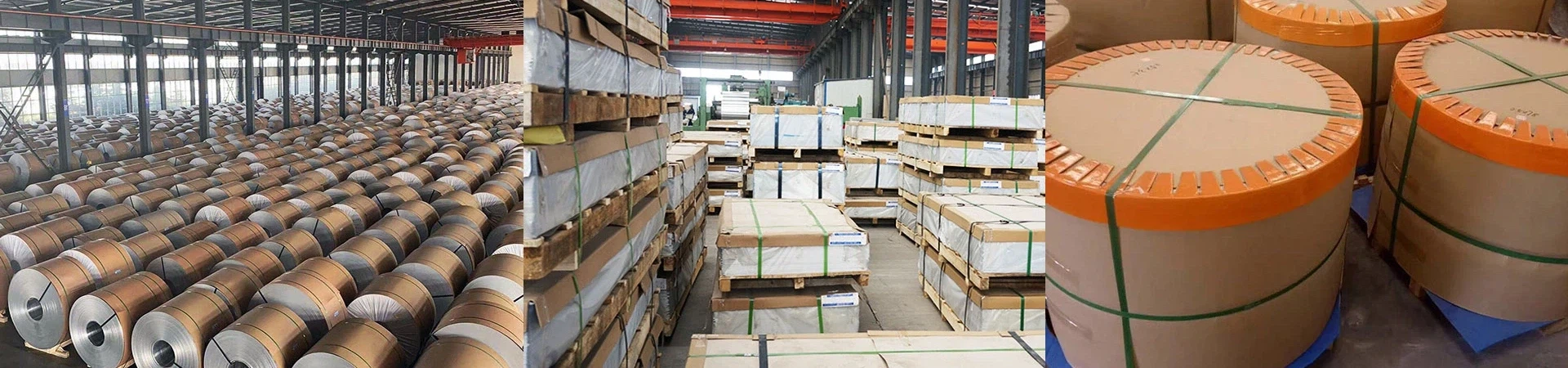
Rolled products: sheet, plate, coil and strip, produced by hot rolling followed where required by cold rolling.
Extruded products: pipe, solid bar and profiles with simple or complex constant cross-sections.
Castings: components produced by gravity, sand or die casting close to final shape.
Temper designations add the final level of definition. The H series covers strain-hardened tempers such as H14, H32 and H34; the O temper covers annealed material; and the T series covers solution heat-treated and aged tempers such as T4, T5 and T6. When material is ordered, alloy and temper must be specified together, because the mechanical properties depend on both.
Typical Applications of Aluminum Products
Aluminum products serve industries that value weight reduction, thermal management and long service life. Typical examples include:
Transport: body panels, structural profiles and heat exchangers for road, rail and marine equipment.
Construction: curtain wall sheets, roofing, ceilings and window profiles.
Electrical and electronics: bus bars, cable conductors and enclosures.
Packaging: foil and rigid containers, chosen for barrier performance and recyclability.
Industrial equipment: heat sinks, radiator components and machine frames.
Recyclability is a further advantage. Aluminum can be remelted repeatedly without losing its essential properties, and remelting consumes only a fraction of the energy needed to produce primary metal from ore. That keeps aluminum attractive wherever both performance and lifecycle cost are assessed.
Frequently Asked Questions
Q: What is the difference between heat-treatable and non-heat-treatable aluminum alloys?
Heat-treatable alloys gain strength through solution heat treatment and ageing, while non-heat-treatable grades are strengthened by strain hardening or solid-solution alloying only.
Q: Why is aluminum used for electrical conductors if copper conducts better?
Aluminum is about two thirds as conductive as copper but only one third as dense, so an equal-mass conductor of the same length carries more current at a lower cost.
Q: Which series should be chosen for corrosion-resistant outdoor parts?
The 5000 series and 6000 series are common choices, because the magnesium and magnesium-silicon additions support a stable protective oxide film.
Q: How are alloy and temper specified on an order?
The two designations are written together, for example 5052-H32 or 6061-T6, since mechanical properties depend on the alloy and the temper in combination.
Q: Can aluminum products be recycled at end of life?
Yes. Aluminum can be remelted repeatedly without losing its essential properties, and remelting requires only a small share of the energy used for primary production.
Q: What determines the choice between rolled, extruded and cast forms?
The geometry of the part decides it: flat or coiled sections suit rolling, constant cross-sections suit extrusion, and complex three-dimensional shapes suit casting.


