

Why Aluminum Foil Is Used to Shield Cables
Aluminum foil is the lightest metallic barrier available for cable shielding. In a shielded construction the foil sits between the insulated conductor or the twisted pair and the outer jacket, where it does three jobs at once: it reflects and absorbs electromagnetic interference, it blocks water vapour before it can reach the insulation, and it forms a continuous equipotential layer that stabilises the electric field around the conductor.
Because a shielding foil is only a few micrometres thick, it adds almost nothing to cable diameter or mass, an important advantage in data cables, instrumentation and control cables, and automotive harnesses where space and weight are tightly budgeted. Compared with braided copper, a bonded foil gives close to 100 percent coverage at a fraction of the cost and mass, which is why most modern cables combine a foil layer with a drain wire or a light braid. The foil also acts as a moisture and chemical barrier, protecting the polymer insulation from hydrolysis and from the corrosive effects of fillers, oils and atmospheric pollutants.
Alloys and Tempers for Cable Shielding Foil
Three wrought alloys cover the majority of cable foil demand.
Alloy 1235 is the general-purpose choice: a high-purity, low-manganese alloy with very good conductivity and a smooth, low-oxide surface that laminates and prints cleanly.
Alloy 8011 provides higher strength after cold rolling and is preferred when the foil has to survive mechanical wrapping, taping or corrugating without tearing.
Alloy 1060 is selected when electrical conductivity is the priority and the foil is applied unsupported.
All three are supplied in the soft O temper for lamination, where high elongation lets the tape bend around tight cable cores without cracking, and in H18 or H16 temper when the foil is used as a self-supporting layer or as a semi-rigid screen. Soft-temper foil is normally specified for foil and polyester laminated tapes, while half-hard or hard foil is used for wrap-around screens and for the corrugated aluminium used on larger power cables.
Thickness, Width and Roll Formats
Thickness is chosen from the shielding performance required, the bending radius of the cable and the mechanical stress during cabling. Unsupported screens usually run from 6 to 50 micrometres, while laminated tapes use a 6 to 25 micrometre foil layer bonded to a polyester carrier.
| Cable foil product | Typical foil gauge | Common alloy | Temper |
|---|---|---|---|
| Unscreened barrier / moisture foil | 0.006 to 0.020 mm | 1235, 1060 | O |
| Laminated shielding tape | 0.006 to 0.025 mm | 1235, 8011 | O |
| Wrap-around electrostatic screen | 0.025 to 0.050 mm | 8011, 1235 | H18 / H16 |
| Semi-rigid and corrugated screen | 0.050 to 0.100 mm | 1060, 8011 | O / H18 |
Jumbo rolls are delivered in widths from about 200 mm up to 1500 mm with a 76 mm or 152 mm core, and are slit to the narrow tape widths of 3 mm to 100 mm that cable taping lines consume. Roll diameter, core type, splices and winding tension are agreed order by order so that the tape feeds without flutter on high-speed taping machines.
Mechanical and Electrical Properties
The values below are typical ranges for cable shielding foil and are confirmed against the purchase specification for each order.
| Property | Soft O temper | Hard H18 temper |
|---|---|---|
| Tensile strength | 45 to 110 MPa | 130 to 180 MPa |
| Elongation at break | 20 to 40 percent | 1 to 4 percent |
| Electrical conductivity | 59 to 61 percent IACS | 59 to 61 percent IACS |
| Density | 2.70 to 2.72 g/cm3 | 2.70 to 2.72 g/cm3 |
| Thickness tolerance | plus or minus 3 percent | plus or minus 3 percent |
Because aluminium carries roughly 60 percent of the conductivity of copper at about 30 percent of the density, a foil shield delivers a very favourable ratio of shielding attenuation to added cable mass. The high purity of the 1xxx alloys also keeps the surface free from the heavy oxide that would raise contact resistance between the foil and the drain wire.
Foil Tape Lamination and Shielding Performance
Most shielded cables do not use bare foil. The foil is bonded to a polyester or polypropylene film with a thin adhesive layer to form a tape that resists tearing during taping and keeps the shield continuous when the cable is flexed.
The polyester layer provides dielectric strength and mechanical protection; the aluminium layer provides the conductive barrier.
A drain wire or a conductive adhesive layer ties the foil to the reference potential along the whole cable length.
Coverage is normally 100 percent with an overlap of 10 to 25 percent, so there is no gap for interference to leak through.
Transfer impedance and shielding attenuation are measured on the finished cable, and depend on overlap, foil thickness and the quality of the bond between foil and film.
Quality Control, Slitting and Packaging
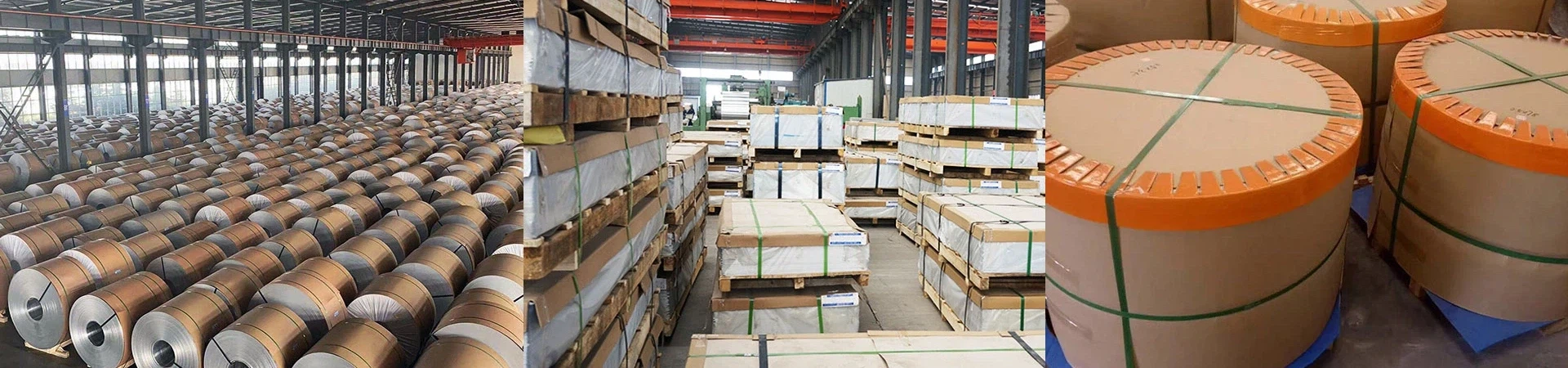
Cable foil is inspected for thickness profile, pinholes, surface wetting tension, camber and burr height before despatch. Pinhole counts and camber are the two defects that most often cause a cable line to stop, so both are recorded batch by batch. Rolls are wound on a fixed core, protected with a moisture barrier wrap and delivered on pallets that keep the roll axis vertical in transit, preserving the flatness that the taping process depends on.
Frequently Asked Questions
Q: Which alloy is best for a laminated cable shielding tape?
Alloy 1235 in the soft O temper is the usual choice, because it laminates cleanly and has the elongation needed to wrap tight cable cores without cracking.
Q: What foil thickness gives effective shielding?
For most signal and data cables a 6 to 25 micrometre foil laminated to a polyester film gives excellent screening. Thicker 50 to 100 micrometre foil is used for semi-rigid screens and larger power cables.
Q: Can the foil be supplied already slit to tape width?
Yes. Jumbo rolls can be slit from 3 mm up to 100 mm with the core type and winding tension matched to the customer taping line.
Q: Does aluminium foil shielding work as well as copper braid?
Foil gives better coverage and lower mass. Braid is stronger mechanically and carries more current, so many cables combine a foil layer with a drain wire or a light braid.
Q: How is the foil protected during shipping?
Rolls are wound on cores, wrapped in a moisture barrier film and shipped on pallets in a vertical orientation to protect flatness and surface quality.
Q: What surface condition is needed for good adhesion?
The foil must be free of rolling oil residue and have a controlled wetting tension so that the laminating adhesive bonds evenly across the full web width.


