What 7075 Aluminum Plate Is
7075 is the best known high-strength aluminum alloy plate, built on an Al-Zn-Mg-Cu system with zinc around 5.1-6.1%, magnesium 2.1-2.9% and copper 1.2-2.0%. It was developed for aircraft structures and remains the reference material wherever strength-to-weight ratio matters more than corrosion margin or weldability. The parameters below are the ones that actually govern plate selection.
Core Performance Parameters
| Parameter | Typical value, T6 and T651 |
|---|---|
| Tensile strength | 540-590 MPa |
| Yield strength, 0.2% offset | 470-520 MPa |
| Elongation | 5-11%, lower in thick plate |
| Hardness | 150 HB typical |
| Density | 2.81 g/cm3 |
| Modulus of elasticity | 71.7 GPa |
| Thermal conductivity at 25 C | about 130 W/m.K |
| Melting range | 477-635 C |
| Composition range | Zn 5.1-6.1%, Mg 2.1-2.9%, Cu 1.2-2.0%, Cr 0.18-0.28% |
Plate is supplied under ASTM B209 and the corresponding aerospace sheet and plate specifications, with composition limits also listed in GB/T 3190 for the 7A04 and 7075 family. Temper designation matters: T6 means solution heat treated and artificially aged, while T651 adds a controlled stretch of roughly 1.5-3% to relieve internal stress before aging. That stretch is what makes T651 the right choice for parts that must hold tolerance during heavy machining.
Advantages That Are Genuinely True
Excellent strength-to-weight ratio: at 540-590 MPa tensile with a density of 2.81 g/cm3, 7075 outperforms almost every other commercial plate alloy.
Good machinability in the T6 and T651 tempers, with clean chip formation and a reliable surface finish.
High fatigue strength relative to density, which is why it dominates aircraft fittings and wing structures.
Predictable response to anodizing, allowing corrosion protection and a controlled decorative finish in the same operation.
Good thermal conductivity for a high-strength alloy, although clearly below 1050 or 6061.
Limitations Often Misstated in Secondary Articles
Two claims appear repeatedly in general write-ups and both are wrong. First, 7075 does not have excellent corrosion resistance. The copper and zinc additions make it markedly less resistant to pitting and stress corrosion than 5xxx or 6xxx plate, and thin plate is frequently supplied Alclad with a pure aluminum or Al-Zn cladding layer to restore surface protection. Second, 7075 is not readily fusion weldable: TIG and MIG welding generally produces hot cracking and severe loss of properties in the joint, so the grade is assembled with rivets, bolts, adhesives or resistance spot welding instead. Machinability, by contrast, is genuinely good, and anodizing to GB/T 8013 or an equivalent sulfuric acid process is the normal protection route wherever cladding is not used.
Fabrication, Handling and Application Notes
Machining: use sharp, polished tooling with adequate coolant, and prefer T651 over T6 for parts with tight dimensional tolerance because residual stress is lower.
Forming: formability in T6 is limited, so tight bends normally require forming in the annealed condition and then aging to final temper.
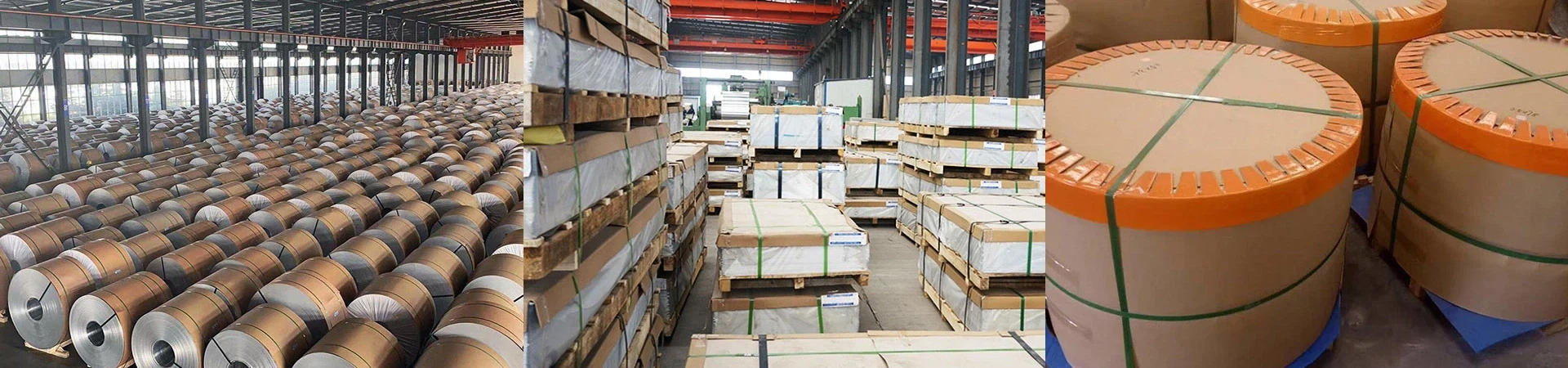
Storage: keep plate dry and ventilated, stacked clear of the floor, and never allow pooled water or chloride-bearing dust to sit on the surface.
Corrosion protection: specify cladding for thin plate and anodizing for machined parts, and avoid uncontrolled metal-to-metal couples in wet conditions.
Maintenance: clean with neutral detergents, since acidic or chloride-based cleaners attack the surface and start pits at machined edges.
Typical applications: aerospace structural components, fittings and frames; high-performance machinery, moulds and tooling plate; bicycle frames and competition sporting equipment; automotive and motorsport suspension parts.
Frequently Asked Questions
Q: What are the core performance parameters of 7075 aluminum plate?
In the T6 and T651 tempers, typical values are 540-590 MPa tensile strength, 470-520 MPa yield strength, 5-11% elongation, about 150 HB hardness and a density of 2.81 g/cm3.
Q: What are the advantages of 7075 aluminum plate?
A very high strength-to-weight ratio, good machinability in T6 and T651, high fatigue strength for its density, reliable anodizing response and good thermal conductivity for a high-strength alloy.
Q: Does 7075 aluminum plate have excellent corrosion resistance?
No. It is less corrosion resistant than 5xxx or 6xxx plate because of its copper and zinc content, so thin plate is often Alclad and machined parts are normally anodized.
Q: Can 7075 aluminum plate be welded?
Fusion welding is not recommended, because TIG and MIG joints tend to crack and lose strength. Use riveting, bolting, adhesive bonding or resistance spot welding instead.
Q: What are the typical applications of 7075 aluminum plate?
Aerospace structural components and fittings, high-performance machinery, moulds and tooling plate, bicycle frames and sporting equipment, and motorsport suspension parts.
Q: What should be considered when using 7075 aluminum plate?
Dimensional stability, because residual stress is high in T6; corrosion protection by cladding or anodizing; suitable tooling and coolant during machining; dry, ventilated storage; and regular cleaning with neutral detergents.