

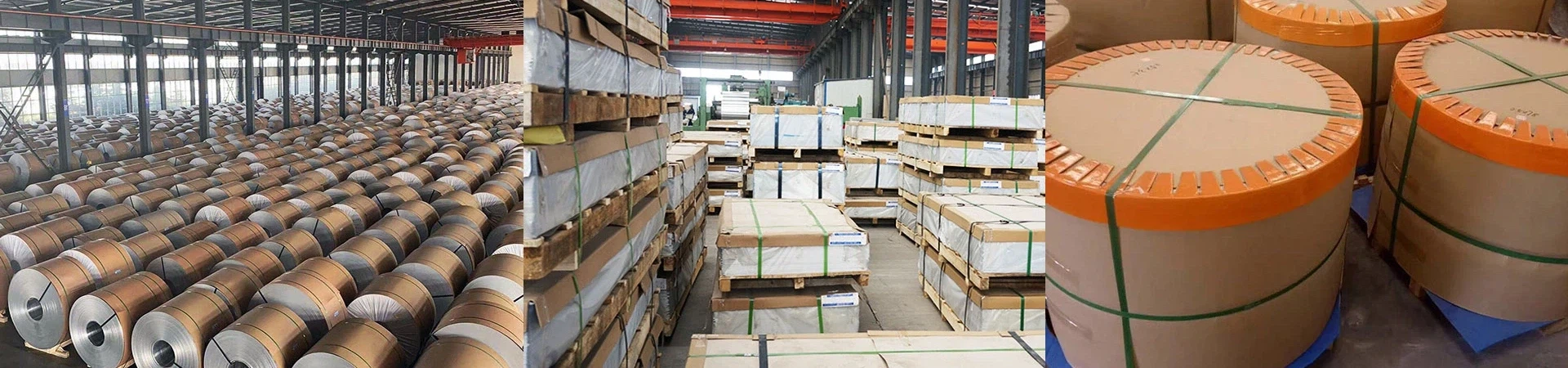
What 1100 Aluminium Plate Is
Alloy 1100 is commercially pure aluminium with a minimum aluminium content of 99.0 %, the remainder being controlled iron and silicon plus very small amounts of copper, manganese and zinc. It is the softest, most ductile and most conductive of the common sheet alloys, with a density of about 2.71 g/cm³, thermal conductivity around 220 W/m·K and electrical conductivity in the region of 59–61 % IACS. Because it contains no deliberate hardening additions, 1100 cannot be strengthened by heat treatment and is supplied in strain-hardened tempers, most commonly O, H12, H14, H16 and H18 under ASTM B209 and GB/T 3880.2. It is chosen whenever formability, conductivity and corrosion resistance matter more than strength.
Mechanical Properties by Temper
| Temper | Tensile strength, ksi | Tensile strength, MPa | Yield strength, min | Typical use |
| O | 11.0–15.5 | 76–107 | 34 MPa | Deep drawing, spinning, severe forming |
| H12 | 14.0–19.0 | 97–131 | 76 MPa | General forming, bent parts |
| H14 | 16.0–22.0 | 110–152 | 97 MPa | Panels, utensils, general fabrication |
| H16 | 19.0–25.0 | 131–172 | 117 MPa | Stiffener and trim parts |
| H18 | 22.0 min | 152 min | 138 MPa | Flat, stiff components with light forming |
Plate is produced from about 6 mm upwards and is normally supplied in the O or H112 condition for machining and forming, with thickness tolerances and flatness limits agreeing with ASTM B209. Elongation in the annealed condition commonly exceeds 25 %, which is the reason the alloy tolerates deep draws and tight bends that would crack harder tempers.
Applications by Sector
Construction applications
In building work 1100 is used for roofing sheet, wall cladding, flashing, gutters, downspouts, soffits, ceiling panels and decorative trim, generally in H14 or H16 tempers between 0.5 mm and 2.0 mm. Its combination of atmospheric corrosion resistance, low weight and easy bending means it can be formed on site and fixed without heavy equipment. Where a paint or anodised finish is required, the surface responds well to chemical conversion coating and to anodising to GB/T 8013.1, producing a clear or natural grey protective film.
Industrial, automotive and electrical applications
Automotive: heat shields, insulation barriers, interior trim panels, fuel tank components and gaskets, where light weight and thermal conductivity are the driving requirements.
Electrical and electronic: heat sinks, busbar and terminal strip, shielding enclosures, transformer and capacitor components, and printed circuit substrate work, exploiting the high conductivity of the pure metal.
Chemical and process plant: storage tank linings, pipe insulation jackets, vessel cladding, and equipment for handling oxidising media where the alloy's corrosion behaviour is acceptable.
Consumer goods: cookware and utensils, appliance panels, nameplates, lighting reflectors and deep-drawn housings.
Signage and display: brushed or etched panels, where the even grain and consistent colour of pure aluminium give a clean appearance.
Forming, Joining and Finishing
1100 is the most formable aluminium sheet alloy in everyday industrial use. Typical guidance is a minimum inside bend radius equal to or slightly above the sheet thickness in the O temper, while H14 and harder tempers need roughly one-and-a-half to two times thickness for a 90° bend. Deep drawing and spinning are carried out in the O temper with a draw-quality lubricant; intermediate annealing near 340 °C restores ductility between forming stages. The alloy is readily welded by TIG and MIG with 1100 or 4043 filler, and is also joined by brazing, soldering and adhesive bonding. Threads should be avoided in thin sections because of low strength; rivets, self-clinching fasteners and inserts are preferred. Anodising and chromate conversion coatings improve appearance and paint adhesion but do not make the alloy structurally stronger.
Selection Notes and Quality Control
Buyers should distinguish 1100 from 1050, which is purer and slightly softer, and from 3003, which adds about 1.2 % manganese and roughly 20 % more strength at a small cost premium. Where a component must carry load, 3003, 5052 or 6061 is the correct choice and 1100 should be reserved for forming, conductivity and corrosion duties. Quality control covers gauge measured with a micrometer against ASTM B209 tolerance, flatness on a straightedge, visual inspection for scratches and dents, surface finish consistency, and a mill certificate stating alloy, temper, heat number, dimensions and mechanical results. Chemical composition is confirmed against the aluminium content requirement of 99.0 % minimum, and mechanical testing follows ASTM B557.
Frequently Asked Questions
Q: Is 1100 aluminium heat treatable?
A: No; it is strengthened only by strain hardening, so it is supplied in O, H12, H14, H16 and H18 tempers.
Q: What is the aluminium content of 1100?
A: A minimum of 99.0 % aluminium with controlled iron and silicon and only trace additions of other elements.
Q: Why is 1100 chosen for heat sinks?
A: Its thermal conductivity of about 220 W/m·K and electrical conductivity near 60 % IACS, together with low cost and easy forming, suit heat dissipation parts.
Q: How does 1100 compare with 3003?
A: 3003 contains roughly 1.2 % manganese and is about 20 % stronger, while 1100 is softer, more conductive and more formable.
Q: Which temper is used for deep drawing?
A: The annealed O temper, with a draw-quality lubricant and intermediate annealing if several forming stages are needed.
Q: What standards cover 1100 sheet and plate?
A: ASTM B209 and GB/T 3880.2, with tension testing to ASTM B557 and anodising to GB/T 8013.1.


