

What Is 5052 Aluminum Plate?
5052 aluminum plate is a non-heat-treatable alloy of the aluminum-magnesium family, designated AA5052 and EN AW-5052. Magnesium at 2.2-2.8% and chromium at 0.15-0.35% are its two deliberate alloying additions, and together they give the grade the highest strength among the ordinary non-heat-treatable aluminum alloys. Strength is developed by work hardening during rolling rather than by solution heat treatment, so the delivered temper and the amount of cold reduction decide the final property level.
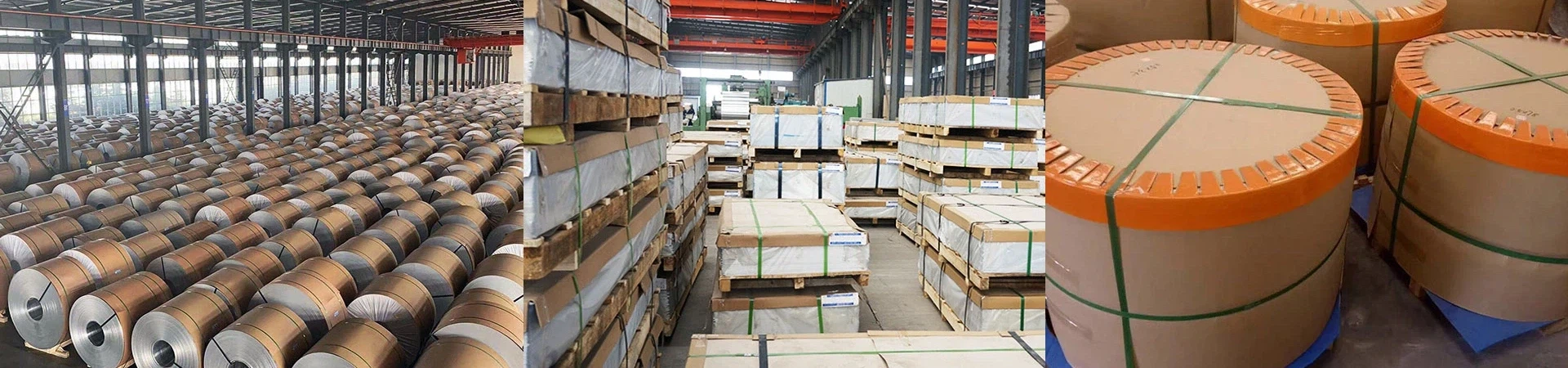
The alloy is rolled on both hot-rolled and cold-rolled routes, which is why it is stocked as heavy plate up to 600 mm thick as well as thin sheet and coil. It is chosen wherever moderate strength has to be combined with excellent corrosion resistance, reliable welding response and good forming behaviour.
Standard Chemical Composition
Composition limits for the 5052 designation follow ASTM B209 and EN 573-3.
| Element | Content (%) |
|---|---|
| Magnesium (Mg) | 2.20 - 2.80 |
| Chromium (Cr) | 0.15 - 0.35 |
| Iron (Fe) | 0.40 max |
| Silicon (Si) | 0.25 max |
| Copper (Cu) | 0.10 max |
| Manganese (Mn) | 0.10 max |
| Zinc (Zn) | 0.10 max |
| Aluminum (Al) | Remainder |
Tempers and Mechanical Properties
The tempers normally traded are 5052-O, 5052-H112, 5052-H32, 5052-H34 and 5052-H38. H32 is the most widely used condition: it is strain hardened and then stabilised by partial annealing, which leaves a workable balance between strength and remaining ductility. H112 is simply the hot-worked, non-heat-treated condition used for thicker plate, and it carries the lowest strength of the group.
| Temper | Tensile strength Rm (MPa) | Yield strength Rp0.2 (MPa) | Elongation A50 (%) | Typical forming use |
|---|---|---|---|---|
| 5052-O | 190 - 215 | 75 - 95 | 25 | Deep drawing, severe forming |
| 5052-H32 | 220 - 250 | 170 - 200 | 12 | General fabrication and panels |
| 5052-H34 | 250 - 275 | 200 - 220 | 10 | Structural sheet and covers |
| 5052-H38 | 275 - 300 | 240 - 260 | 8 | High-strength panels |
Values are typical for ASTM B209 and EN 485-2 deliveries and shift slightly with thickness. Physical constants are density 2.68 g/cm³, elastic modulus 70 GPa, melting range 607-649 °C, thermal conductivity about 138 W/m·K and electrical conductivity about 35% IACS.
Corrosion Resistance, Welding and Forming
Corrosion: 5052 resists seawater, marine atmospheres and many industrial chemical environments far better than 1100 or 3003, and it does not need cladding for most outdoor service.
Welding: easily joined by MIG and TIG using 5xxx-series filler metals such as ER5356 or ER5556; no post-weld heat treatment is required, and welded joints retain most of the parent-metal strength.
Forming: ductility is highest in the O temper and still good in H32; minimum bend radii must be increased as the temper hardens.
Surface: mill finish, bright finish, mirror finish, paper-interleaved sheet, protective film lamination and embossed patterns are all available on the same alloy.
Typical Industrial Applications
Hulls, decking, superstructures and fuel tanks for boats and work vessels
Automotive body panels, underbody linings, truck bodies and heat shields
Pressure vessels, chemical storage tanks, road tankers and silos
Chassis and enclosures for electronics, cable protection sleeves and control cabinets
Architectural curtain wall panels, suspended ceilings, doors and window frames
Furniture frames, ladders, refrigeration panels and general sheet-metal work
A typical rolling programme covers thickness from 0.15 mm to 600 mm, width from 20 mm to 2650 mm and length from 500 mm to 16000 mm. Packaging can be plain, fine-wrapped, domestic logistics grade or export sea-worthy grade with fumigated wooden pallets.
Frequently Asked Questions
Q: Can 5052 aluminum plate be heat treated to increase strength?
No. 5052 is a non-heat-treatable alloy, so it cannot be strengthened by solution treatment and aging; strength comes only from work hardening, which is why the temper designation matters so much when ordering.
Q: Which temper should be selected for bending and deep drawing?
The O temper gives the greatest ductility for deep drawing, while H32 suits most general bending and roll forming. Tight radii on H34 or H38 increase the risk of cracking and call for a softer temper.
Q: Is 5052 suitable for marine and salt-water service?
Yes. Its magnesium and chromium content produces a stable protective oxide film, so it performs well in seawater, splash zones and coastal atmospheres, and it is a standard material for boat hulls, decks and fuel tanks.
Q: How does 5052 compare with 6061?
6061 is a heat-treatable alloy and reaches higher strength after T6 aging, but 5052 offers better corrosion resistance, better formability and easier welding. Where forming and corrosion matter more than peak strength, 5052 is usually the better choice.
Q: What is the maximum thickness available for 5052 plate?
Plate is regularly rolled up to 600 mm thick, with 5052-H112 used for the heaviest gauges and H32 or H34 for thin sheet, coil and general fabrication stock.


