Custom processing of perforated aluminum sheets involves more than producing holes in a metal sheet. Panel dimensions, hole patterns, edge margins, cutting methods, flatness and surface requirements all need to be considered together. Buyers can submit drawings or specifications for a review of material selection and suitable processing options.

Custom Processing Options for Perforated Aluminum Sheets
The table below maps each process to what it is used for and what a buyer typically needs to confirm.
| Process | What it is used for | What the buyer confirms |
|---|---|---|
| Cutting to Size | Cut length, width and outline to required dimensions | Dimensions, tolerances, edge condition |
| Mechanical Perforation / CNC Punching | Regular hole patterns, repeated hole position and pitch | Hole diameter, pitch, arrangement, open area |
| Laser Cutting | Complex profiles, irregular openings, decorative patterns | Pattern accuracy, edge quality |
| Bending and Forming | Edge folding, bending and simple forming | Bend direction, radius, hole-to-bend distance |
| Additional Processing | Deburring, edge treatment and other confirmed operations | Burr, distortion, surface protection |

Aluminum Sheet Cutting Services
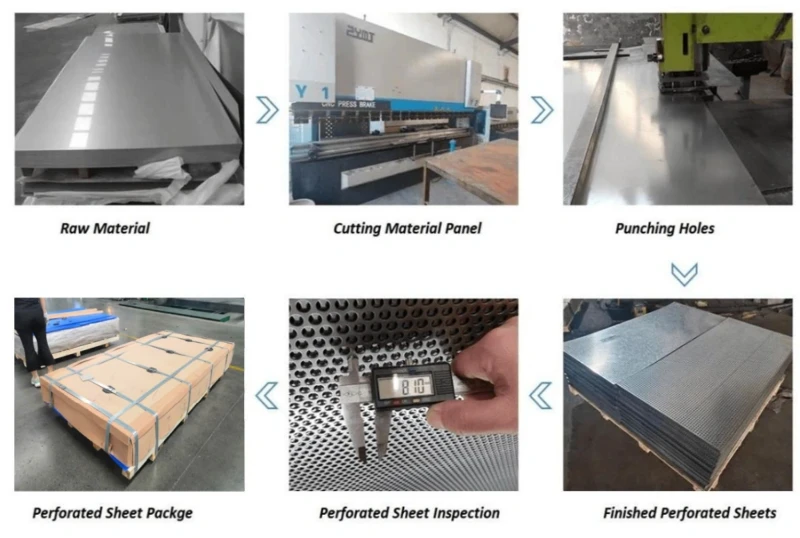
Cutting is usually the first operation after material selection. The goal is a finished panel whose dimensions, edges and flatness match the project drawing, without damaging the existing hole pattern.
Cutting Perforated Aluminum Sheets to Custom Dimensions
Sheets are cut to specified length, width and outline from supplied or sourced coil and plate. Raw sheet size and finished panel size are confirmed separately, because the starting format limits achievable panel dimensions and yield. After cutting, edge deburring, chamfering or protective taping may be specified depending on handling and downstream assembly.
Cutting tolerances and panel flatness are agreed before quotation. Large panels need planned handling and support to avoid bowing during transport and storage, and these logistics are part of the order review.
Cutting Perforated Sheets Without Damaging the Hole Pattern
Cutting a perforated sheet is different from cutting a plain sheet because the cut line interacts with the hole layout. The relationship between the cut line and hole positions decides whether edge holes stay complete or get clipped, and whether a solid margin (without holes) must be reserved along the trimmed edge.
Buyers should mark no-cut zones. After cutting, the edge may show minor burr or local deformation that is removed or controlled during deburring. For large sheets, handling and support spacing are planned so the panel is not strained during cutting and packing.
CNC Perforation and Custom Hole Pattern Processing
This is the core of perforated aluminum supply: forming regular, repeatable hole patterns with controlled diameter, pitch and open area.
Standard Perforation Patterns for Aluminum Sheets
The most common geometries are round holes, square holes, slotted holes and hexagonal holes, plus fully custom patterns defined by the buyer. Round holes in staggered or straight arrangement remain the workhorse for ventilation, screening and architectural facades because open area and strength are easy to predict.
Pattern choice affects not only appearance but also open area, stiffness and processing cost. The matching of pattern to alloy, thickness and pitch is reviewed during drawing check rather than guessed.

Hole Diameter, Pitch and Open Area of Perforated Aluminum Sheets
Key parameters are hole diameter (d), center-to-center pitch (p), staggered versus straight arrangement, open area and edge margin (the border without holes around the panel). Open area is the share of the perforated zone occupied by holes.
For regular round holes only, open area is estimated by:
60° staggered layout: OA(%) = 90.69 × (d/p)²
90° straight layout: OA(%) = 78.54 × (d/p)²
Example: d = 10 mm, p = 15 mm → (10/15)² = 0.444 → staggered OA ≈ 90.69 × 0.444 ≈ 40.3%. These formulas apply only to regular round-hole arrays and not to arbitrary decorative patterns. For open-area calculation across patterns, see the dedicated open area calculation guide.
Custom Hole Patterns Based on Drawings
Buyers can submit CAD/DXF/DWG files, PDF technical drawings, or a defined hole diameter, pitch and arrangement. Drawing review checks whether hole diameter, pitch, edge spacing, sheet thickness and chosen processing method are mutually compatible - for example, whether the pitch leaves enough web between holes and whether the panel stays stiff enough after perforation.
Laser Cutting for Decorative Aluminum Panels
Laser cutting follows a programmable path and is used where the shape is not a simple repeated hole - decorative geometry, architectural motifs, logos and irregular openings. It is a different process from mechanical perforation and is not a substitute for it.
Laser-Cut Decorative Patterns for Aluminum Sheets
Complex geometric contours, building-decoration patterns, signage cutouts and non-standard openings are typical laser applications. Because the path is digital, low-to-medium batches and one-off patterns are practical without dedicated tooling.
Laser Cutting vs. Mechanical Perforation
| Comparison | Mechanical Perforation / CNC Punching | Laser Cutting |
|---|---|---|
| Regular repeated holes | Usually suitable | Possible, but may not be economical |
| Complex decorative patterns | Limited by tooling and machine capability | Usually more flexible |
| Tooling requirement | May need dedicated punching tools | Usually no dedicated perforation tooling |
| Batch production | Often advantageous for regular holes | Depends on pattern complexity and cutting efficiency |
| Edge quality | Watch punch burr | Watch heat-affected zone, dross and cut-edge condition |
Design Considerations for Laser-Cut Aluminum Sheets
Pattern design affects both looks and manufacturability. Minimum spacing and thin connecting sections must be large enough to avoid breakage; thicker sheets and more complex patterns raise cutting time and heat input. Cut-edge burr, dross and the heat-affected zone are managed by parameter selection and post-cleaning.
Decorative patterning also reduces local strength, so the pattern density is balanced against panel span and support. Subsequent anodizing or powder coating changes edge and surface appearance, and is planned together with the cutting stage.

Bending and Additional Fabrication of Perforated Aluminum Sheets
After perforation or cutting, panels may need forming and secondary operations. These are reviewed for feasibility against hole layout and material condition.
Bending and Edge Folding of Perforated Aluminum Sheets
Common forms include edge folding, simple bends, U-shaped and box-type edges. The distance from holes to the bend line, the bend radius, alloy and temper, and sheet thickness all influence the result. A solid margin (without holes) is normally kept in the bend zone to prevent hole distortion, and bend direction is taken from the drawing.
Notching, Drilling and Cutouts in Perforated Aluminum Sheets
Notches, mounting holes, irregular cutouts and connection points are processed to the drawing. Their position relative to the existing perforation and to panel edges is checked so the panel keeps enough material for strength and fixing.
Deburring and Edge Finishing of Perforated Aluminum Sheets
After cutting and forming, burrs and sharp edges are removed or controlled, and edges are inspected. Surface protection such as film or edge taping may be applied before packing to prevent handling marks. These operations are confirmed as part of the processing scope per order.

Surface Finishing for Processed Perforated Aluminum Panels
Finishing is selected for appearance and service environment. Perforation and cutting change how coating covers edges, so finish and hole geometry are planned together.
Mill Finish Aluminum Panels
Mill finish is the as-processed surface with no added coating. It is the lowest-cost option and suits internal or non-decorative uses where appearance is not critical. Surface marks from rolling or processing are normal and are judged against the agreed standard.
Anodized Perforated Aluminum Panels
Anodizing builds a controlled oxide layer that is integral to the metal, giving consistent color and corrosion resistance. It is often chosen where a uniform architectural look is required. Color and film thickness are specified per project, and hole-edge coverage is checked during inspection.
Powder Coated Perforated Aluminum Sheets
Powder coating gives a thick, even colored film with good weathering resistance for facades and equipment enclosures. After perforation, coating must cover hole edges and cut edges consistently; very small holes can partially close if film build is excessive, so hole size and coating thickness are balanced.
PVDF Coated Perforated Aluminum Panels
PVDF (fluoropolymer) coating is specified for long-term exterior exposure where color retention and weathering matter most. It is typically applied as coil or panel coating with a defined film thickness, and the same edge-coverage checks apply as for powder coating.


Custom Perforated Aluminum Panels Made to Drawings
What Information to Include in a Custom Drawing for Perforated Aluminum Sheets
A useful drawing shows panel dimensions, hole type and layout, edge margins, no-cut zones, bending lines if any, surface finish and quantity. DXF, DWG or PDF are all accepted; a marked-up PDF is enough for a first review, while DXF/DWG speed up production setup.
Material, Thickness and Panel Dimensions of Perforated Aluminum Panels
State alloy and temper (for example 3003-H14, 5052-H32, 6061-T6), sheet thickness, and finished length and width. These drive perforation feasibility, flatness and post-processing options, and are confirmed against the project specification.
Hole Pattern and Edge Requirements for Aluminum Sheets
Define hole type (round, square, slotted, hexagonal or custom), hole diameter, pitch and target open area, plus the solid edge margin and any zones that must stay unperforated for fixing or strength.
Tolerances and Inspection Requirements for Processed Aluminum Sheets
Specify dimensional tolerances, hole-position tolerance, flatness and any surface-quality criteria. Stating the acceptance basis up front (for example referenced standards or a sample) shortens the review and reduces disagreement at delivery.
| RFQ information | What the buyer provides |
|---|---|
| Alloy and temper | Grade and temper |
| Thickness | Sheet thickness |
| Panel dimensions | Length, width |
| Hole type | Round, square, slotted, etc. |
| Hole diameter and pitch | Hole diameter and center distance |
| Open area | Target open area if specified |
| Edge margin | Border without holes requirement |
| Processing | Cutting, bending, notching, etc. |
| Surface finish | Anodizing, powder coating, etc. |
| Quantity | Order quantity |
| Application | Building, equipment, ventilation or other |
| Drawing | DXF, DWG, PDF |
Other Metal Materials for Custom Perforated Sheet Projects
The focus of this page is perforated aluminum sheet processing. Other metals are covered here, after the aluminum core and drawing-based customization are explained, so that multi-material project inquiries can be picked up without diluting the primary aluminum topic.
Stainless Steel Perforated Sheets
Stainless steel is considered where higher corrosion resistance, wear resistance or specification-driven requirements apply, such as coastal, industrial or food-related environments. Specific grade and surface condition are confirmed per project.
Carbon Steel Perforated Sheets
Carbon steel fits strength-led and cost-sensitive industrial uses such as equipment guards, screening and ventilation. Corrosion protection (for example painting or galvanizing) is specified according to the service environment.
Copper Perforated Sheets
Copper is selected for decorative, architectural-detail and some conductive or specialized designs where its appearance and properties are valued. Grade, thickness and surface condition are confirmed per inquiry.
Selecting the Right Metal for Your Project
| Material | Typical selection driver |
|---|---|
| Aluminum | Weight, corrosion resistance, workability |
| Stainless Steel | Corrosion resistance, wear, strength |
| Carbon Steel | Strength, cost, industrial use |
| Copper | Appearance, conductivity, decoration |
In addition to perforated aluminum sheets, GNEE can assist with the supply of perforated stainless steel, carbon steel and copper sheets for projects requiring different metal materials. Material grades, available thicknesses, processing options and supply arrangements are subject to project review and confirmation.
Supply Scope & Confirmation
GNEE's core supply is perforated aluminum sheet material and custom processing to buyer drawings. Specific processes, equipment sources, maximum processed sizes, any subcontracted operations and certificates are confirmed against each project's drawings and supply scope rather than stated as a fixed in-house catalogue. Where a process or material is provided through a partner or external channel, it is described as assisted supply, not as GNEE-owned manufacturing, until verified. Buyers are encouraged to share drawings early so the feasible processing route and supply arrangement can be confirmed before quotation.
Commercial Terms for Custom Perforated Aluminum Sheet Orders
MOQ: Flexible - both small trial orders and large-volume orders are accepted; larger orders are welcome.
Lead time: Typically 15–30 days, depending on alloy, processing route and order volume.
Mill test certificate: EN 10204 3.1 MTC available.
Pricing basis: Benchmarked to SMM (Shanghai Metals Market) with the agreed alloy and processing scope.
Response: Project review and quotation reply within 24 hours of receiving a complete drawing and specification.
Incoterms & payment: FOB / CIF available; T/T and L/C accepted.
Quality Inspection for Processed Perforated Metal Sheets
Inspection confirms that the processed panel matches the drawing and the agreed acceptance basis. The checks below are typical; exact criteria follow the buyer's specification.
Dimensional Inspection of Perforated Aluminum Sheets
Panel length, width, thickness and outline dimensions are measured against the drawing. Cut edges and any bent profiles are checked for conformance.
Hole Diameter and Pitch Inspection
Hole diameter, pitch, pattern arrangement and edge-hole positions are verified, including whether edge holes and solid margins match the marked layout.
Flatness and Surface Inspection
Panel flatness, scratches, dents, burr and the condition of the surface finish are inspected. For coated panels, coating integrity at holes, cut edges and bends is checked.
Packaging and Protection
Interleaving, surface protection, edge and corner guarding and moisture-resistant packing are arranged per the transport and storage requirement. Packaging method is confirmed as part of the order.
FAQ
What processing methods are available for perforated aluminum sheets?
Common processes are cutting to size, mechanical perforation or CNC punching for regular hole patterns, laser cutting for decorative or irregular shapes, plus downstream fabrication such as bending, notching, drilling and deburring. Which processes apply depends on the drawing, material, thickness and quantities, and is confirmed per inquiry.
What is the difference between CNC punching and laser cutting?
CNC punching uses tooling to form repeated regular holes and is usually efficient for high-volume standard patterns. Laser cutting follows a programmable path and is more flexible for complex decorative patterns and irregular openings, but edge quality such as dross and heat-affected zones must be managed. They are different processes and are not interchangeable without checking cost and feasibility.
Can perforated aluminum sheets be cut to custom dimensions?
Yes. Sheets can be cut to specified length, width and outline. Raw sheet size and finished panel size are confirmed separately, and cutting tolerances, edge deburring and flatness are agreed before quotation. Cutting must respect the hole layout, solid edge margins and any no-cut zones.
Can perforated aluminum sheets be bent after perforation?
Bending and edge folding can be carried out after perforation, but the distance from holes to the bend line, bend radius, alloy and temper, and thickness all affect results. A solid margin is usually kept in the bend zone to avoid hole distortion. Feasibility is reviewed against the drawing and confirmed per order.
Can I submit my own CAD drawing?
Yes. Drawings in DXF, DWG or PDF are reviewed for hole diameter, pitch, edge margins, panel dimensions, thickness and processing-method compatibility. A drawing lets the team confirm layout, edges and tolerances faster than a text spec alone.
How do hole diameter and pitch affect open area?
Open area is the percentage of the perforated zone that is hole. For regular round holes, 60° staggered gives OA = 90.69 × (d/p)² and 90° straight gives OA = 78.54 × (d/p)², where d is hole diameter and p is pitch. These apply only to regular round-hole arrays. Larger holes or closer pitch raise open area; the value is balanced against stiffness, span and the visual brief.
Can perforated aluminum sheets be anodized or powder coated?
Yes. Mill finish, anodizing, powder coating and PVDF coating are options. Coating after perforation can affect hole-edge coverage and effective hole diameter, so color, gloss, film thickness and surface quality are confirmed per project, and coating integrity at holes, edges and bends is checked.
Can you supply perforated stainless steel, carbon steel and copper sheets?
In addition to perforated aluminum sheets, GNEE can assist with the supply of perforated stainless steel, carbon steel and copper sheets for projects requiring different metals. Grades, thicknesses, processing options and supply arrangements are subject to project review and confirmation.
What information is required for a quotation?
Provide alloy and temper, thickness, panel dimensions, hole type, hole diameter and pitch, target open area if any, edge margin, required processing, surface finish, quantity, application and the drawing (DXF/DWG/PDF). The more complete the drawing, the faster the feasibility and pricing review.
Request a Quote for Custom Perforated Aluminum Sheets
Need perforated aluminum sheets processed to your drawings? Send your material specification, panel dimensions, hole patterns and processing requirements. Our team can review your project details and confirm the suitable supply and processing options.
Submit Your Drawing for a Quote - send DXF / DWG / PDF with specifications
About GNEE
GNEE has supplied aluminum products to overseas buyers since 2008, with exports to 100+ countries and regions. For perforated aluminum sheets, GNEE provides material supply and custom processing to drawings, with EN 10204 3.1 mill test certificates and pricing benchmarked to SMM. MOQ is flexible for both trial and volume orders, with typical lead time of 15–30 days and quotation reply within 24 hours of a complete inquiry.