


Surface-passivation-process-of-5052-aluminum-alloy.pdf
Aluminum alloy, a nonferrous metal with good overall qualities, is widely utilized in aerospace, construction, vehicle, mechanical equipment, and other industries.
Because 5052 aluminum alloy is lightweight and weldable, it is commonly utilized in the production of aluminum alloy car fuel tanks, gas storage tanks, operational platforms, and other elements in the automobile manufacturing business. However, the standard electrode potential of aluminum alloy is low, and micro-battery corrosion is easily caused in a humid environment (particularly in a chlorine-containing humid environment), reducing the corrosion resistance of aluminum alloy materials and negatively impacting their service life and engineering applications. Have a significant negative influence.
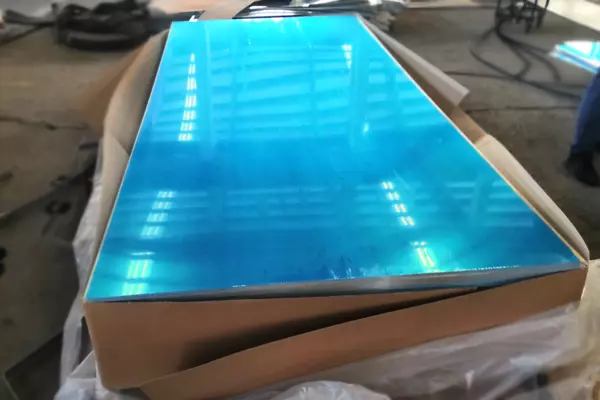
5052 aluminum alloy sheet with blue film
Common methods of anticorrosion for aluminum alloys include surface electrochemical treatment and chemical treatment. Among them, electrochemical surface treatment of aluminum alloy has the disadvantage of complex equipment and high cost, whereas chemical passivation treatment has become popular in recent years due to its low cost and efficiency. application.
For 5052 aluminum alloy, an automotive exterior engineering material, it is still critical to find a simple, low-cost, and environmentally friendly corrosion passivation process.
Hexavalent chromium passivation is the most efficient and commonly used chemical passivation. However, hexavalent chromium is hazardous and carcinogenic, and it is increasingly being prohibited in more nations. Researchers have developed technologies to replace hexavalent chromium, such as rare earth metal salt passivation, molybdate passivation, silicate passivation, and trivalent chromium salt passivation, among which the film-forming mechanism of hexavalent chromium is the same and non-toxic. Trivalent chromium salt passivation performs well and is likely to replace hexavalent salt passivation.
Although previous studies on trivalent chromium passivation have been conducted on aluminum alloys, the key exterior parts of aluminum alloy automobiles have higher corrosion resistance requirements, and trivalent chromium is suitable for adding organic complexing agents to the color passivation scheme. As a result, based on previous research, this work selects the chemical passivation method of chromium sulfate salt with research potential, uses the addition of an activator to improve film quality, optimizes the passivation process parameters, and finally successfully develops an application. Based on the trivalent chromium passivation method of 5052 aluminum alloy, the passivation layer created is continuous and uniform in silver white, uniform in color, high gloss, outstanding in corrosion resistance, non-polluting to the environment, and has a promising future use.
Chromium sulfate passivation
| ρ[Cr2(SO4)3]/ Test grade |
ρ( K2 ZrF6 ) / t/min |
||
| ( g·L-1 ) | ( g·L-1 ) | ||
| 1 | 1.0 | 2.5 | 4 |
| 2 | 3.0 | 2.5 | 4 |
| 3 | 5.0 | 2.5 | 4 |
| 4 5 |
7.0 5.0 |
2.5 1.0 |
4 4 |
| 6 | 5.0 | 4.0 | 4 |
| 7 | 5.0 | 5.5 | 4 |
| 8 | 5.0 | 2.5 | 1 |
| 9 | 5.0 | 2.5 | 2 |
| 10 | 5.0 | 2.5 | 3 |
Performance testing of passivated surfaces
Exterior
Based on the appearance requirements of automobile exterior parts, visually inspect the passivation film formation for appearance color changes, film continuity, and uniformity, and completely evaluate the passivation film's appearance quality.
Neutral Salt Spray Test
The neutral salt spray test (NSS test) method in GB/T10125-2012 is used to evaluate the 240-hour salt spray corrosion resistance of automotive aluminum alloy cosmetic parts, as specified by the manufacturer. The reagent contains 5% NaCl solution (mass fraction), with a pH of 6.5-7.2. The saturated pressure chamber has a pressure of 70-170 kPa, a salt mist settling rate of 1-2 mL/h per 80 cm² area, and a test piece oriented 20° vertically.
The temperature of the test chamber is kept at (35±2)°C, and the spraying is continued for 10 days. At the end of the test, wash the surface of the finished product with water and a soft brush, dry it, take pictures with a digital camera, observe the corrosion of the test piece, and according to GB/T12335-1990 "The metal coating is anodic to the substrate after the coating corrosion test. "Specimen Rating" by calculating the corrosion area to rate the degree of corrosion defects on the surface appearance of the specimen.
Copper Sulfate Drop Test
Copper sulfate drop tests were used to assess the corrosion resistance of aluminum alloy passivation films. Copper sulfate corrosion solution contains 41 g/L copper sulfate, 35 g/L NaCl, and 13 mL/L HCl. In the test, use a dropper to apply a drop of copper sulfate corrosion solution to the surface of the sample at room temperature, then examine the color change of the droplet, which changes from sky blue to black, and record the time of color change. The spot test for each sample takes the average value of the data from five different regions. The length of time might represent both the advantages and disadvantages of the passivation film's corrosion resistance.
Factors Affecting Passivation Effect
Effect of Chromium Sulfate Concentration on Passive Film
In the passivation test, chromium sulfate, a film-forming material, influences surface corrosion resistance by altering the content and structure of the conversion film.
Macroscopic morphology of an aluminum alloy sample.
Good film-forming quality is determined by the compatibility of chromium sulfate and surfactant. Because of the increased chromium sulfate concentration and insufficient amount of surfactant K₂ZrF₆, the surface activity is diminished, so the bonding between film-forming molecules and the matrix is weakened, causing passivation. The film formation is incomplete, and the film quality deteriorates, making the film more durable. Corrosion decreases.
Effect of Potassium Fluozirconate Concentration on Passive Film
K₂ZrF₆ serves as the surface-active component in the passivation solution, and its concentration has a significant impact on film quality. In the passivation test, potassium fluorozirconate's primary function is to reduce the surface tension of aluminum alloy, activate the alloy's surface, promote the full reaction of chromium sulfate and the substrate to form a uniform and dense coating, and increase corrosion resistance.
Effect of passivation time on passivation film
The passivation time primarily influences the thickness of the conversion film, and in an industrial setting, an adequate passivation time can cut costs and conserve resources.
Drip time of aluminum alloy sample plate over time.
Summary of passivation process for 5052 aluminum alloy
1) Based on the 5052 aluminum alloy sample, the best conditions for chemical passivation of chromium sulfate are chromium sulfate 1.0 g/L, potassium fluozirconate 2.5 g/L, and passivation time 3 minutes. the passivation prepared under this condition The film's surface has a high gloss, uniform color, and high corrosion resistance, making it suitable for 240 h salt spray.
(2) In the chromium sulfate passivation test, chromium sulfate, as a film-forming agent, primarily impacts the composition and structure of the conversion film, resulting in a passivated aluminum alloy surface. Its concentration must match that of the activator, potassium fluozirconate. If the chromium concentration is too high, the corrosion resistance of the passivation coating will be compromised. The primary role of potassium fluorozirconate is to reduce the surface tension of aluminum alloy, activate its surface, and enable the complete reaction of chromium sulfate and matrix. The concentration of potassium fluorozirconate is insufficient to serve its purpose.
(3) The passivation time primarily influences the thickness of the passivation film and the degree of passivation reaction. If the duration is too short, the reaction will be insufficient, resulting in poor film-forming quality; if the time is too long, the film will be too thick, affecting appearance quality, such as surface color, and wasting resources.


