Why Shipbuilding Uses 5xxx Aluminium Alloys
A ship works in one of the harshest environments any structure has to face: permanent humidity, chloride-bearing spray, alternating wet and dry cycles, and continuous mechanical loading from waves and cargo. The aluminium-magnesium family answers that combination because it is not heat treated, it welds without losing its corrosion resistance, and it keeps useful strength and toughness at low temperature. Two alloys dominate the market. 5052 covers inland craft, workboats and superstructures, while 5083 covers hulls and structures that operate in open seawater.
5052 Sheet for Freshwater and Inland Craft
5052 contains 2.2-2.8% Mg with 0.15-0.35% Cr and is most often supplied in the H32 temper for hull plating above the waterline, decking, tanks, lockers and cabin structures. H32 is strain hardened and then stabilized, which leaves a good balance between strength and formability: tensile strength is typically in the region of 230 MPa, yield strength about 195 MPa, and elongation above 10%. Hardness sits at approximately 60 HBW, so 5052 is not the right answer where a hard, abrasion-resistant surface is needed. Keel strips, wear pads and high-contact areas call for a different material or a protective treatment. Hardness is never the only criterion anyway; for most hull and superstructure panels, corrosion resistance, weldability and formability matter more. Full annealing to the O temper is carried out at approximately 345 degrees Celsius, and that softer temper is reserved for parts that must be heavily formed before assembly. Freshwater lake yachts are commonly built from 5052 H32 plate or 5052-O sheet, while craft that sail in open sea normally step up to 5083.
5083 H116 and H321 for Seawater Service
5083 carries 4.0-4.9% Mg, 0.40-1.00% Mn and 0.05-0.25% Cr. The high magnesium level gives the alloy its strength and its seawater resistance, while manganese and chromium control grain structure and improve resistance to stress corrosion cracking. Marine plate is normally supplied in the H116 or H321 temper, both produced under the requirements of ASTM B928. The two tempers follow slightly different thermomechanical routes but share one purpose: keeping magnesium in solid solution so the alloy resists intergranular corrosion and exfoliation even after long exposure. Material to ASTM B928 is qualified by a nitric acid mass loss test to ASTM G67, with a maximum mass loss of 15 mg/cm2 as the usual acceptance limit. H112 is a hot-worked, strain-hardened temper without that special control; it is suitable for parts that will be formed again before installation, but it does not offer the same assurance in permanent seawater service.
Mechanical Properties of Marine Aluminium Plate
The table below summarises typical values for plate in the 6-25 mm range. Actual values vary with thickness, and design values must always be taken from the applicable plate specification and classification requirements.
| Alloy and temper | Tensile strength (MPa) | Yield strength, 0.2% offset (MPa) | Elongation (%) | Density (g/cm3) | Typical marine use |
|---|---|---|---|---|---|
| 5052 H32 | 215-240 | 160-200 | 7-12 | 2.68 | Superstructures, tanks, inland hulls |
| 5083 H112 | 275-305 | 125-150 | 12-16 | 2.66 | Formed parts, lightly loaded panels |
| 5083 H116 | 305-340 | 215-250 | 12-16 | 2.66 | Hull plating, decks, bulkheads |
| 5083 H321 | 305-340 | 215-250 | 12-16 | 2.66 | Hull plating, decks, pressure parts |
| 5083 O | 275-300 | 125-145 | 16-20 | 2.66 | Deep-formed sections |
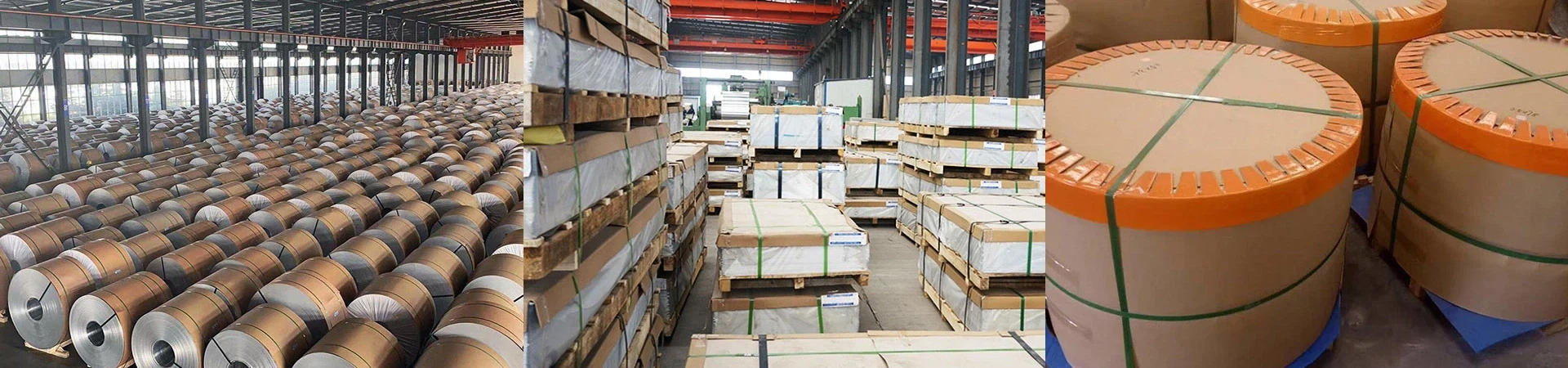
Typical sections built from plate: hulls, decks, bulkheads, superstructures and work platforms.
Extrusions for stiffeners, handrails and frames are usually matched to the plate alloy family.
Weight saving against steel is around 50% for equivalent stiffness-limited panels, which raises payload and lowers fuel burn.
Welding, Forming and Detailing Practice
5083 is welded with matching 5xxx filler metals such as ER5183 or ER5356, and 5052 with ER5356 or a similar 5xxx filler. The heat of welding softens the heat-affected zone, so a welded joint typically develops only about 70-80% of the base metal strength there. The practical remedy is to position welds in regions of lower stress rather than at a peak-stress location. Hull plating below the waterline needs proper edge preparation and full penetration. Filler metal and procedure should be qualified by procedure testing under the rules of the relevant classification society. Forming follows the temper: 5083-O bends to a tight radius, H112 to a moderate one, and H116 or H321 need generous bend radii and, in some cases, warm forming. Where the structure will be exposed to heat, such as engine room components or panels close to an exhaust run, the service temperature must be limited. Sustained temperatures above roughly 65 degrees Celsius can precipitate magnesium-rich phases at the grain boundaries and sensitise the alloy to intergranular corrosion. That is why 5xxx plate is kept away from hot zones, and it is also why zinc-rich coatings are avoided on aluminium structures, since contact between dissimilar metals in a wet environment drives galvanic attack.
Frequently Asked Questions
Q: Which alloy should be used for a boat that stays on a lake?
5052 in the H32 temper is the usual choice for hulls, decks and superstructures of freshwater craft, because the water chemistry is mild and the alloy is easy to form and weld. 5052-O is used where panels must be heavily shaped before assembly.
Q: What is the difference between 5083 H116 and H321?
Both are marine tempers produced to ASTM B928 and both resist intergranular corrosion and exfoliation. They differ in the exact thermomechanical processing route and in the thickness ranges for which each is supplied. Both are qualified by the ASTM G67 nitric acid mass loss test with a limit of 15 mg/cm2.
Q: Is 5052 suitable for permanent seawater immersion?
It is generally used above the waterline and in freshwater service. For hulls and structures that remain in seawater, 5083 in H116 or H321 offers higher strength and better long-term resistance to chloride attack, so it is the safer specification.
Q: Can 5052 and 5083 be welded to each other?
Yes. A 5xxx filler such as ER5183 or ER5356 suits both alloys, and because neither is heat treated there is no hardening or softening reaction beyond the normal heat-affected zone. Procedure qualification is still recommended for structural joints.
Q: Does 5083 need heat treatment after welding?
No. The 5xxx alloys are not strengthened by heat treatment, so there is no post-weld heat treatment that would restore strength. Strength in the heat-affected zone is managed by design, by joint location and by welding procedure instead.
Q: How does 5086 compare with 5083?
5086 is a related aluminium-magnesium alloy with slightly lower magnesium content and somewhat lower strength, but good weldability and corrosion resistance. It suits hulls and structures where moderate strength is sufficient, while 5083 remains the preferred grade for highly loaded seawater structures.