

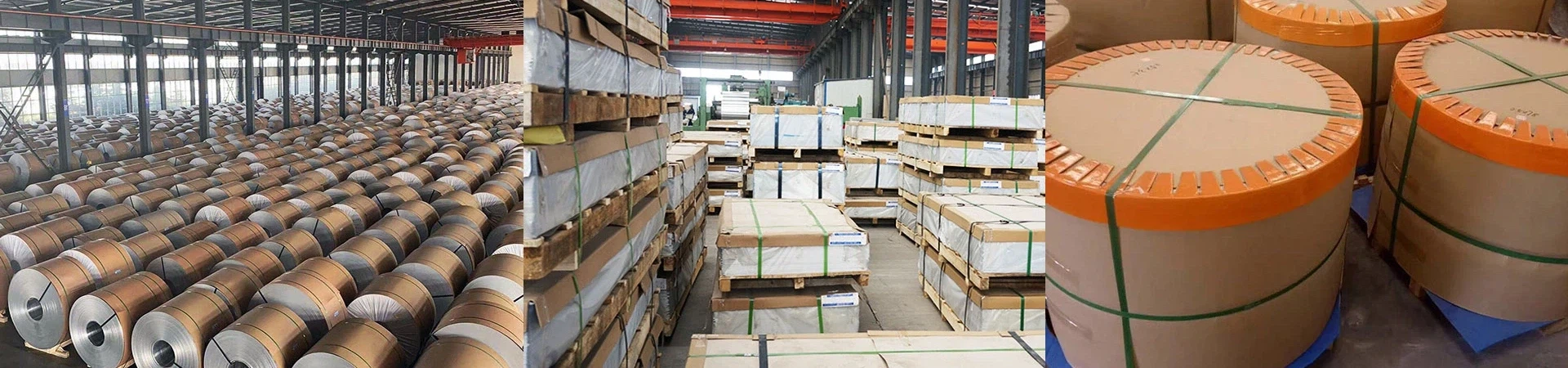
Alloy Design of 8021 Aluminum Foil
8021 is a wrought aluminium foil alloy built on a commercially pure base metal with a deliberately high iron addition. Iron in the 1.2-1.7 % range refines the as-cast grain structure and lifts the strength of very thin gauges, while the low silicon, copper and magnesium levels keep the foil chemically stable in direct contact with food. The alloy is registered as EN AW-8021 in EN 573-3 and belongs to the AlFe1.5 family, and foil made from it is ordered against the general requirements of GB/T 3198 for aluminium and aluminium alloy foil or EN 546 for European projects.
Base metal: 99 % aluminium minimum in the finished foil
Iron: 1.2-1.7 %, for grain refinement and thin-gauge strength
Silicon, copper, manganese, magnesium and zinc: trace levels only
Standard tempers offered: O, H22, H24 and H18
Common packaging gauges: 0.006-0.06 mm, slit to the ordered width
Why the Barrier Performance Matters
Food spoilage is driven by oxygen, moisture, light and odour transfer, and aluminium foil is the most efficient low-cost barrier available to converters. Gauges of 9 micrometres and above remain effectively pinhole-free in normal handling, so water vapour and oxygen transmission falls to practically zero under standard gravimetric and coulometric test conditions. A laminate built around an 8021 layer therefore keeps snacks crisp, stops dairy powders from caking, and shields pharmaceutical products from light-induced degradation.
Opaque to visible and ultraviolet light
Grease and oil resistant without an additional coating
No moisture uptake, so aroma and flavour stay inside the pack
Heat resistant at the temperatures used in retort and lidding processes
Fully recyclable and non-toxic in food contact
Typical Mechanical and Physical Properties
| Property | O temper | H24 temper |
|---|---|---|
| Tensile strength, typical | 70-115 MPa | 130-180 MPa |
| Elongation, typical | 20 % and above | 3-8 % |
| Density | 2.70-2.72 g/cm3 | 2.70-2.72 g/cm3 |
| Surface finish | Bright, wet or dry | Bright, wet or dry |
| Typical gauge range | 0.006-0.06 mm | 0.006-0.06 mm |
Mechanical values are checked on samples taken from the finished coil in line with EN 546-2 or the equivalent clauses of GB/T 3198. Thickness, width and camber tolerances follow EN 546-3, and every coil is supplied with a mill certificate that allows chemistry, temper and gauge to be traced back to the cast.
Production Route From Cast to Slit Coil
Foil is never cast to final gauge; it is reduced from much thicker stock through a long rolling chain.
Melting and continuous casting or DC casting into rolling slabs
Hot rolling to transfer stock, then cold rolling on tandem and single-stand mills
Intermediate and final annealing to reach the ordered temper
Finish rolling to gauge, normally in doubled layers, followed by separation
Slitting to ordered width with edge trimming and surface inspection
Winding, wrapping and palletising with moisture protection for transport
Where 8021 Foil Is Used
Flexible food packaging is the main outlet: chocolate and confectionery wraps, snack and biscuit laminates, dairy lidding, sachets for powders and dry soup mixes, and liners for takeaway containers. Outside food it appears as pharmaceutical blister backing and strip packs, cable wrap and insulation facings, and electromagnetic shielding layers in electronic assemblies, where the high surface conductivity of the foil provides the required attenuation.
Comparing 8021 With Neighbouring Foil Alloys
| Alloy | Main characteristic | Typical outlet |
|---|---|---|
| 8021 | High iron content, strong thin-gauge foil | Food and pharmaceutical packaging |
| 8079 | Similar purity, slightly different iron balance | Soft packaging laminates |
| 1235 | Very high purity, lowest strength | Cable wrap and capacitor foil |
| 8011 | Broader chemistry window | Lidding and closures |
The practical selection rule is simple: choose the softest alloy that still survives the converting line without pinholes. Where the laminate must be drawn or embossed, a higher iron grade such as 8021 is the safer choice than a high purity foil.
Frequently Asked Questions
Q: What makes 8021 aluminum foil suitable for food packaging?
Its 99 % pure base metal, continuous barrier layer and heat resistance block oxygen, moisture, light and odours, while the low alloying content keeps it non-toxic and safely recyclable in food contact.
Q: How does 8021 differ from 1235 or 8011 foil?
8021 carries more iron than 1235, so thin gauges retain higher strength, and it holds a tighter chemistry window and more consistent thin-gauge performance than most 8011 products.
Q: Which temper should be ordered for flexible packaging?
Soft O temper is used where the foil must conform to irregular shapes, while H22, H24 or H18 is chosen when higher stiffness and dead-fold behaviour are required on high-speed lines.
Q: How is 8021 foil produced?
The metal is melted and cast, hot rolled to transfer stock, cold rolled to gauge, annealed to the ordered temper, then slit, inspected and packed, with a mill certificate issued for each coil.
Q: Can 8021 foil be used outside food packaging?
Yes. Its conductivity, light opacity and heat resistance suit cable wrap, insulation facings, pharmaceutical blisters and electromagnetic shielding layers in electronic assemblies.
Q: What determines the barrier value of the finished laminate?
Barrier performance depends mainly on the foil gauge and on pinhole density after converting, which is why foil of 9 micrometres and above is specified for the most demanding shelf life targets.


