In the commercial shipbuilding and marine engineering industry, reducing vessel weight without sacrificing structural strength is the ultimate goal. Replacing traditional steel ship hulls with marine grade aluminum 5083 can effectively reduce a vessel's weight by 8 to 100 tons, depending on the ship's size. This massive weight reduction directly translates to lower fuel consumption, higher top speeds, and improved maneuverability.
Unlike steel, the 5083 aluminum alloy possesses outstanding natural rust resistance and easily adapts to harsh, highly corrosive marine climates.
As a direct manufacturer and supplier, GNEE provides premium, class-certified 5083 aluminum plates for hulls, decks, engine pedestals, and marine superstructures. In this guide, we detail the chemical composition, mechanical limits, and temper selections required for safe marine construction.
Get Your Accurate Marine Material Quote Today
1. Chemical Composition of 5083 Aluminum Plate
There is a common misconception online that 5083 contains Silicon as a primary element. This is false. 5083 is a pure Al-Mg (Aluminum-Magnesium) alloy belonging to the 5xxx series. Silicon is kept strictly as a trace element to prevent brittleness. The high magnesium content is what gives this metal its immense strength and absolute immunity to seawater.
| Element | Content (Wt%) | Function |
|---|---|---|
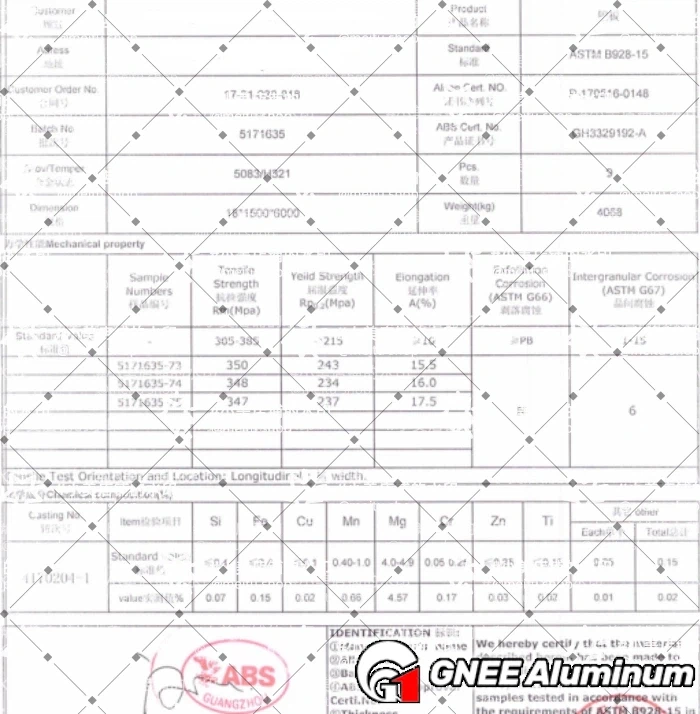
| Magnesium (Mg) | 4.00 – 4.90% | Provides primary strength and excellent seawater corrosion resistance |
| Manganese (Mn) | 0.40 – 1.00% | Enhances toughness and structural stability |
| Chromium (Cr) | 0.05 – 0.25% | Stabilizes grain structure and improves corrosion resistance |
| Silicon (Si) | ≤ 0.40% | Controlled impurity to maintain alloy performance |
| Iron (Fe) | ≤ 0.40% | Controlled impurity to ensure mechanical properties |
| Copper (Cu) | ≤ 0.10% | Low content helps preserve corrosion resistance |
| Zinc (Zn) | ≤ 0.25% | Prevents reduction in durability |
| Titanium (Ti) | ≤ 0.15% | Refines grain structure and enhances mechanical properties |
GNEE Technical Edge: During our casting process, we add trace amounts of Beryllium (Be) to the 5083 aluminum ingot. This highly advanced metallurgical step reduces the cracking tendency of the ingot and significantly improves the final surface quality of the rolled plate, ensuring zero surface defects.
2. Choosing the Right 5083 aluminum Temper
While the chemical block is the same, the mechanical properties change drastically based on how the mill rolls and processes the metal. Shipbuilders must specify the correct temper for different parts of the vessel.
- 5083-H116 Aluminum Sheet: This temper is heavily strain-hardened and strictly temperature-controlled at the mill to lock its grain structure against marine exfoliation corrosion. It is the mandatory choice for the underwater parts of the hull, keels, and outer bottom plates where constant seawater impact occurs.
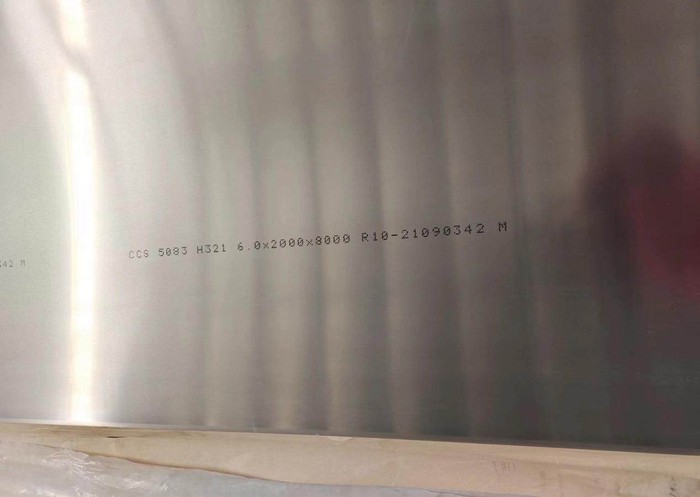
- 5083-H321 Marine Aluminum Plate: Strain-hardened and then thermally stabilized, H321 offers identical tensile strength and seawater corrosion resistance as H116. Both H116 and H321 pass the strict ASTM G66 (ASSET) test, meaning they will not peel or flake in saltwater. They are interchangeable for heavy marine hull construction.
- 5083-O / H111 / H112 Tempers: These tempers are softer and more ductile. While they have excellent general corrosion resistance, they do not undergo the strict exfoliation testing of H116/H321. They are used for internal marine components, ship decks, cabinets, and non-structural bending parts where deep drawing or heavy forming is required.
3. Verified Mechanical Properties for Ship Design
To pass classification society inspections, your material must meet strict mechanical baselines.
Typical Limits (According to ASTM B928 and Marine Codes):
- 5083 H116 & H321: Minimum Tensile Strength ≥ 305 MPa; Minimum Yield Strength ≥ 215 MPa; Elongation ≥ 10%. (Both guarantee passing results for Exfoliation and Intergranular corrosion tests).
- 5083 O / H111: Minimum Tensile Strength ≥ 275 MPa; Minimum Yield Strength ≥ 125 MPa; Elongation ≥ 16%.
4. Core Applications of 5083 Aluminum Plate
Due to its high strength-to-weight ratio and weldability, 5083 is deployed in areas requiring absolute reliability:
- Ship Hulls & Keels: The longitudinal members connecting the bow to the stern rely on thick 5083 plates to absorb ocean wave impact.
- Decks and Superstructures: Using aluminum for the upper structures of heavy steel cruise ships lowers the center of gravity, drastically improving vessel stability.
- Commercial Transport: Outside of the ocean, 5083 is heavily used to manufacture LNG pressure vessels, railway tank cars, and automobile fuel tankers due to its formability and crack resistance. (Note: 5083 is too heavy for aerospace applications, which require 7xxx series alloys).
Why Choose GNEE as Your 5083 Aluminum Plate Supplier?
Sourcing marine metal from unverified suppliers risks your shipyard's reputation. GNEE is a direct manufacturer providing heavy-duty structural aluminum with uncompromising quality control.
- Classification Society Certified: Our 5083 marine aluminum plates are fully certified by major global societies, including DNV, ABS, CCS, BV, GL, KR, and LR.
- Flawless Surface Quality: We guarantee our plates are delivered with no oil spots, no scratches, no rolling marks, no burrs, and perfectly neat trimming.
- Shipyard-Ready Dimensions: We supply standard wide marine plates (e.g., 2000mm width x 6000mm / 8000mm / 12000mm lengths) to minimize your welding seams. Thicknesses range from 3mm up to 200mm.
- Strong Supply Capacity: Whether you need 8 tons for a luxury yacht or 5000 tons for a commercial fleet, we offer incredibly competitive 5083 aluminum plate prices with fast delivery times of 7 to 35 days.
Stop guessing your material costs. Are you looking for a reliable supply chain to keep your shipyard running on schedule?
Contact GNEE today. Send us your required thickness, temper, dimensions, and total tonnage. Our technical sales engineers will provide an exact quote within 24 hours.