

What Are 3003 H14 and 3105 H14 Aluminum?
Both 3003 and 3105 belong to the 3000 series Aluminum-Manganese (Al-Mn) alloy family. Because they use manganese as their primary alloying element, they offer about 20% higher strength than standard 1000 series pure aluminum, while keeping excellent natural rust resistance.
What does "H14" mean?
When you look at the material specifications, "H14" represents the metal's temper.
H means the metal is strain-hardened. The aluminum is strengthened by cold rolling through heavy machines at room temperature, without any heat treatment.
14 means the material is in a half-hard state.
This half-hard temper provides a perfect balance for manufacturing. It makes the aluminum coil rigid enough to hold its shape well but still flexible enough to be bent, stamped, or roll-formed without cracking at the edges.
3003-H14 and 3105-H14 Aluminum Alloy Composition
| Element | 3003-H14 Aluminum | 3105-H14 Aluminum |
| Aluminum (Al), % | 96.8 to 99 | 96 to 99.5 |
| Chromium (Cr), % | 0 | 0 to 0.2 |
| Copper (Cu), % | 0.050 to 0.2 | 0 to 0.3 |
| Iron (Fe), % | 0 to 0.7 | 0 to 0.7 |
| Magnesium (Mg), % | 0 | 0.2 to 0.8 |
| Manganese (Mn), % | 1.0 to 1.5 | 0.3 to 0.8 |
| Silicon (Si), % | 0 to 0.6 | 0 to 0.6 |
| Titanium (Ti), % | 0 | 0 to 0.1 |
| Zinc (Zn), % | 0 to 0.1 | 0 to 0.4 |
| Residuals, % | 0 | 0 to 0.15 |
3003-H14 Aluminum vs. 3105-H14 Aluminum Mechanical Properties
| Property | 3003-H14 Aluminum | 3105-H14 Aluminum |
| Brinell Hardness | 42 | 48 |
| Elastic (Young's, Tensile) Modulus (x 10⁶ psi) | 10 | 10 |
| Elongation at Break (%) | 8.3 | 2.7 |
| Fatigue Strength (x 10^3 psi) | 8.7 | 9.9 |
| Poisson's Ratio | 0.33 | 0.33 |
| Shear Modulus (x 10^6 psi) | 3.8 | 3.8 |
| Shear Strength (x 10^3 psi) | 14 | 15 |
| Tensile Strength: Ultimate (UTS, x 10^3 psi) | 23 | 25 |
| Tensile Strength: Yield (Proof) (x 10³ psi) | 20 | 21 |
3003-H14 Aluminum vs. 3105-H14 Aluminum Thermal Properties
| Property | 3003-H14 Aluminum | 3105-H14 Aluminum |
| Latent Heat of Fusion (J/g) | 400 | 400 |
| Maximum Temperature: Mechanical (°F) | 360 | 360 |
| Melting Completion (Liquidus, °F) | 1210 | 1210 |
| Melting Onset (Solidus, °F) | 1190 | 1180 |
| Specific Heat Capacity (BTU/lb-°F) | 0.21 | 0.21 |
| Thermal Conductivity (BTU/h-ft-°F) | 100 | 98 |
| Thermal Expansion (µm/m-K) | 23 | 24 |
3003-H14 Aluminum vs. 3105-H14 Aluminum Electrical Properties
| Property | 3003-H14 Aluminum | 3105-H14 Aluminum |
| Electrical Conductivity: Equal Volume (% IACS) | 44 | 44 |
| Electrical Conductivity: Equal Weight (% IACS) | 140 | 140 |
Otherwise Unclassified Properties
| Property | 3003-H14 Aluminum | 3105-H14 Aluminum |
| Base Metal Price (% relative) | 9.5 | 9.5 |
| Calomel Potential (mV) | -740 | -750 |
| Density (lb/ft³) | 170 | 170 |
| Embodied Carbon (kg CO₂/kg material) | 8.1 | 8.2 |
| Embodied Energy (x 10³ BTU/lb) | 66 | 66 |
| Embodied Water (gal/lb) | 140 | 140 |
Common Calculations
| Property | 3003-H14 Aluminum | 3105-H14 Aluminum |
| Resilience: Ultimate (Unit Rupture Work, MJ/m³) | 12 | 4.5 |
| Resilience: Unit (Modulus of Resilience, kJ/m³) | 130 | 160 |
| Stiffness to Weight: Axial (points) | 14 | 14 |
| Stiffness to Weight: Bending (points) | 50 | 50 |
| Strength to Weight: Axial (points) | 16 | 17 |
| Strength to Weight: Bending (points) | 23 | 25 |
| Thermal Diffusivity (mm²/s) | 71 | 68 |
| Thermal Shock Resistance (points) | 6.9 | 7.5 |
3003-H14 And 3105-H14 Aluminum Alloy Applications
| Final Application | Recommended Alloy & Temper | Recommended Specifications | Why Make This Choice? |
| Corrugated Roofing Sheets | 3105-H14 | 0.4mm – 0.8mm (PVDF Coating) | Provides higher structural strength for wind loads; highly weather-resistant outdoors. |
| Cookware & Deep Drawing | 3003-H14 | Custom thickness based on molds | Excellent elongation allows the metal to stretch deep into molds without tearing. |
| Exterior Wall Cladding | 3105-H14 | 0.5mm – 1.0mm (PVDF Coating) | Better outdoor durability and stronger resistance to salt spray in harsh environments. |
| Indoor Panels & Appliance Shells | 3003-H14 | 0.3mm – 0.6mm (PE Coating) |
Cost-effective and easy to form; indoor environments do not require extreme rust protection. |


Why 3105 is More Popular for Roofing
- Better Mechanical Strength: 3105 has higher tensile and fatigue strength than 3003. When you process it through a roll-forming machine, it holds the corrugated wave shape perfectly. Once installed on a building, it will not dent easily under heavy rain, small hail, or when workers step on the roof during maintenance.
- Stronger Coating Adhesion: Roofing sheets are almost always color-coated. 3105 acts as a fantastic substrate for color-coated aluminum. PE (Polyester) and PVDF paints bond tightly to its surface. This strong adhesion prevents the paint from peeling, cracking, or blistering when exposed to strong UV sunlight over many years.
- Superior Corrosion Resistance: The chemical secret behind 3105 is the addition of small amounts of Magnesium (Mg) and Chromium (Cr). These elements act as a powerful shield against pitting corrosion. If your roofing project is located in a coastal region with salty sea air or in an industrial zone with acid rain, 3105 will survive significantly longer than 3003 or standard galvanized steel.
Quality Control & Manufacturing
Whether you order bare 3003 aluminum or color-coated 3105 coils, our continuous coating lines and testing labs ensure you receive exact specifications.
Here is the standard inspection process your order goes through before leaving our factory:
| Inspection Process | Testing Details | Why It Matters for the Buyer |
| Thickness Tolerance | Controlled within ±0.02mm. | Ensures the metal feeds smoothly into your processing equipment without jamming or damaging your molds. |
| Coating Adhesion Test | T-bend test and MEK wiping test on the coating line. | Guarantees the PE or PVDF paint will not crack, peel, or fade when you bend the metal into corrugated sheets. |
| Mechanical Testing | Verifies tensile strength, yield strength, and elongation. | Confirms the "H14" temper is accurate, ensuring the metal is not too soft or too brittle. |
| Surface Inspection | Visual and machine checks for oil stains, scratches, or bare spots. | Ensures your final products look perfect and are ready for immediate sale or installation. |

Packaging & Export Experience
| Packaging & Logistics | Export Standard Details |
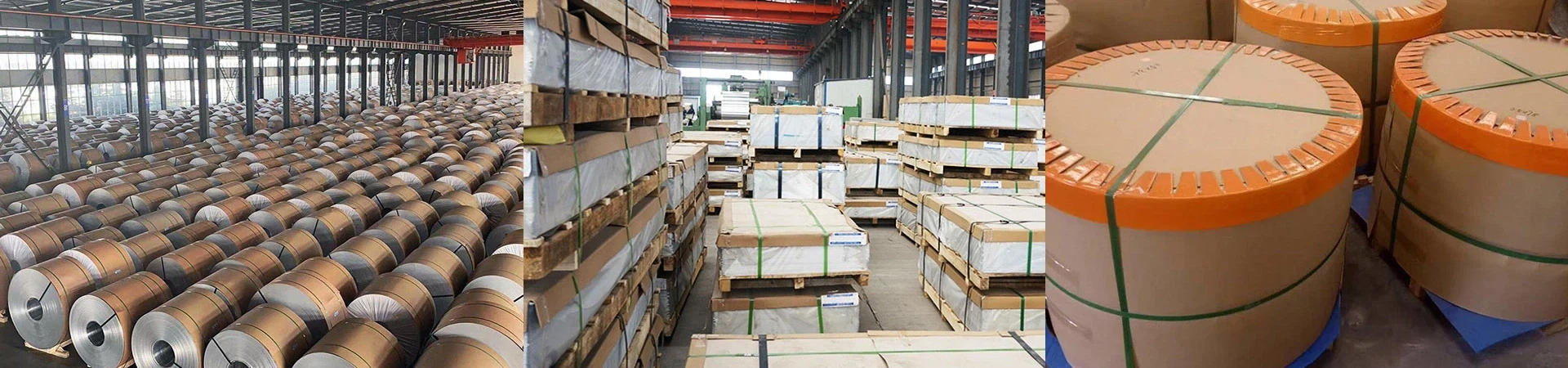
| Moisture Protection | Every coil is tightly wrapped in waterproof kraft paper and heavy-duty PVC plastic film to block ocean humidity. |
| Physical Protection | We apply hard cardboard or steel edge protectors, secured with heavy-duty steel strapping to keep the coil shape intact. |
| Pallet Loading | Coils are placed on strong, fumigated, seaworthy wooden pallets (Eye-to-Sky or Eye-to-Wall based on your factory's forklift). |
| Container Loading | A standard 20 ft. container safely holds 20 to 25 tons. Coils are blocked and braced with wood to prevent shifting at sea. |


