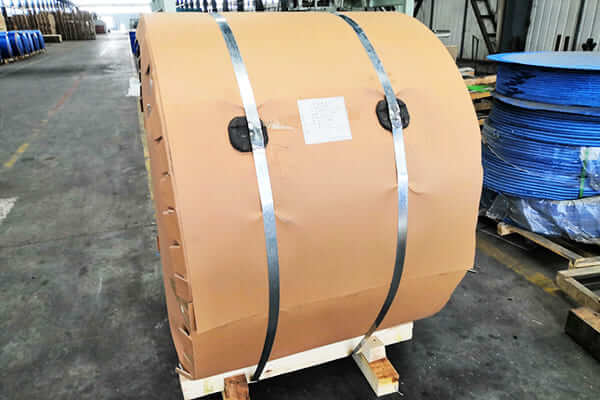
5052 aluminum alloy coil introduction
The 5052 alloy offers good corrosion resistance, low strength, high plasticity, great formability, and outstanding welding performance.
Mg is the major element in the 5052 alloy, which provides a solid solution strengthening effect that enhances the work hardening rate of aluminum while also providing apparent strain strengthening. Partial dissolution of Mn into the matrix can raise the recrystallization temperature, improve corrosion resistance, and eliminate welding fractures. Cr and Mn produce the same effect. Ti can help improve the cast structure. The primary impurities are Fe and Si, which should be regulated.
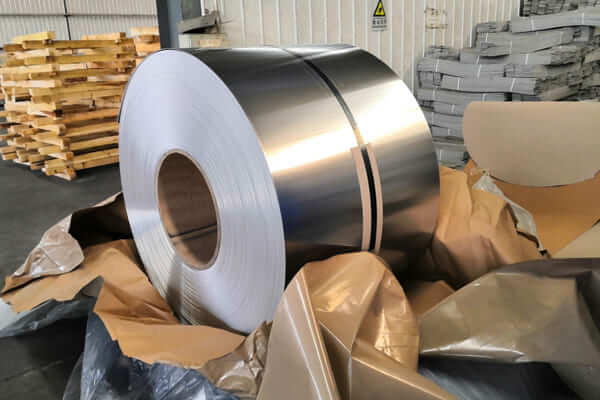
5052 aluminum alloy coil manufacturing method
5052 alloy alloys are commonly utilized in petrochemical equipment, ships, and transportation equipment. The annealing process of coils in O and H24 states produced by big ingots of 5052 aluminum alloy is investigated, and a suitable annealing process system for 5052 aluminum alloy coils is developed to produce qualified goods that fulfill the standards.
| Temper | Thickness/mm | R m/ (N*mm- 2) | R p0. 2/( N*mm- 2) | A/% |
| O | 0.5~1.3 | 170~215 | ≥65 | ≥17 |
| 1.3~4.0 | 170~215 | ≥65 | ≥19 | |
| H24 | 0.5~1.3 | 235~258 | ≥180 | ≥6 |
| 1.3~4.0 | 235~258 | ≥180 | ≥4 |

Annealing test of 5052 aluminum alloy plate and its result and analysis
The manufacturing procedure for the 5052 aluminum alloy coil test material is as follows: The ingot size is 300mmx1240mmx3800mm, after equalizing fire in the melting and casting workshop, double-sided milling, and pressing the heating furnace to heat the metal to 480°C~520°C for hot rolling, hot-rolled plate. Thickness 8.0mm hot coiling, 1°C cold rolling mill rolling completed plate thickness 2.0mm, the coil is annealed in a 40t annealing furnace, straightened by a cross-shearing machine, and cut to the finished product's width and length.
Among them, the laboratory-annealed samples are cut from cold-rolled coils to the thickness of the finished plate, and the annealing test is performed in the laboratory to identify the appropriate annealing temperature range and annealing holding time for the plate. The annealing test results of samples cut from 5052 aluminum alloy coils in the laboratory show that under the same annealing and holding time, the performance of the plate changes steadily in the annealing temperature range of 100°C~250°C. As the temperature ranges from 250°C to 320°C, the tensile strength and yield strength decrease rapidly, while the elongation increases sharply. This demonstrates that when the annealing temperature spans from 100°C to 250°C, the plate is at the recovery stage, with the internal structure simply undergoing polygonalization and subgrain merging, resulting in smooth performance changes. When the annealing temperature varies from 250°C to 320°C, the plate's interior structure transitions from partial to complete recrystallization. When the annealing temperature exceeds 320°C, the values of tensile strength, yield strength, and elongation remain relatively constant. The 5052 aluminum alloy coil in the H24 state has an annealing metal temperature of 240°C to 250°C and a holding time of 1.0h, according to the annealing data of the 5052 test material. The coil in the O state has an annealing metal temperature of 340°C to 350°C and a holding time of 1.0h.
Temper process of 5052 aluminum alloy
(1) Annealing process parameters for 5052 aluminum alloy coils: H24 state, annealing temperature 240°C to 250°C, heat preservation 1.0h; O state, annealing temperature 340°C to 350°C, heat preservation 1.0h.
(2) The 5052 aluminum alloy coil made using the aforementioned technique has stable mechanical qualities that meet and above the technical standard of GB/T3880-1997's stated value for 5052 aluminum alloy sheets.