

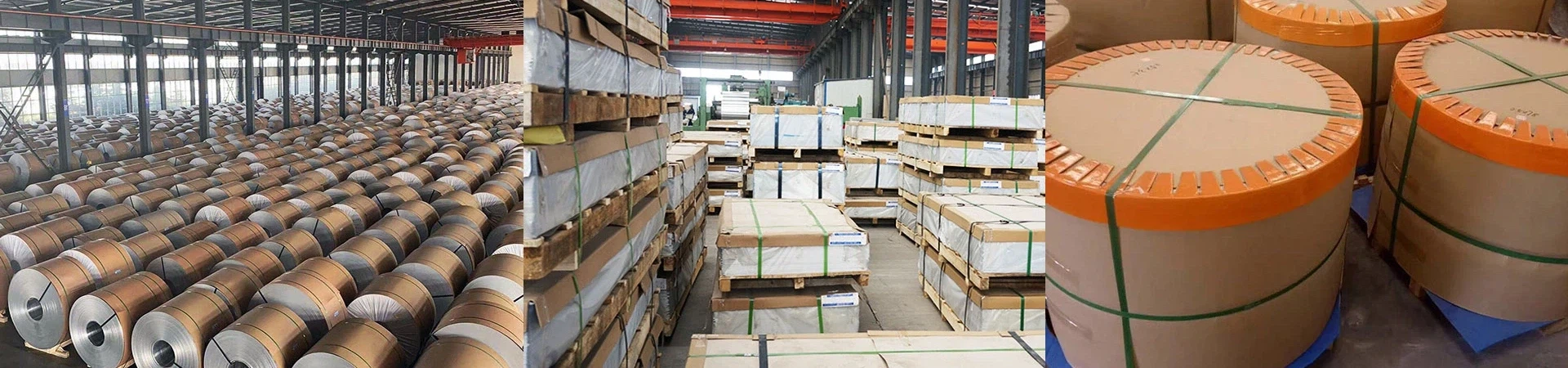
The production process of 5052 aluminum alloy is melting and casting → ingot sawing and milling → billet heating → hot rolling → cold rolling → finished product annealing → cross cutting → packaging.
To prepare the ingot, it is degassed online using a double rotor, refined with Al5TiB in the chute, filtered via a ceramic filter plate, and cast into a flat ingot measuring 630 mm × 1400 mm × 8000 mm.
Ingot Sawing and Heating
A sawing machine is used to cut the ingot, which is then transferred to a milling machine for peeling, which removes the surface segregation layer and oxide scale, before being heated in the furnace. Heating system: 480°C for 3 hours; following heat preservation, it is removed from the furnace and rolled.
Hot Rolled
To form an intermediate billet, the high-temperature ingot goes through 19 passes of hot rough rolling. After being chopped, the material head enters the four-stand hot finish rolling mill. Following continuous rolling and thinning, high-temperature coiling starts to regulate the hot-rolled coil. The coil is 6.7mm thick, with a final rolling temperature of 325°C±5°C, and cools spontaneously following removal from the machine.
Cold-Rolling Hardening
The cooled hot-rolled coils are rolled out of the finished goods one at a time on the cold rolling machine, with a total processing rate of 25%. Furthermore, the cold rolling mill must adjust the angle and air pressure of the edge purge to prevent oil and splash from reaching the coil's surface, lowering the likelihood of oil spot faults.
Completed Annealing
For direct annealing without cleaning, it is first important to guarantee that there are no oil spots on the coil's surface, as well as that the leftover oil can be totally volatilized, with a very limited process window. If the temperature is too low, there will be no oil spots, but there will be residual oil; if the temperature is too high, there will be oil spots but no residual oil.
The particular annealing process system utilized:
In the first stage, the furnace gas is set to 180°C, the heating rate is set to 35°C per hour, and the negative pressure and purging are turned on to play the role of pre-drying in the air environment.
In the second stage, when the furnace gas hits 180°C, begin filling it with N₂ gas to keep the oxygen level below 0.1%, and then keep it warm for 6 hours to act as a pre-drying environment. Will result in oil stains due to oxidation;
In the third step, the furnace gas is heated to 235°C at a rate of 30°C per hour. When the coil reaches 230°C, it is held for 3 hours to finish the quenching and tempering process, resulting in the desired mechanical qualities. At this point, the residual oil has also volatilized, but it has not crossed the harmful temperature range of oil spots (245°C to 400°C).
In the fourth stage, the furnace gas is set to 0°C, and the side cooling fan is turned on to swiftly cool down. When the metal temperature falls below 150°C, it leaves the furnace and is exposed to air.
| Si | Fe | Cu | Mn | Mg | Cr | Ti | Al |
| 0.1 | 0.2~0.3 | 0.05 | 0.08 | 2.5~2.7 | 0.18~0.24 | 0.01~0.03 | Remainder |
Chemical Composition Analysis
1) The alloy contains Si as an impurity element. During casting and solidification, it can create complicated ternary compounds with Fe and aluminum. The first phase is big in size and is dispersed throughout the dendritic boundary. It is an insoluble phase formed during the melting process that reduces the alloy's fluidity. Strict control of w(Si)≤0.10% in the test reduces the overall amount of AlFeSi complex ternary compounds, enhancing the alloy's plasticity.
2) Fe in the alloy is not made up entirely of impurity elements, and its mass fraction is kept between 0.2% and 0.3%, allowing it to avoid negative consequences while also playing a positive function. A portion of the Fe element in the alloy resides in supersaturated form. During the homogenization process at high temperatures, the AlFeSi dispersion phase can precipitate inside the grain, and its size is very small, refining the recrystallized grain and contributing to its strength and plasticity.
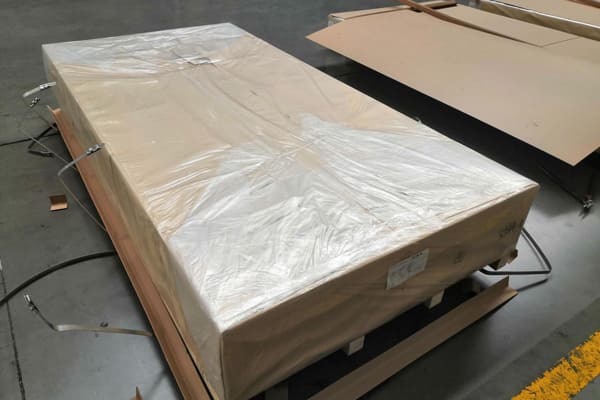
Packaged 5052-H32 aluminum sheet
3) The alloy has a regulated w(Fe)/w(Si)>2.0 ratio, with the α phase (AlFeSi) and a minor quantity of β phase (AlFeSi) forming during solidification. The α phase has a bone-like shape. It can be completely shattered during the rolling process and is not harmful to the plasticity. The β phase (AlFeSi) is a needle-like, stiff, and brittle phase that is difficult to break during hot rolling and detrimental to plasticity.
4) Cu is an impurity in the alloy that affects its corrosion resistance. The w(Cu) is limited to no more than 0.05%.
5) Mn in the alloy is an impurity element. Cr, not Mn, is utilized to refine the recrystallized grains in 5052 aluminum alloy; hence, w(Mn) should be kept at 0.08% or below.
6) Mg is an alloying element, and it is dissolved in the aluminum matrix, which can slow dislocation movement and contribute to work hardening. Controlling w(Mg) at 2.5% to 2.7% can result in faster work hardening and sufficient tensile strength without requiring a high cold working rate.
7) The alloy contains Cr, which is an alloying element. When the ingot solidifies, it becomes supersaturated, and it precipitates during the subsequent heating process to form a scattered phase of CrAl7. The particles have excellent thermal stability and can improve recrystallized grains. It can increase the strength and fluidity of the alloy. Control w(Cr) from 0.18% to 0.24%. If the chromium content is too high, a detrimental coarse phase forms; if the chromium content is too low, the dispersed phase is insufficient, reducing the positive effect.
8) Ti in the alloy can create TiAl₃ and AlTi₅B₁, refining the ingot's grains and increasing its mechanical qualities.
Finished 5052-H32 analysis
1) The coil generated by the new technique has good surface quality, no oil spots or residual oil, and complies with the norm. Internal structural observation: The crystal grains are fine and homogeneous, with no fibrous structure. This organizational state has low anisotropy and is difficult to shatter when bent. However, traditional hot-rolled low-temperature directly off-line products have fibrous structures with high anisotropy, and the plates are prone to fracture when bent transversely.
2) Table 4 shows the mechanical characteristics and bending test results of the 5.0mm thick 5052-H32 aluminum alloy plate produced using the novel technique. The plates were distributed to end users for trial use. The findings were satisfactory, and the 90°0t bending did not crack. The new craft products met the established objective parameters.

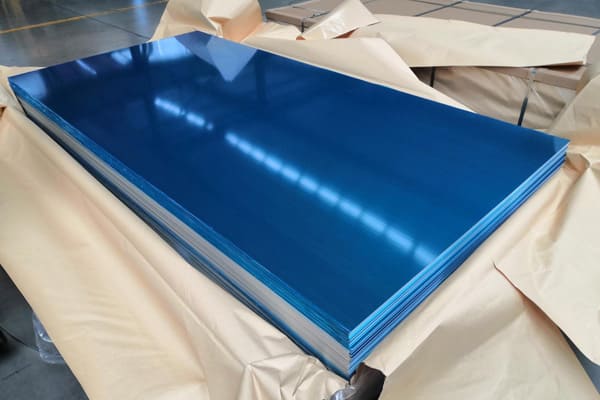
2 mm thickness 5052-H32 aluminum sheet
The core process in the production of 5052-h32
1) The 5052-H32 aluminum alloy national standard medium-thick plate produced by the conventional hot-rolling direct low-temperature off-line technique has a fibrous structure and is prone to cracking during transverse bending.
2) Blanking is done using a newly constructed 1+4 hot continuous rolling machine. The final rolling temperature is accurately regulated at 325°C±5°C, resulting in complete recrystallization, similar to the effect of cold rolling-intermediate annealing.
3) The cold-rolled final plate is directly annealed without cleaning, and the specific finishing annealing process ensures that there are no oil spots or residual oil on the surface, resulting in good bending performance.


