

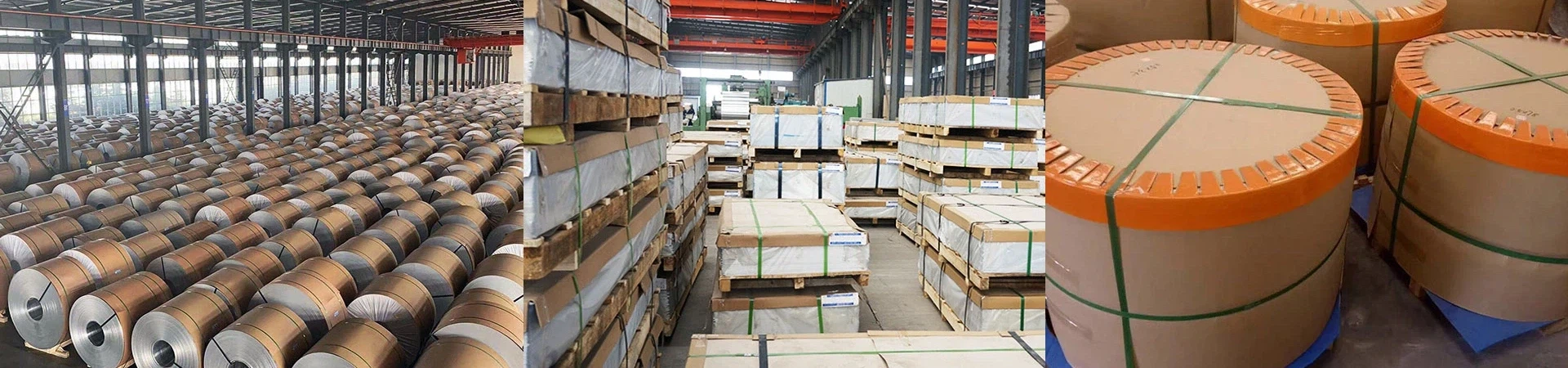
What High-Precision 5083 Plate Means
Standard 5083 plate is bought for strength and corrosion resistance. High-precision 5083 plate is bought for something else as well: dimensional reliability during machining. The plate is homogenised, stress relieved and then precision milled on both faces, so it arrives flat, with a controlled thickness and a surface that does not need a second facing cut before use. For tooling and moulds that saves setup time.
Characteristics of the precision milled product:
Homogenised and stress relieved for dimensional accuracy and internal stability.
Precision milled surface with roughness down to Ra 0.4 um, protected by foil on both faces.
High strength with excellent corrosion and oxidation resistance.
Isotropic, homogeneous structure that behaves consistently in every direction.
Chemical Composition and Temper Range
Precision plate is made from standard 5083 alloy, so the analysis follows the usual 5083 limits rather than the substitute values that appear in some catalogue tables. Content in mass percent:
| Element | Content |
|---|---|
| Silicon (Si) | 0.40% maximum |
| Iron (Fe) | 0.40% maximum |
| Copper (Cu) | 0.10% maximum |
| Manganese (Mn) | 0.40-1.0% |
| Magnesium (Mg) | 4.0-4.9% |
| Chromium (Cr) | 0.05-0.25% |
| Zinc (Zn) | 0.25% maximum |
| Titanium (Ti) | 0.15% maximum |
| Aluminium (Al) | Remainder |
Available tempers include O, H12, H14, H16, H18, H22, H24, H26, H28, H32, H34, H36, H38, H111, H112, H114, H116 and H321. Annealed O plate is chosen where machining stability matters most, H112 is used for general structural work, and the stabilised H116 and H321 tempers are selected when the finished part faces permanent seawater exposure.
Typical Mechanical and Physical Properties
| Temper | Tensile strength, Rm | 0.2% proof strength, Rp0.2 | Elongation |
|---|---|---|---|
| O (annealed) | 275-350 MPa | 125 MPa minimum | 16% minimum at 50 mm |
| H32 | 305-380 MPa | 250 MPa minimum | 12% minimum at 50 mm |
| H116 / H321 | 305-385 MPa | 215 MPa minimum | 12% minimum at 50 mm |
Brinell hardness of the annealed temper is around 70 HBW, rising as the plate is cold worked. Catalogue tables that quote 240-290 MPa tensile strength with a 110-130 MPa proof strength do not describe 5083 in any of these tempers; figures of that order belong to softer aluminium-magnesium alloys. H112 milled plate is supplied as fabricated, so tensile strength and elongation are agreed in the purchase order.
Typical physical properties used for fixture and tooling design:
Density: 2.66 g/cm3
Thermal conductivity: 110-140 W/(m.K)
Electrical conductivity: 16-19 MS/m
Elastic modulus: about 70,000 N/mm2
Coefficient of thermal expansion: 24.2 x 10⁻⁶ /K
Size Range and Tolerance Capability
Milled precision plate is produced from 5 mm to 100 mm thick, with width and length limited by thickness as shown below. Wider and longer sizes are produced to order.
| Thickness | Maximum width | Maximum length |
|---|---|---|
| 5 mm and above | 1520 mm | 3020 mm |
| 10 mm and above | 1570 mm | 3670 mm |
| 15 mm and above | 1860 mm | 4000 mm |
Standard tolerance package for milled plate:
Surface: precision milled, roughness Ra 0.4 um maximum
Thickness tolerance: plus or minus 0.05 mm
Flatness: 0.30 mm maximum for 6-12 mm thickness, 0.12 mm maximum for 12-100 mm thickness
Width tolerance: 0 / +10 mm, length tolerance: 0 / +15 mm
Machining, Finishing and Typical Applications
The alloy machines cleanly, polishes well and takes anodic oxidation with a good but non-decorative finish. Typical uses of milled plate include:
Food machinery components and product contact parts
Automotive and aerospace fixtures and checking gauges
Electronic and medical instrumentation and test devices
Plastic injection moulds, blow moulds and prototype moulds
Machine tool and equipment manufacturing
Thermoforming tools and printing machinery components
Frequently Asked Questions
Q: What makes 5083 plate high precision?
Homogenising, stress relieving and precision milling on both faces, combined with a thickness tolerance of plus or minus 0.05 mm and flatness controlled to 0.12 mm on heavier plate.
Q: Which temper should be used for tooling plate?
Annealed O temper is the usual choice because it is stable during machining. Where higher strength is needed, rough machine first and stress relieve before finishing.
Q: Is the magnesium content of precision 5083 plate the same as standard 5083?
Yes. Milled plate is made from standard 5083, with magnesium in the range of 4.0-4.9% and manganese between 0.40% and 1.0%.
Q: Can milled 5083 plate be anodised?
Yes. Anodic oxidation gives a good, functional and non-decorative finish, and protective foil is normally left on both faces until machining is complete.
Q: How flat is the plate on delivery?
Flatness is held to 0.30 mm maximum for 6-12 mm thickness and 0.12 mm maximum for 12-100 mm thickness, which is why the product is used for large fixtures and mould bases.
Q: What is the maximum thickness available?
Milled plate is supplied up to 100 mm thick, with maximum width and length depending on thickness and other sizes produced on request.


