In the commercial shipbuilding and offshore platform industries, the structural integrity of the hull is non-negotiable. Marine engineers and naval architects globally rely on the 5083 aluminum-magnesium alloy for its exceptional high strength and absolute immunity to seawater corrosion.
However, buying standard industrial aluminum is not enough for ocean-going vessels. To pass strict maritime inspections, shipyards must procure materials backed by international classification societies. As a direct manufacturer and supplier, GNEE provides CCS (China Classification Society)-certified aluminum sheet 5083 H116, ensuring your vessel meets all global maritime regulations.
In this comprehensive guide, we correct common misinformation regarding marine tempers, provide verified mechanical data, and explain why CCS-certified plates are critical for your next shipbuilding project.
Specifications of 5083 H116 Aluminum Sheet
Below is the accurate data according to international maritime standards.
To comply with ASTM B928 and EN 485, the chemistry and mechanical limits of genuine 5083 H116 marine plates must be strictly controlled at the mill.
5083 Aluminum Plate – Chemical Composition (Wt%)
| Element | Content | Function / Role |
|---|---|---|
| Magnesium (Mg) | 4.0 – 4.9% | Primary strengthening element; provides excellent seawater corrosion resistance |
| Manganese (Mn) | 0.40 – 1.0% | Enhances toughness and controls grain structure |
| Chromium (Cr) | 0.05 – 0.25% | Improves resistance to stress corrosion cracking |
| Silicon (Si) | ≤ 0.40% | Impurity element; controlled to prevent brittleness |
| Iron (Fe) | ≤ 0.40% | Impurity element; excess reduces ductility |
| Copper (Cu) | ≤ 0.10% | Kept low to avoid galvanic corrosion |
| Zinc (Zn) | ≤ 0.25% | Minor element; excessive levels may reduce corrosion resistance |
| Aluminum (Al) | Balance | Base metal |
5083 H116 Aluminum Sheet Mechanical Properties (ASTM B928 Minimum Requirements)
| Property | Value | Notes |
|---|---|---|
| Ultimate Tensile Strength (UTS) | ≥ 305 MPa (≈ 44,000 psi) | Indicates maximum load-bearing capacity |
| Yield Strength (0.2% Offset) | ≥ 215 MPa (≈ 31,000 psi) | Stress before permanent deformation |
| Elongation | ≥ 10% | Based on 50 mm gauge length; reflects ductility |
| Density | 2.66 g/cm³ | Much lighter than steel; improves payload efficiency |
5083 H116 vs 5083 H321 Aluminum Plate
Purchasing managers frequently ask about the difference between H116 and H321. Both are premium marine grades, but they achieve their strength through different metallurgical routes.
- The H116 Temper: This temper means the aluminum is strictly strain-hardened (cold-rolled) under highly controlled temperature limits at the mill. It does not undergo a stabilization heat treatment. This specific cold-working process locks the internal grain structure, safeguarding the material against exfoliation corrosion (flaking) in severe marine environments.
- The H321 Temper: To achieve H321, the metal is strain-hardened and then undergoes a low-temperature thermal stabilizing process.
The Verdict: According to international marine codes, both tempers have the exact same minimum yield strength (215 MPa) and both pass the exact same seawater corrosion tests. You can confidently buy marine grade aluminum plate 5083 in either temper based on shipyard availability.
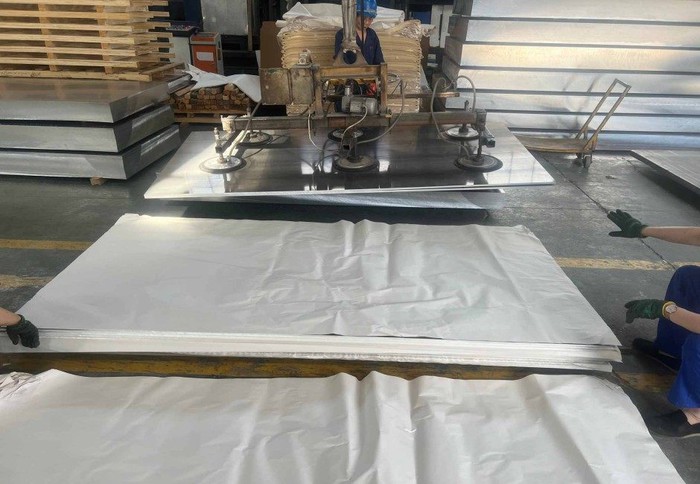
The Importance of CCS Certified 5083 Marine Aluminum Plate
The China Classification Society (CCS) is a full member of the International Association of Classification Societies (IACS). A CCS certificate carries the same global legal weight as DNV, ABS, KR or LR.
Why must you buy CCS-certified plates from GNEE?
- Exfoliation Corrosion Testing: Standard commercial aluminum (ASTM B209) is not tested for saltwater peeling. Our CCS-certified plates pass the mandatory ASTM G66 (ASSET) test, proving absolute resistance to seawater exfoliation.
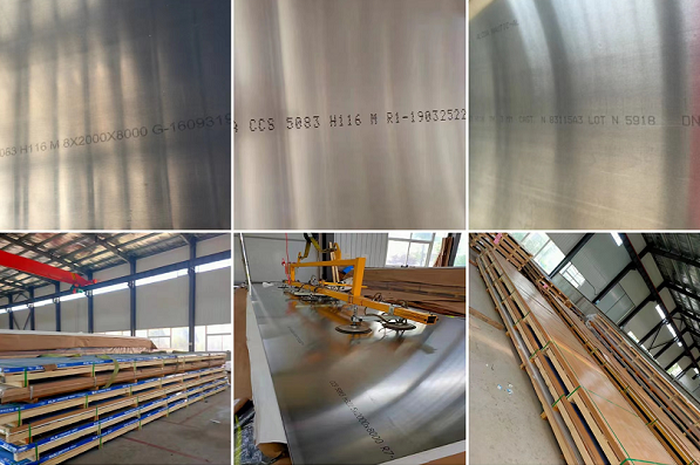
- 100% Traceability: During factory audits, CCS surveyors verify the chemical heat lots. Every plate is hard-stamped with the CCS logo, heat number, and temper.
- Mill Test Certificate (MTC): Every shipment from GNEE is accompanied by an EN 10204 3.2 MTC signed by a CCS inspector. This document allows your shipyard to pass final vessel inspections instantly.
Forming and Welding 5083-O Aluminum Sheet vs H116
Depending on your fabrication needs, you must select the right temper to avoid metal cracking.
- Welding H116: 5083 H116 offers exceptional weldability using Gas Metal Arc Welding (GMAW/MIG) and Gas Tungsten Arc Welding (GTAW/TIG). Always use a high-magnesium filler wire like ER5183 or ER5356. Be aware that the heat-affected zone (HAZ) will revert to the annealed strength, which naval architects factor into the hull design.
- Bending and Forming: Because H116 is strain-hardened, it is relatively stiff. If your shipyard needs to cold-form tight angles, deep-draw the metal, or construct complex pressure vessels, you should purchase the 5083-O aluminum sheet (the fully annealed, soft temper), which provides a much higher elongation rate for heavy bending.
Core Applications Of 5083 Marine Aluminum Plate in the Marine Industry
By utilizing GNEE's certified 5083 aluminum plates, marine operators achieve major reductions in vessel weight, translating to lower fuel consumption and higher speeds.
- Shipbuilding: Main structural hulls, keels, and bulkheads for fast ferries, naval patrol boats, and luxury yachts.
- Superstructures: Constructing the upper decks of heavy steel ships using aluminum lowers the vessel's center of gravity, drastically improving stability.
- Offshore Platforms: Walkways, helipads, and crew quarters on oil and gas rigs where maintenance-free anti-corrosion materials are required.
Partner with GNEE as Your 5083 H116 Aluminum Sheet Supplier
Do not risk your entire shipbuilding project by purchasing unverified materials from general traders. GNEE is a direct manufacturer of heavy marine aluminum. We supply standard marine dimensions (e.g., 2000mm x 6000mm) and custom heavy plates ranging from 2mm up to 150mm thick.
Get Your Precise Shipyard Quote Today
Are you looking for a reliable 5083 h321 marine aluminum price or need urgent CCS-certified plates for your current hull build?
Contact GNEE today. Send us your required thickness, temper, dimensions, and total tonnage. Our marine engineering sales team will provide an accurate quotation within 24 hours.