
When marine engineers, shipbuilders, and pressure vessel fabricators require a material that balances high tensile strength with absolute immunity to seawater, the 5083 H116 aluminum plate sheet is the global standard.
Belonging to the 5xxx series (Al-Mg alloy family), 5083 is a non-heat-treatable alloy. Its mechanical strength and corrosion resistance are achieved strictly through cold working at the mill. While many tempers exist, the H116 temper is specifically engineered to survive severe marine environments without suffering from exfoliation or intergranular corrosion.
As a direct 5083 aluminum plate supplier, GNEE manufactures and exports fully traceable, class-certified aluminum plates to shipyards and industrial fabricators worldwide. This guide provides the exact chemical specifications, temper comparisons, and fabrication data you need for your next project.
5083 Aluminum Plate – Chemical Composition (Wt%)
| Element | Content | Function / Role |
|---|---|---|
| Magnesium (Mg) | 4.0 – 4.9% | Primary strengthening element; provides excellent seawater corrosion resistance |
| Manganese (Mn) | 0.40 – 1.0% | Enhances toughness and controls grain structure |
| Chromium (Cr) | 0.05 – 0.25% | Improves resistance to stress corrosion cracking |
| Silicon (Si) | ≤ 0.40% | Impurity element; controlled to prevent brittleness |
| Iron (Fe) | ≤ 0.40% | Impurity element; excess reduces ductility |
| Copper (Cu) | ≤ 0.10% | Kept low to avoid galvanic corrosion |
| Zinc (Zn) | ≤ 0.25% | Minor element; excessive levels may reduce corrosion resistance |
| Aluminum (Al) | Balance | Base metal |
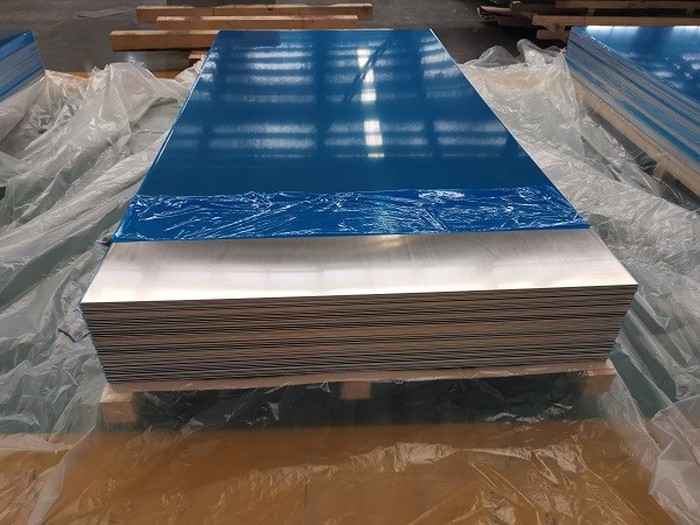
Mechanical Properties: 5083 H116 vs H321 Aluminum Plate
Shipbuilders frequently ask whether they should order H116 or H321 tempers. Under international marine codes, both are premium marine grades that pass the exact same ASTM G66 exfoliation corrosion tests.
- 5083 H116: This temper is strictly strain-hardened (cold-rolled) with highly controlled temperature limits at the mill to lock its grain structure.
- 5083 H321: This temper is strain-hardened and then subjected to a low-temperature thermal stabilizing process.
Both tempers deliver identical structural reliability in saltwater.
| Property | Value | Notes |
|---|---|---|
| Ultimate Tensile Strength (UTS) | ≥ 305 MPa (≈ 44,000 psi) | Indicates maximum load-bearing capacity |
| Yield Strength (0.2% Offset) | ≥ 215 MPa (≈ 31,000 psi) | Stress before permanent deformation |
| Elongation | ≥ 10% | Based on 50 mm gauge length; reflects ductility |
| Density | 2.66 g/cm³ | Much lighter than steel; improves payload efficiency |
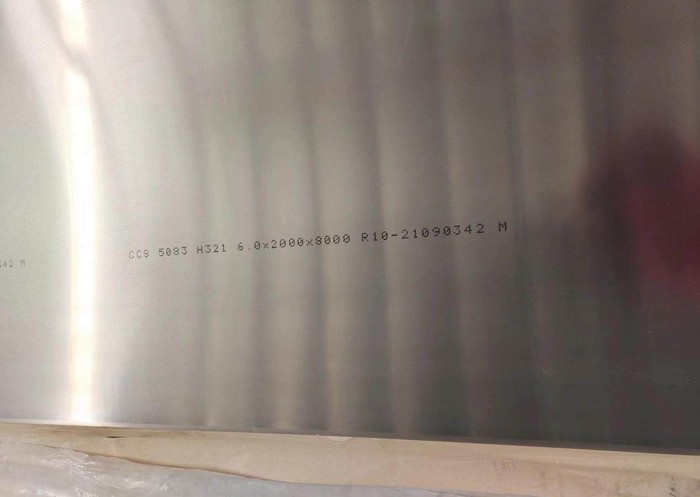
5083 H116 vs H111 and H112 Aluminum Sheet
To prevent metal cracking during fabrication, you must select the right temper for your specific manufacturing process.
- 5083 H116 vs. H111: The H111 temper is annealed and slightly strain-hardened. It has lower yield strength (≥ 125 MPa) but much higher elongation (≥ 16%). If your project requires heavy cold-forming, deep drawing, or bending (like manufacturing LNG tanker trucks), you must use 5083 H111. If the metal will be used for a load-bearing ship hull submerged in seawater, you must use 5083 H116.
- 5083 H116 vs H112: H112 is a general temper achieved through hot-working with basic mechanical limits. It is suitable for general structural parts. H116, however, is rigorously tested for marine exfoliation corrosion. Never use H112 for critical underwater marine applications.
5083 H116 Marine Aluminum vs 6061 T6
While 6061 T6 is a highly popular structural alloy, it is not suitable for harsh marine immersion.
- Corrosion: 5083 H116 is naturally immune to seawater pitting. 6061 T6 will corrode in saltwater unless heavily painted or anodized.
- Weldability: 5083 retains excellent strength in the Heat-Affected Zone (HAZ) after welding. 6061 T6 loses up to 50% of its strength after welding and requires post-weld heat treatment to recover it.
- Verdict: Use 6061 T6 for land-based structural frames. Buy marine grade aluminum 5083 for shipbuilding and offshore platforms.
Minimum Bend Radius for 5083 H116 Aluminum Sheet
Because H116 is strain-hardened, it is relatively stiff. When bending this plate in a press brake, you must respect the minimum bend radii to prevent fracturing along the grain direction.
- Thickness 1.5mm – 3.0mm: 3.0t (where 't' is plate thickness) for a 90° bend.
- Thickness 3.0mm – 6.0mm: 2.5t for a 90° bend.
- Thickness 6.0mm – 12.5mm: 4.0t for a 90° bend.
(Note: Always use a larger radius punch for hardened tempers and bend perpendicular to the rolling direction when possible).
Critical Safety Warning: The 65°C (150°F) Temperature Limit
Do not use 5083 aluminum plates in environments where continuous operating temperatures exceed 65°C (150°F). Due to the high magnesium content, prolonged heat causes the magnesium to precipitate to the grain boundaries. This destroys the plate's corrosion resistance and leads to rapid stress corrosion cracking.
5083 H116 Aluminum Sheet Core Industrial Applications
- Shipbuilding: Hulls, decks, keels, and bulkheads for fast ferries, naval vessels, and luxury yachts.
- Pressure Vessels & Cryogenics: LNG (Liquefied Natural Gas) storage tanks. 5083 performs exceptionally well at cryogenic temperatures (-196°C) without becoming brittle.
- Heavy Transportation: Dump truck beds, railway tank cars, and fuel transport trailers.
Your Reliable 5083 Aluminum Plate Supplier
Using unverified materials in heavy industry leads to rejected inspections and structural failures. GNEE acts as your direct manufacturing partner, supplying fully traceable, export-ready aluminum plates.
- Class Society Approvals: We supply plates certified by DNV, ABS, LR, CCS, KR and BV.
- Custom Shipyard Dimensions: We supply standard wide plates (2000mm x 6000mm) and thicknesses ranging from 3mm up to 200mm to reduce your welding seams.
- Verified MTC: Every shipment includes an EN 10204 3.1 or 3.2 Mill Test Certificate.
Get Your Precise Material Quote Today
Do you need an accurate marine aluminum plate price for your current vessel build or tank fabrication project?
Contact GNEE today. Send us your required thickness, temper, dimensions, and total tonnage. Our technical sales engineers will quote you within 24 hours.