

Equivalents to 3003 Aluminum
The equivalent materials to ASTM 3003 aluminum include EN AW-3003 (European standard), JIS A3003 (Japanese standard), and DIN 3.0517 (German standard). Similar substitute alloys include 3103 and 3004. These equivalents share nearly identical chemical compositions and offer the same excellent corrosion resistance and moderate strength, though minor tolerance differences may exist depending on the specific regional standard.
What Is 3003 Aluminum Sheet Material?
The 3003 aluminum alloy belongs to the 3xxx series, which means its primary alloying element is Manganese (Mn). It is famously known as the standard "anti-rust aluminum. " Because it is a non-heat-treatable alloy, its strength comes purely from cold rolling rather than heat treatment. It provides about 20% more tensile strength than the 1100 series pure aluminum. Engineers globally rely on 3003 for its excellent workability, weldability, and resistance to moisture and mild chemicals.

International Equivalents of 3003 Aluminum Plate
When buying aluminum internationally, different countries use different naming systems for the exact same material. If your drawing specifies "3003," but your local supplier only uses European or Japanese codes, here is the direct cross-reference guide.
| Standard System | Region | Equivalent Grade |
| ASTM / AA | USA / Global | 3003 |
| EN (Euronorm) | Europe | EN AW-3003 |
| JIS | Japan | A3003 |
| ISO | International | AlMn1Cu |
| DIN | Germany | 3.0517 |
| GB/T | China | 3003 |
Note: If your supplier offers you EN AW-3003 or JIS A3003, they are giving you the correct equivalent material. The core metal is the same; only the certification paperwork differs.
Chemical Composition Comparison of 3003 Aluminum Plate
Why are these grades considered equivalent? The proof is in the chemistry. The international standards keep the elemental limits almost identical to ensure the metal behaves the same way in your workshop.
| Element (%) | ASTM 3003 | EN AW-3003 | JIS A3003 |
| Manganese (Mn) | 1.0 – 1.5 | 1.0 – 1.5 | 1.0 – 1.5 |
| Copper (Cu) | 0.05 – 0.20 | 0.05 – 0.20 | 0.05 – 0.20 |
| Iron (Fe) | ≤ 0.70 | ≤ 0.70 | ≤ 0.70 |
| Silicon (Si) | ≤ 0.60 | ≤ 0.60 | ≤ 0.60 |
| Zinc (Zn) | ≤ 0.10 | ≤ 0.10 | ≤ 0.10 |
| Aluminum (Al) | Balance | Balance | Balance |
Conclusion: The chemical makeup is practically identical. You can safely interchange these materials for general manufacturing purposes without worrying about chemical failures or rust issues.
Substitute Alloys for 3003 Aluminum Coil
Sometimes, exact equivalents are out of stock. In such cases, you can use substitute alloys that offer similar, but not identical, performance.
- Alloy 3103: This is the closest substitute. It is widely used in Europe. It has slightly less copper and slightly different impurity limits. It performs almost exactly like 3003 in bending and welding.
- Alloy 3004: This is a stronger alternative. By adding about 1% Magnesium (Mg), 3004 becomes significantly stronger than 3003. However, because it is harder, its formability (bending capability) is lower.
- Alloy 1100: This is a weaker alternative. It is 99% pure aluminum. If you cannot find 3003, and your project does not require high strength but needs extreme bending (like deep drawing), 1100 is an excellent substitute.
Mechanical Comparison of Substitutes
| Alloy | Overall Strength | Formability (Bending) | Corrosion Resistance |
| 3003 | Medium | Good | Excellent |
| 3103 | Medium (Slightly higher) | Similar to 3003 | Excellent |
| 3004 | Higher | Lower | Good |
| 1100 | Low | Excellent (Best for deep draw) | Excellent |
Available Forms of 3003 Aluminum
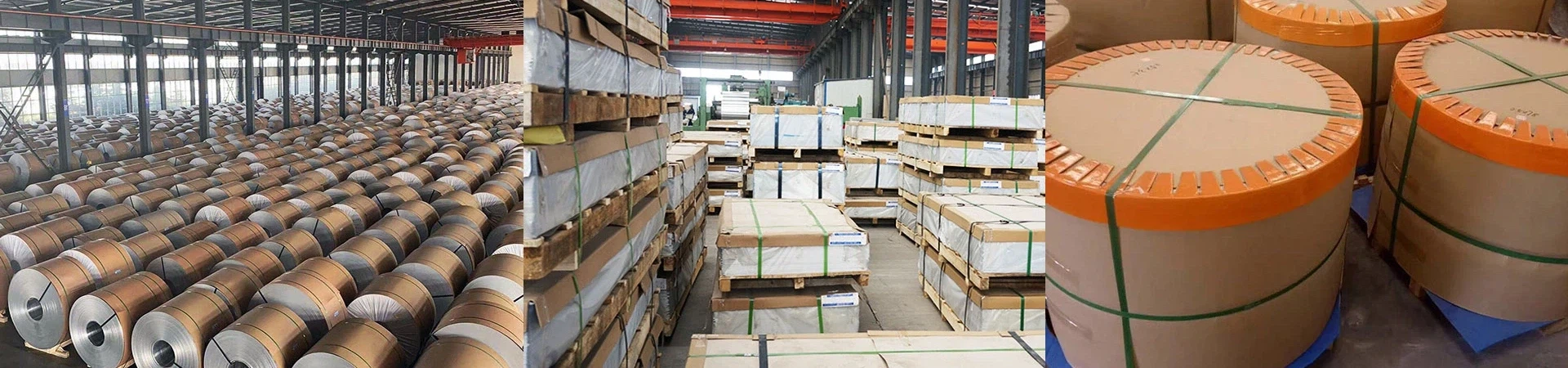
- 3003 Aluminum Sheet & Plate: Flat panels used for laser cutting, roofing, and structural bases.
- 3003 Aluminum Coil: Large rolls used for continuous feeding into roll-forming machines or press brakes.
- 3003 Aluminum Pipe & Tube: Extruded or welded hollow sections used for fluid transfer and structural framing.
Note: We supply all the above forms with full MTC documentation matching ASTM, EN, or GB standards.
Applications of 3003 & Its Equivalents
Because of its reliable balance of rust resistance, formability, and cost, 3003 and its equivalents are found in everyday commercial applications.
- Roofing and Wall Cladding: The material resists outdoor weather for decades without rusting.
- Chemical Equipment: Used to handle mild chemicals that would destroy standard steel.
- Storage Tanks: Fuel tanks for trucks, water storage, and food-grade liquid containers.
- HVAC Systems: Air conditioning ductwork and heat exchanger fins where moisture is constantly present.
- Decorative Panels: Building facades and interior panels that require painting or anodizing.
How to Choose Your Equivalent
If you cannot source standard 3003 aluminum, follow this simple checklist to choose your substitute:
- Requirement: I need the exact same chemical and mechanical performance, just from a different region.
Action: Buy the exact regional equivalent (EN AW-3003, JIS A3003, AlMn1Cu).
- Requirement: I need a material that acts almost exactly like 3003 for general fabrication.
Action: Buy 3103.
- Requirement: I need a stronger material for a load-bearing panel, but I am okay with less bending ability.
Action: Upgrade to 3004.
- Requirement: I am doing deep drawing (like making cookware) and need the metal to stretch more easily without cracking.
Action: Switch to 1100 pure aluminum.
Common Mistakes When Buying Equivalents
Mistake: Believing all equivalents are legally interchangeable.
Truth: While physically similar, a building inspector in the USA may reject a structure built with EN AW-3003 if the legal blueprints strictly mandate ASTM 3003. Always check your local compliance laws.
Mistake: Changing to a substitute alloy without testing.
Truth: Just because 3103 is "very similar" to 3003 does not mean your specific welding machine settings will work perfectly. Always do a trial run.


