

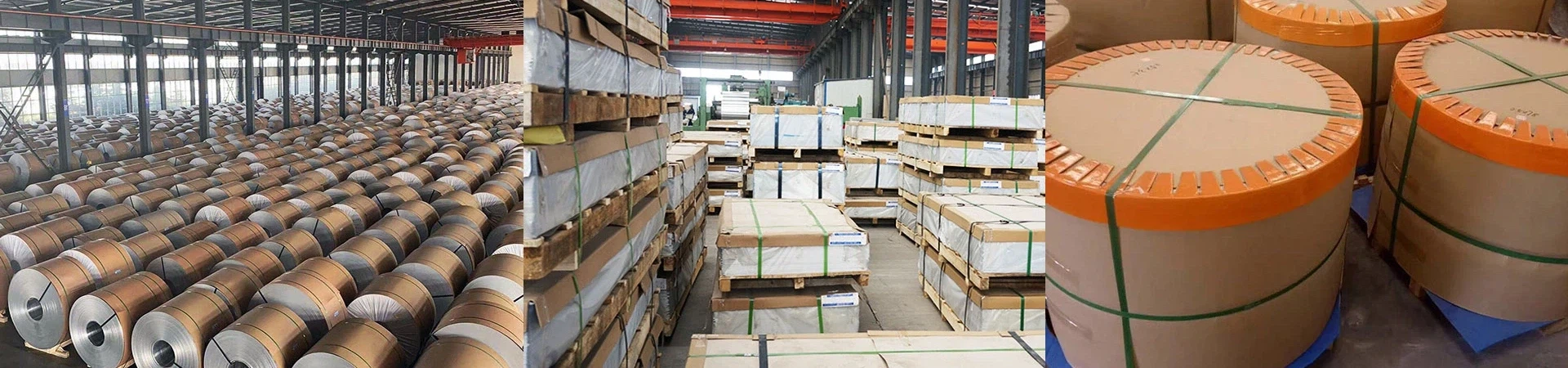
3003 H14 and H24 aluminum have similar strength levels but differ in processing. 3003 H14 is strain-hardened to a half-hard condition, offering a good balance of strength and formability. 3003 H24 is also strain-hardened, but it is then partially annealed (heated slightly) to relieve internal stress and restore some ductility.
As a result, H24 offers slightly better formability and a lower risk of cracking during bending or deep drawing while keeping the same basic strength as H14.
Basics of 3003 Aluminum Sheet
Before comparing the tempers, you must understand the base material. The 3003 aluminum series is an Aluminum-Manganese (Al-Mn) alloy. It is the most widely used general-purpose aluminum on the market. By adding about 1.2% manganese, 3003 becomes roughly 20% stronger than the 1100 series pure aluminum.
More importantly, 3003 is a non-heat-treatable alloy. You cannot make it stronger by baking it in a high-temperature furnace. Its strength comes solely from physical rolling at room temperature. It is famous for its excellent corrosion resistance against moisture, making it a top choice for everyday industrial and commercial products.

What Is H14 Temper in a 3003 Aluminum Plate?
In the aluminum industry, the "H" stands for strain-hardened (cold-worked).
- The "1" means the metal was only cold-rolled. No heat was applied to soften it after rolling.
- The "4" means the degree of hardness is exactly Half Hard (1/2 hard).
When you buy a 3003 H14 aluminum plate, the factory has rolled the metal until its strength is exactly halfway between the fully soft (annealed) state and the fully hard (H18) state. It provides a reliable middle ground: strong enough to hold a shape, but soft enough to be bent into 90-degree angles without breaking.
What Is H24 Temper in a 3003 Aluminum Coil?
- The "2" means the metal was strain-hardened, and then partially annealed.
- The "4" still means the final product is Half Hard.
During production, the factory rolls the 3003 aluminum coil much harder than the H14 level. Then, they put the coil into a low-temperature furnace for a specific amount of time. This partial annealing process relieves the internal mechanical stress built up during rolling. It drops the strength back down to the "half-hard" level but significantly restores the metal's elasticity.

Key Takeaway: H24 is not harder than H14. It has the same final strength as H14, but because it was stress-relieved with heat, it is more ductile and forgiving during complex manufacturing processes.
| Property | 3003 H14 | 3003 H24 |
| Processing Method | Strain-hardened only | Strain-hardened + partially annealed |
| Overall Strength | Medium (Half Hard) | Similar (Half Hard) |
| Ductility | Moderate | Slightly better |
| Formability | Good | Better (Less risk of cracking) |
| Internal Stress | Higher | Lower (Stress relieved) |
Mechanical Properties of 3003 Aluminum Panels
Data from ASTM B209 standards proves that these two materials are in the same strength tier but behave slightly differently under tension.
| Property | 3003 H14 | 3003 H24 |
| Tensile Strength | 140 – 180 MPa | 140 – 180 MPa |
| Yield Strength | 115 – 145 MPa | Slightly lower (Approx. 110 - 140 MPa) |
| Elongation | 5% – 10% | 6% – 12% |
What the data means:
Their maximum pulling strength (Tensile Strength) is exactly the same. However, H24 has a slightly lower yield strength and a higher elongation percentage. This means H24 will start to bend slightly earlier than H14 when pushed by a machine, and it can stretch further before it tears.
Forming 3003 Aluminum Material
How these materials act in your press brakes and stamping machines dictates your production efficiency.
| Fabrication Process | 3003 H14 | 3003 H24 |
| Standard Bending | Good | Better (Smoother bend line) |
| Deep Drawing | Good | Better (Highly recommended) |
| Complex Forming | Good | Improved |
| Welding | Good | Good |
If you are just doing simple 90-degree folds, H14 works perfectly fine. But if you are using a punch press to force the flat sheet into a deep cup shape, the internal stress in H14 might cause the metal to split at the corners. Because H24 is partially annealed, it flows into the mold much easier.
High scrap rates during deep drawing eat your profits. Do not guess which temper will solve the problem. Send our technical team your CAD drawing and mold depths. We offer a Free Forming Evaluation. We will analyze your design and tell you exactly whether you should use H14 or upgrade to H24 to eliminate cracking.
Common Applications for 3003 Aluminum Sheet Tempers
Typical Applications for 3003 H14
Use H14 for standard fabrication where heavy stretching is not required.
- General Sheet Metal Work: Simple folded boxes, HVAC ductwork, and equipment covers.
- Roofing and Siding: Flat or simply corrugated panels for buildings.
- Tank Fabrication: Rolled bodies for fuel, water, and mild chemical storage tanks.
Typical Applications for 3003 H24
Use H24 when the metal needs to be heavily manipulated, stamped, or drawn into a 3D shape.
- Deep Drawing Parts: Cookware, baking pans, and metal cups.
- Appliance Housings: Washing machine or refrigerator panels that require complex, curved edge folding.
- Complex Formed Components: Automotive heat shields and irregular metal enclosures.
- Decorative Panels: Architectural parts pressed into textured shapes.
| Application | Recommended Temper |
| Standard flat panels | H14 |
| Simple 90-degree bending | H14 |
| Deep drawing (cookware) | H24 |
| Complex bending/stamping | H24 |
| General fabrication | H14 |
Cost of 3003 H14 vs H24 Aluminum Plates
- Raw Material Cost: H24 is slightly more expensive per ton to produce than H14. This is because H24 requires an extra manufacturing step-putting the aluminum coils into an annealing furnace and carefully monitoring the temperature.
- Processing Efficiency: H24 is easier on your workshop machines. It causes less tool wear and results in fewer cracked parts.
- Overall Cost: If you are doing simple bending, H14 is the most cost-effective choice. If your product requires complex forming, the slightly higher initial price of H24 will actually save you money by dropping your scrap rate from 10% down to near zero.
How to Choose the Right Temper
- Choose 3003 H14 if: Your project involves standard sheet metal work, simple bending, or roofing, or you are highly sensitive to raw material costs.
- Choose 3003 H24 if: Your production line involves deep drawing, heavy stamping, or complex curved forming, or if you are experiencing cracking issues with your current H14 supply.
Common Mistakes When Buying 3003 Aluminum Panels
Mistake: "H24 is a higher number than H14, so it must be harder."
Truth: Completely false. The "4" in both codes dictates the hardness. Both are half-hard. The "2" simply means H24 was heat-treated to restore ductility.
Mistake: "H14 cannot be formed or bent."
Truth: H14 is widely used for bending and forming. It folds 90 degrees beautifully. It only struggles when pushed into extreme deep-drawing limits.
The Reality: Think of H24 as the "upgraded processing version" of H14.
Get Your 3003 Aluminum Sheet Price Today
Selecting the correct temper makes a massive difference in your production speed and profit margins. As a direct aluminum manufacturer, we supply both 3003 H14 and 3003 H24 in standard sheets, customized plates, and large coils.
Because H14 and H24 are very similar on paper, the best way to choose is to test them on your own machines. Contact us today with your required thickness.
We will provide a fast, competitive price quote and ship you a Free Dual-Sample Kit featuring both H14 and H24 aluminum sheets. Test the formability yourself and buy with confidence.


