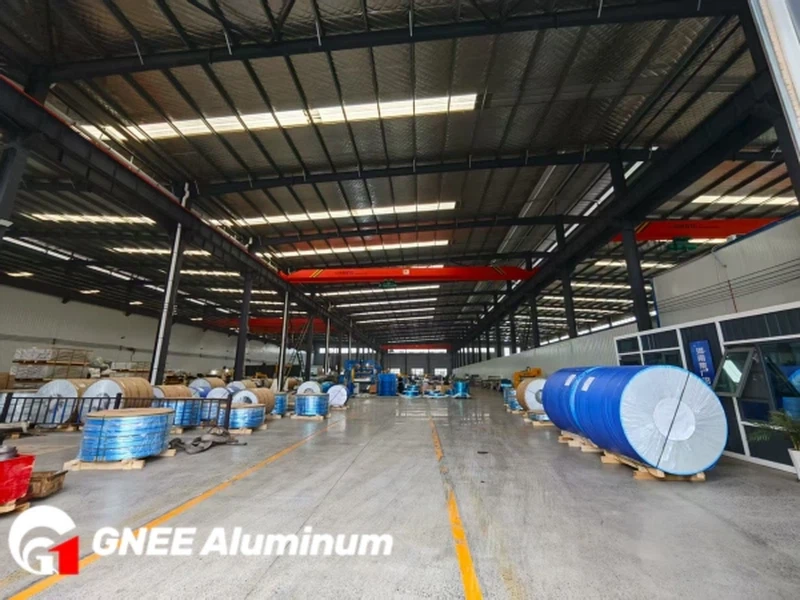
This technical guide provides immediate, unedited factory data for sourcing 3003 aluminum.
Chemical Composition of 3003-O Aluminum Sheet
Chemical Composition of Bulk 3003-O Aluminum Coil
| Element | Symbol | Required Percentage (%) | Factory Metallurgical Purpose |
| Aluminum | Al | ~96.8 - 99.0 | Base matrix material. |
| Manganese | Mn | 1.0 - 1.5 | Primary strengthener. Increases strength by 20% over the 1100 series without losing ductility. |
| Iron | Fe | ≤ 0.7 | Impurity limit. Strictly controlled at the GNEE mill to prevent edge cracking during rolling. |
| Silicon | Si | ≤ 0.6 | Impurity limit. |
| Copper | Cu | 0.05 - 0.20 | Added in trace amounts to provide a minor boost to tensile strength. |
| Zinc | Zn | ≤ 0.10 | Restricted to guarantee maximum atmospheric corrosion resistance. |
The addition of 1.0–1.5% manganese classifies 3003 as a non-heat-treatable alloy. It gains strength exclusively through cold working (strain hardening) at the rolling mill, not through thermal aging ovens.
Mechanical Properties of Wholesale 3003-H14 Aluminum Sheet
| Temper | Tensile Strength (MPa) | Yield Strength (MPa) | Elongation (%) | Bending & Machining Reality |
| O (Soft/Annealed) | 110 | 40 | ~30% | Maximum ductility. Mandatory for severe deep drawing (e.g., deep cooking pots, seamless tanks). |
| H14 (Half Hard) | 150 | 145 | 8% - 16% | The industry standard for sheet metal. Easily forms 90-degree bends without cracking. |
| H18 (Full Hard) | 200 | 185 | ~4% | Maximum rigidity. Used strictly for flat panels or corrugated roofing. Will crack if bent sharply. |
| H24 (Half Hard) | 150 | 145 | 8% - 16% | Strain-hardened and partially annealed. Offers identical strength to H14 but with slightly better impact absorption. |
Do not order the H18 temper if your production line utilizes a CNC press brake for tight-radius bending. The 4% elongation limit of H18 guarantees material fracture. Always specify O or H14 temper for complex forming.
Unsure which temper matches your CNC tooling? Send your CAD drawings and required bend radii to the GNEE engineering team. We will identify the exact temper required to drop your scrap rate to zero.
Request a Free Technical Review Now
Physical Specs for 3003-H24 Aluminum Tread Plate
Density: 2.73 g/cm³ (0.0986 lb/in³). One-third the weight of carbon steel.
Thermal Conductivity: 193 W/m-K. Excellent for heat dissipation and transfer applications.
Electrical Conductivity: 40% IACS (International Annealed Copper Standard).
Melting Point Range: 643 - 654°C (1190 - 1210°F).
Modulus of Elasticity: 68.9 GPa (10,000 ksi).
These baseline physical traits make custom 3003-H24 aluminum tread plate the optimal choice for lightweight commercial trailer flooring, toolboxes, and anti-slip architectural walkways where weight reduction and rust prevention are critical.
Fabrication and Welding of Custom 3003 Aluminum
Welding Specifications:
Process: Readily weldable using standard TIG (GTAW) or MIG (GMAW) methods.
Filler Rod (Welding 3003 to 3003): Use ER1100 filler wire.
Filler Rod (Welding 3003 to 5052/6061): Use ER4043 filler wire to prevent weld cracking.
Heat Affected Zone (HAZ): Welding heat will locally anneal the metal around the seam, dropping H-temper material back down to an O-temper (soft) strength level at the joint.
Machining Specifications:
3003 is generally considered "gummy" when CNC milled or turned due to its softness. If heavy CNC machining is required, utilize high cutting speeds, sharp carbide tooling, and copious amounts of cutting fluid to prevent the aluminum from fusing to the tool bit.
Uses for 3003-H18 Aluminum Roofing
- HVAC Systems and Heat Exchangers: Evaporator coils, automotive radiators, and industrial pipe insulation jacketing. The alloy conducts heat rapidly and resists continuous condensation without oxidizing.
- Food and Chemical Storage: Commercial baking pans, large cooking vessels, and pressure cookers (utilizing 3003-O for deep drawing). Non-toxic oxide layer prevents reactions with acidic foods.
- Commercial Truck Trailers: Roofing panels and interior kick plates. Reduces overall vehicle weight to save fuel while resisting road salt and weather.
- Industrial Roofing and Siding: Corrugated profiles using the rigid H18 temper. Endures high wind loads and harsh outdoor humidity without the need for protective paint.
3003 Aluminum Plate Supplier vs. 6061 Alloy
- Formability: 3003 is vastly superior for bending, stamping, and deep drawing. 6061 will crack under severe forming unless fully annealed.
- Strength: 6061-T6 (heat-treated) is structurally stronger and designed for heavy load-bearing frames. 3003 is for moderate-strength sheet metal applications.
- Cost: 3003 is significantly cheaper per metric ton. It does not require expensive thermal aging ovens (T-tempers) during factory production.
- Machinability: 6061 chips nicely and is the standard for CNC milling. 3003 is too soft for precision milling.
The GNEE Pricing Formula:
Current SMM Aluminum Base Price + Factory Processing Fee + Ocean Freight.
Why SMM? The actual aluminum ingots melted in our factory are purchased in RMB from domestic Chinese smelters based on the SMM daily spot price.
Export Packaging Standards:
Ocean freight condensation destroys bare aluminum. GNEE utilizes a strict marine-grade packaging protocol for all bulk 3003-O aluminum coil and flat sheet shipments:
- Surface Protection: PE/PVC protective film applied to the top surface (optional based on client stamping requirements).
- Moisture Barrier: Sheets are tightly interleaved with acid-free paper, then wrapped in heavy-duty waterproof kraft paper.
- Encapsulation: The entire bundle is sealed in thick plastic shrink film loaded with industrial silica gel desiccants to absorb container humidity.
- Palletizing: Secured with steel bands onto custom, fumigated wooden pallets (ISPM 15 compliant) for safe forklift handling at your destination port.
Send GNEE your exact thickness, width, temper, and monthly tonnage requirements. We will calculate a transparent, SMM-based quotation within 24 hours.
Contact the GNEE Wholesale Team Today
FAQ
Q1: Is 3003 aluminum bendable?
Yes, exclusively in the O (Annealed), H12, and H14 (Half-Hard) tempers. In these states, it easily achieves a 90-degree bend with a tight radius (often 1t). Do not attempt to bend the H18 (Full Hard) temper, as its low elongation will result in immediate structural cracking.
Q2: What is the thickness tolerance for GNEE 3003 aluminum sheets?
GNEE manufactures strictly to ASTM B209 commercial tolerances. For a standard 3.0mm thick sheet, the thickness tolerance is consistently maintained at ±0.08mm. Tighter custom tolerances are available upon specific mill request to ensure automated CNC feeders do not jam.
Q3: Can 3003 aluminum be heat-treated for extra strength?
No. 3003 is a non-heat-treatable alloy. Thermal treatments (like baking in an oven) will only anneal (soften) the metal. The only method to increase its strength is through mechanical strain hardening (cold rolling) at our factory, which results in the H-series tempers.
Q4: Will 3003 aluminum rust in outdoor environments?
No. 3003 aluminum does not contain iron and cannot rust. Upon exposure to oxygen, it instantaneously forms a microscopic, highly dense aluminum oxide barrier that seals the metal from further atmospheric corrosion. It is widely deployed bare in outdoor architectural and roofing applications.
Q5: Can 3003 aluminum be anodized?
Yes. However, due to the 1.0-1.5% manganese content, the resulting anodized layer will typically exhibit a slight yellowish or brownish tint rather than a bright, clear silver finish. It is excellent for hard-coat protective anodizing but less desirable for high-end decorative cosmetic finishes.