

When designing and manufacturing Electric Vehicle (EV) charging infrastructure, selecting the right conductive metal is critical for safety, efficiency, and cost control.
6101 aluminum strip is widely used in EV charging piles because it combines high electrical conductivity (52–60% IACS), medium-high strength (150–220 MPa), and excellent corrosion resistance. It is especially suitable for busbars, conductive plates, and structural components where both electrical performance and mechanical reliability are required.
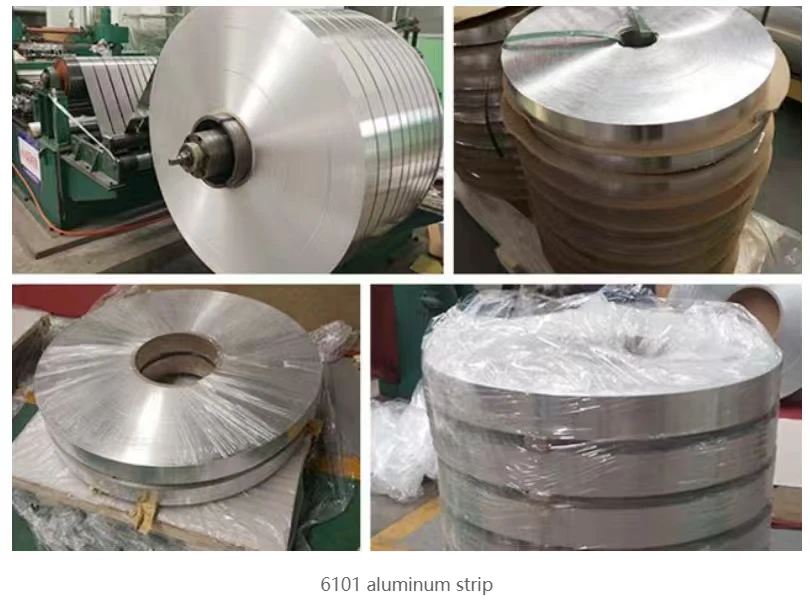
Chemical Composition of 6101 Aluminium
| Elements | Si | Fe | Cu | Mn | Mg | Zn | B | Cr | Al |
| Content | 0.30-0.7 | 0.50 | 0.10 | 0.03 | 0.35-0.8 | 0.10 | 0.06 | 0.03 | Remain |
echnical Specifications
| Property | 6101-T6 | 6101-T61 | 6101-T63 |
|---|---|---|---|
| Tensile Strength (MPa) | 250 | 220 | 200 |
| Yield Strength (MPa) | 220 | 200 | 180 |
| Elongation (%) | 10 | 12 | 14 |
| Electrical Conductivity (% IACS) | 53 | 55 | 54 |
| Density (g/cm³) | 2.70 | 2.70 | 2.70 |
Specifications of 6101 Aluminum Strip
| Parameter | Specification |
|---|---|
| Alloy | 6101 |
| Temper | T6 (also available in T4, T451, F, O, H112) |
| Thickness Range | 0.5 – 500 mm |
| Width Range | 100 – 2650 mm |
| Length Range | 500 – 16000 mm (customizable) |
| Conductivity | 52 – 60% IACS |
| Standards | AA (Aluminum Association), GB/T 3190, ASTM B209 |
- 52-60% IACS Conductivity: This is highly efficient for transferring power to an electric car. It ensures minimal energy loss during the charging process.
- 150-220 MPa Tensile Strength: Inside a charging pile, heavy cables are bolted tightly to the busbars. If the metal is too weak, the bolt threads will strip or the metal will bend. This strength rating guarantees the connections remain secure under mechanical stress and vibration.
- Excellent Corrosion Resistance: EV charging piles are installed outdoors in rain, snow, and humid coastal areas. 6101 aluminum naturally forms a protective oxide layer, preventing the internal conductive parts from rusting and causing electrical failures.
6101 Aluminum vs Copper for Charging Infrastructure
| Feature | 6101 Aluminum | Copper |
| Conductivity | ~55% IACS | ~100% IACS |
| Weight | 30% of copper | Heavy |
| Cost | 30–50% lower | High and volatile |
| Installation | Easier (lightweight) | Difficult (heavy labor) |
| Corrosion | Better (natural oxidation protective) | Needs surface coating (tin/silver) |

Aluminum is the best cost-performance conductor: While copper has higher absolute conductivity, aluminum is incredibly light. To match the conductive capacity of a copper busbar, you simply use a slightly thicker 6101 aluminum strip. Even with the increased size, the aluminum part will still weigh 50% less and cost 40% less than the copper equivalent.
Copper is high-end but expensive: Copper is heavy, driving up shipping costs and requiring stronger structural supports inside the charging cabinet. The raw material price of copper is also highly volatile, making it difficult for manufacturers to control their budget.
By switching to 6101 aluminum strip, charging pile manufacturers can drastically cut production costs while maintaining safe and stable charging speeds.
Contact GNEE's technical team today. We can help you calculate the correct dimensions to buy 6101 aluminum strip that matches your current copper busbar performance.
Processing Advantages of 6101 Aluminum Strip
- Excellent Extrusion & Rolling Performance: The material structure is highly stable, meaning we can supply strips with extremely flat surfaces and precise thickness tolerances.
- Easy Bending and Punching: Charging pile busbars often need to be bent at 90-degree angles to fit tightly inside the cabinet. 6101-T63 and T64 tempers allow for clean bending without cracking at the corners. It is also very easy to punch clean holes for fastening bolts.
- Good Weldability: If your design requires joining multiple conductive tracks, 6101 aluminum can be easily welded using standard TIG or MIG methods.
- High Dimensional Stability: Once cut and formed, the material does not warp over time. This is critical for mass production, ensuring every component fits perfectly into the assembly line without manual adjustments.


Typical Applications of 6101 Aluminum in Charging Piles
The 6101 aluminum strip is not just a general casing material; it is used for highly specific, functional components.
Here are the core components made from 6101 aluminum strip:
- Busbars: This is the most common application. Busbars are flat metal strips that conduct massive amounts of electricity from the power grid connection to the charging cables. 6101 aluminum handles high-current transmission safely without overheating.
- Conductive Plates: Inside the charging cabinet, various electrical modules need to be connected. 6101 aluminum strips are stamped into conductive plates to link transformers, inverters, and circuit breakers together.
- Power Distribution Systems: DC fast chargers require complex power distribution networks. 6101 aluminum is used to build the internal power routing tracks because it is easy to shape into tight spaces.
- Structural Frames: Because 6101 offers medium-high strength, some thicker strips are used to frame and support heavy electrical components, doing double duty as both a ground conductor and a mechanical support.
- Cooling Components: Fast charging generates intense heat. 6101 aluminum has great thermal conductivity, making it highly effective for heat sinks and cooling tracks attached to the power modules.


Send your required width, thickness, and temper to GNEE today. We provide factory-direct wholesale 6101 aluminum strips with fast quotes within 24 hours.
Why Choose GNEE as Your 6101 Aluminum Strip Supplier
- Specialized in 6101 Aluminum Production: We focus heavily on conductive alloys and control the magnesium and silicon ratios precisely to guarantee 52-60% IACS conductivity.
- Accurate Tempers: We supply exact T63 and T64 tempers tailored to your bending and strength requirements.
- Precision Slitting: We understand that tight spaces require accurate materials. We provide precision slitting with width and thickness tolerances controlled within ±0.02 mm.
- Global Export Experience: We have years of experience safely packaging and exporting aluminum materials to clients manufacturing EV infrastructure, power transmission networks, and industrial busbar systems across the globe.


Looking for 6101 Aluminum Strip for EV Charging Systems?
When building EV charging piles, material cost and safety are the top priorities. Choosing 6101 aluminum helps you achieve both.
GNEE provides:
✔ Stable conductivity performance tested before delivery
✔ Custom width and thickness slitting
✔ Fast delivery and secure packaging for bulk orders
Contact us now to get technical support, request a free sample, and receive a complete quotation within 24 hours.


