



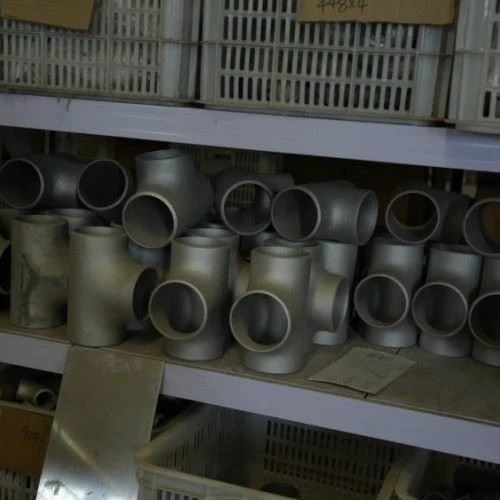
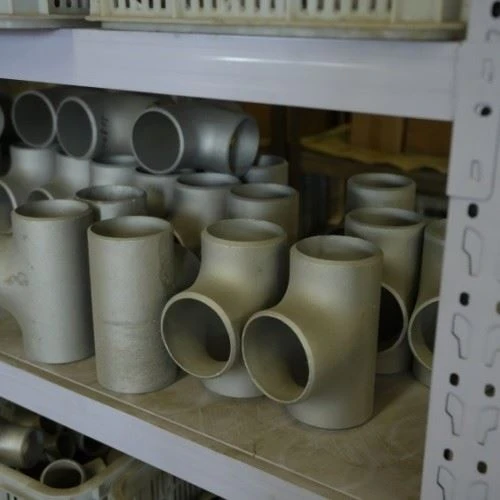
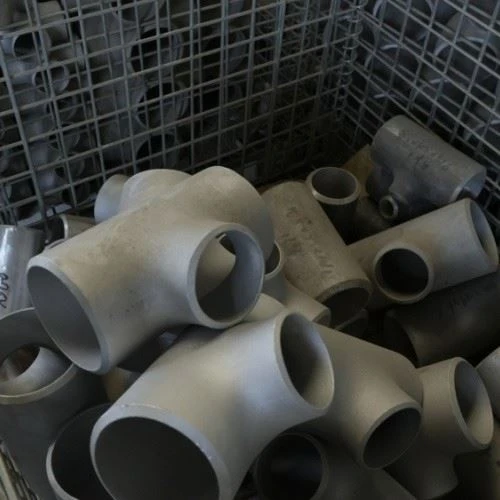
Aluminum Pipe Tee Fittings
Customer service is online. Enter the chat to get the latest quotation.
 Spot stock
 Customize
 Factory direct sale
 7 days delivery
What an Aluminum Tee Does
A aluminum tee is a short pipe-fitting with two outlets at 90° to the run. It splits one line into two - or, in the reducing version, drops the branch to a smaller size. On aluminum systems, tees are used where the line itself is aluminum and you want a continuous metallic weld rather than a transition fitting.
For comparison, on a carbon-steel line you'd use a long-radius carbon tee; on a copper line you'd braze a copper tee. The aluminum version exists because aluminum pipework is preferred for weight, corrosion resistance, and thermal reasons - and you need the tee to match the pipe alloy.
The two main distinctions that matter when ordering:
Aluminum Equal Tee: branch size = run size (e.g., 4" × 4"). Used for splitting flow evenly into two branches.
Aluminum Reducing Tee: branch size < run size (e.g., 6" × 4"). Used when one branch drops to a smaller instrument line, a chemical injection point, or a smaller distribution header.
A tee is the second-most-asked-for fitting in any aluminum pipe system after the elbow. If you have a piping isometric that lists aluminum, tees are on it.
Common Types of Aluminum Tee

Aluminum equal tee (straight tee)
All three openings the same size. This is what most people mean by "tee." It splits a line into two equal branches.

Aluminum reducing tee
The branch opening is smaller than the run. Example: a 2 x 2 x 1 tee takes a 2 inch line and drops the branch to 1 inch without a separate reducer. Order it as run x run x branch.

Butt weld aluminum pipe tee fitting
Beveled ends for full-penetration butt welds. Strongest joint, used on the larger sizes and wherever the line is welded anyway.

Socket weld aluminum pipe tee fitting
The pipe slides into a socket and gets a fillet weld. Common on smaller sizes and higher-rated work, though aluminum socket weld fittings are less common than steel because most aluminum piping is welded at the butt or threaded.

Threaded aluminum pipe tee fitting
apered threads per ASME B1.20.1. This is the fitting type covered by MIL-DTL-52618F: 150-lb class, intended for water, oil, or air service at 72°F (22°C), hydrostatic proof tested to 250 psi (1.72 MPa), air tested to 90 psi.

Flanged aluminum pipe tee fitting
A tee with flange faces on one or more ends, bolted to mating flanges. Used where the line must come apart for maintenance.

Lateral (45°)
Branch at 45° instead of 90°. A lateral does reduce pressure loss on the branch flow versus a 90° tee, which matters on high-flow lines.
Specification of GNEE aluminum pipe tee fitting
|
Item |
Options |
|
Type |
Equal tee, Reducing tee, Straight tee, Barred tee (on request) |
|
Connection |
Butt-weld (BW), Socket-weld (SW for forged, class 3000), Threaded (NPT/BSP) |
|
Manufacturing |
Seamless extruded, fabricated (welded), forged (small sizes) |
|
Size range |
½" NPS – 24" NPS (DN15 – DN600), larger up to 48" on RFQ |
|
Wall thickness |
SCH 5s, 10s, 40s, 80s, 160s, XXS (per ASME B36.10M / B36.19M) |
|
Alloys |
6061-T6, 6063-T5/T6, 6082-T6, 5083-O, 5086-O, 5052-O, 1100-H14 etc. |
|
Standards |
ASTM B361, ASME SB361, ASME B16.9, ASME B16.52 (for forged SW), EN 755 |
|
Temper (as shipped) |
O / H111 / H112 / T6 / T651 - depends on alloy |
|
Surface |
Mill finish, anodized (clear / colour / hard), brushed, polished, painted,Sandblasted Finish |
|
Pressure class |
Depends on alloy and schedule - example: 6061-T6 SCH 40 at 100°C ≈ 18 bar rated |
|
Documentation |
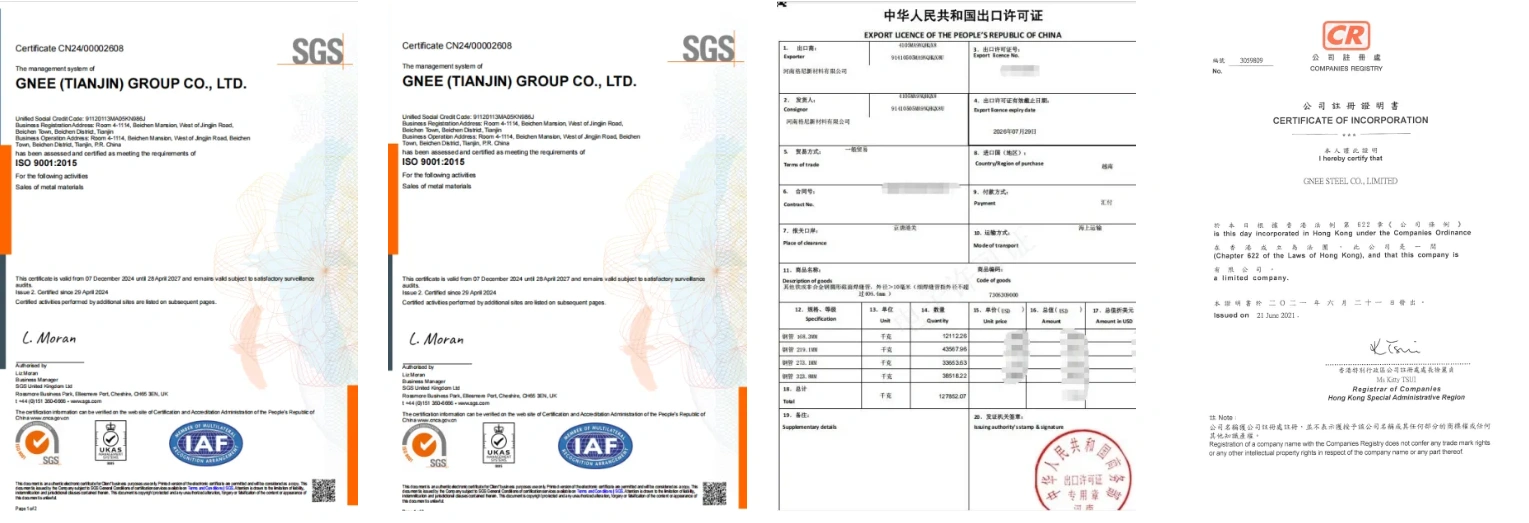
EN 10204 3.1 mill cert, PMI report, dimensional report, hydrostatic test |
|
Lead time |
15–25 days for stock sizes, 30–45 days for custom |
|
Packaging |
VCI film + ISPM 15 wooden case, FOB / CIF / EXW / DDP |
Common alloys of aluminum pipe tee fitting
6061-T6 aluminum pipe tee fitting is the default for most jobs. It is strong, weldable, machinable, and it anodizes well. Tensile minimum 290 MPa, yield minimum 241 MPa per ASTM B221. Use it for compressed air, water, general industrial piping.
6063-T6 aluminum pipe tee is the choice when the surface matters. Lower strength than 6061 (207/172 MPa minimums) but it extrudes to a smoother surface and anodizes to the cleanest finish. Architectural and HVAC work often specifies it.
5083 aluminum tee fitting is the marine and cryogenic grade. O temper for cryogenic service down to -196°C, H116/H321 for shipboard structure. Tensile minimum 269–303 MPa depending on temper. 5083 resists seawater pitting that would eat a 6061 line.
5086 aluminum tee is the other marine alloy, close to 5083 with slightly lower magnesium. Both are acceptable for seawater; 5083 is more common in fittings.
6082 aluminum tee is the European equivalent of 6061 with a bit more strength. If your spec is EN, we supply it; US buyers usually stay with 6061.
5052 aluminum tee is manufactured from 5052 aluminum alloy, offering excellent corrosion resistance, weldability, and formability; it is suitable for marine applications, industrial piping, HVAC systems, and general fluid transport systems.
Chemical composition
|
Element |
6061 |
6063 |
5083 |
5086 |
6082 |
|
Si |
0.40–0.80 |
0.20–0.60 |
0.40 max |
0.40 max |
0.70–1.30 |
|
Fe |
0.70 max |
0.35 max |
0.40 max |
0.50 max |
0.50 max |
|
Cu |
0.15–0.40 |
0.10 max |
0.10 max |
0.10 max |
0.10 max |
|
Mn |
0.15 max |
0.10 max |
0.40–1.00 |
0.20–0.70 |
0.40–1.00 |
|
Mg |
0.80–1.20 |
0.45–0.90 |
4.00–4.90 |
3.50–4.50 |
0.60–1.20 |
|
Cr |
0.04–0.35 |
0.10 max |
0.05–0.25 |
0.05–0.25 |
0.25 max |
|
Zn |
0.25 max |
0.10 max |
0.25 max |
0.25 max |
0.20 max |
|
Ti |
0.15 max |
0.10 max |
0.15 max |
0.15 max |
0.10 max |
Mechanical properties
|
Alloy & temper |
Spec min UTS |
Spec min YS |
Spec min Elong |
Typical UTS / YS |
|
6061-T6 |
290 MPa |
241 MPa |
8% |
310 / 276 MPa |
|
6063-T6 |
207 MPa |
172 MPa |
8–10% |
241 / 214 MPa |
|
6063-T5 |
152 MPa |
110 MPa |
8% |
186 / 145 MPa |
|
5083-O |
269 MPa |
110 MPa |
16% |
290 / 145 MPa |
|
5083-H116/H321 |
303 MPa |
228 MPa |
10% |
310 / 240 MPa |
|
6082-T6 |
310 MPa |
260 MPa |
10% |
340 / 310 MPa |
Density is 2.70 g/cm³ for the 6xxx series and 2.66–2.68 for the 5xxx series. Young's modulus is about 69–70 GPa, one third of steel.
Standards of aluminum tees
We manufacture and inspect aluminum tees to:
|
Standard |
What it covers |
|
ASTM B361 |
Factory-made wrought aluminum and aluminum-alloy welding fittings |
|
ASME SB361 |
ASME material version of ASTM B361 |
|
ASME B16.9 |
Factory-made wrought buttwelding fittings - dimensions, tolerances, marking |
|
ASME B16.52 |
Forged aluminum and aluminum-alloy fittings with socket-welding and threaded ends |
|
EN 755-1 to -9 |
Wrought aluminum extrusion products (used for stock pipe) |
|
EN 10204 3.1 |
Mill test certificate content |
Sizes and Dimensions
We supply stock tees from ½" NPS to 24" NPS. Custom sizes up to 48" NPS available on request. For a 90° equal tee in ASME B16.9 dimensions:
|
NPS |
OD (mm) |
Center-to-End C (mm) |
SCH 40 wall (mm) |
SCH 80 wall (mm) |
|
½" |
21.3 |
25.4 |
2.77 |
3.73 |
|
¾" |
26.7 |
28.4 |
2.87 |
3.91 |
|
1" |
33.4 |
38.1 |
3.38 |
4.55 |
|
1½" |
48.3 |
47.8 |
3.68 |
5.08 |
|
2" |
60.3 |
57.2 |
3.91 |
5.54 |
|
3" |
88.9 |
76.2 |
5.49 |
7.62 |
|
4" |
114.3 |
95.3 |
6.02 |
8.56 |
|
6" |
168.3 |
124.0 |
7.11 |
10.97 |
|
8" |
219.1 |
152.4 |
8.18 |
12.70 |
|
10" |
273.1 |
175.0 |
9.27 |
15.09 |
|
12" |
323.9 |
203.2 |
10.31 |
17.48 |
|
16" |
406.4 |
254.0 |
12.70 |
21.44 |
|
20" |
508.0 |
304.8 |
15.09 |
26.19 |
|
24" |
609.6 |
355.6 |
17.48 |
30.96 |
Tolerances per ASME B16.9:
Center-to-end C: ± 2 mm for sizes ≤ 4"; ± 3 mm for sizes 5" – 8"; ± 5 mm above.
Wall thickness: -12.5% of nominal, no upper limit.
Outside diameter (at welding ends): per ASME B36.10M / B36.19M tables.
For reducing tees, the branch center-to-end is typically the same as an equal tee of the run size. The branch opening is bored to match the smaller NPS - see ASME B16.9 for the exact branch bore dimensions.
For threaded tees (NPT/BSP) up to 4" NPS, dimensions follow ASME B16.52. Larger threaded tees go through an SW transition.
Surface Treatment Options
Aluminum tees ship in mill finish by default. Other options:
- Mill finish - standard, as-extruded or as-formed.
- Anodized clear (Type II) - adds ~0.0003" oxide layer, slight matte finish, better corrosion resistance for indoor/casual-outdoor use.
- Anodized colour - black, bronze, gold, red, blue, custom colours. Used when visual appearance matters (architectural, food equipment).
- Hard anodized (Type III) - 0.002" oxide layer, very wear-resistant. Often used for hydraulic equipment.
- Brushed - mechanical finish for appearance.
- Polished - for sanitary / food-grade (note aluminum is rarely chosen for sanitary lines - 316L stainless dominates here).
- Painted / powder-coated - for colour matching on architectural projects.
- Sandblasted Finish


Applications by Industry

Hydraulic systems
light hydraulic return lines, machine tool hydraulics, mobile equipment. 6061-T6 is the standard.

Compressed air
factory compressed air distribution, oil-free air for food/pharma. 6061-T6 or 6063-T6. Aluminum is naturally corrosion-resistant, doesn't rust into the airstream.

Chemical plants
for non-oxidizing acids (acetic, dilute sulfuric), aldehydes, ketones. NOT for strong caustic (pH > 9) or chloride salts (will pitting-corrode). 6061-T6 with proper isolation works for many applications.

Marine piping
seawater cooling lines, ballast, bilge, freshwater systems on aluminum hulls. 5083-O is the only alloy to pick for continuous seawater contact.

Cryogenic / LNG
5083-O is rated down to -196°C with no embrittlement. Used for LNG vapor lines, nitrogen service, LNG carrier deck piping.

Architectural / structural
visible piping on architectural aluminum structures, atrium piping, decorative headers. 6063-T6 is the choice for the finish.

Food and beverage
limited. Aluminum is reactive with acidic foods; stainless 304/316 is the default. Aluminum tees are usable in non-acidic dry-food pneumatic conveyance.

Equipment OEM
air/oil/coolant manifolds built into machine tools, injection moulding machines, packaging machinery.
Welding the Tee (BW version)
For 6061-T6 tees, the recommended filler wires are:
ER4043 - the most common choice. Easy to feed, good wetting, slight as-welded strength drop (HAZ softens by ~30% in 6061-T6). Cosmetic finish is good.
ER5356 - slightly higher as-welded strength, better colour match after anodizing. Use when cosmetic anodizing is required post-fabrication.
For 5083-O, use ER5183 or ER5356.
For 6063, ER4043 or ER5356 - both work; 5356 is preferred when anodizing afterward.
The 6061-T6 HAZ softening is the main gotcha: if your tee is welded into a system that needs full T6 strength at the weld, that's something to plan for. Allowable stress derating factors are in ASME B31.3.
We do not pre-weld-age our tees - we ship them in the alloy's base temper (T6 or O). The post-weld aging step is performed on the finished piping assembly if the assembly is small enough to fit into an aging oven.
Pressure Rating
Pressure rating depends on the alloy, temper, schedule, and the ASME B31.3 allowable stress at design temperature. A useful sanity-check for the common case of 6061-T6:
|
NPS × SCH |
Design pressure at 38°C |
Design pressure at 100°C |
Design pressure at 200°C |
|
1" SCH 40 6061-T6 |
35 bar |
30 bar |
22 bar |
|
2" SCH 40 6061-T6 |
24 bar |
21 bar |
16 bar |
|
4" SCH 40 6061-T6 |
18 bar |
16 bar |
12 bar |
|
6" SCH 40 6061-T6 |
14 bar |
12 bar |
9 bar |
These are illustrative. Final rating must be calculated per ASME B31.3 with the specific allowable stress for the alloy at design temperature, including appropriate joint efficiency factor for welded construction. We provide this calculation in the datasheet for any pressure-rated PO.
Comparison with other materials
|
Property vs other materials |
Aluminum tee |
304/316 stainless tee |
Carbon steel tee |
|
Density |
2.7 g/cm³ |
8.0 g/cm³ |
7.85 g/cm³ |
|
Weight for the same NPS SCH 40 |
1 (reference) |
3.0× heavier |
2.9× heavier |
|
Corrosion to atmosphere |
Excellent (oxide film) |
Excellent (Cr oxide) |
Poor (needs paint) |
|
Corrosion to seawater |
Limited to 5xxx series |
Good (316 better) |
Poor |
|
Corrosion to strong caustic |
Poor |
OK |
OK |
|
Approximate cost vs aluminum |
- |
2.5–4× |
0.6–0.9× |
|
Welding ease |
Moderate (needs TIG, clean) |
Moderate (TIG/MIG) |
Easy (SMAW/GTAW) |
|
Temperature limit continuous |
200°C |
800°C |
400°C |
|
Galvanic compatibility with steel |
Not direct (use dielectric union) |
OK |
- |
Packaging and Lead Time
Small tees (½" – 2" NPS): individually PE-bagged, then bundled in cartons, then palletized.
Medium tees (3" – 8" NPS): PE bag + carton + pallet stretch wrap.
Large tees (10" – 24" NPS): each piece wrapped, wooden case per ASME ISTA Procedure 3A or ISPM 15 (for export).
Oversize (>24" NPS): custom crating.
Trade terms we quote on: EXW Tianjin, FOB Tianjin / Shanghai / Qingdao, CIF destination port, DDP project site. Lead time for stock sizes is 15–25 working days; custom fabricated sizes are 30–45 days; custom alloys are 45–65 days.

Quality Inspection
Material verification - PMI on every heat using a positive material identification gun to confirm alloy.
Dimensional inspection - center-to-end, OD, wall thickness, branch bore diameter.
Visual inspection - weld bead, surface finish, no cracks/porosity/dent.
Hydrostatic test - for pressure service, 1.5× design pressure held for 5 minutes.
Documentation - EN 10204 3.1 cert, dimensional report, PMI report.
Each tee is marked with: manufacturer logo, material, size, schedule, heat number, standard.
FAQs
Hot Tags: aluminum pipe tee fittings, China aluminum pipe tee fittings manufacturers
You Might Also Like


Send Inquiry