

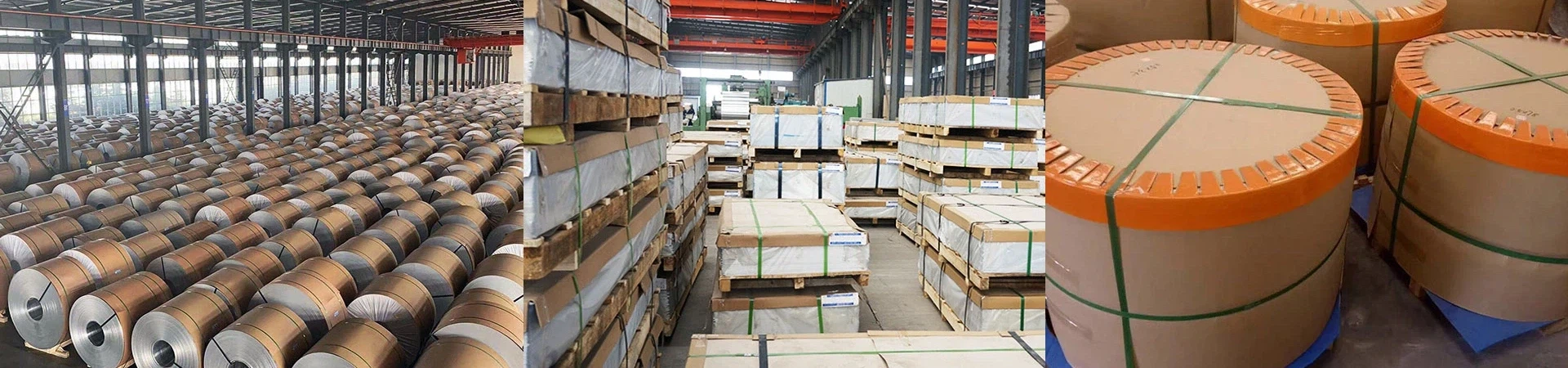
3003 is a manganese-alloyed metal known for exceptional formability and rust resistance. 6061 is a magnesium and silicon-alloyed metal celebrated for its structural strength and machinability.
Chemical Composition of 3003 and 6061 Aluminum Flat Panel
The foundational difference between these two metals is their chemistry. At GNEE, our casting process strictly follows the ASTM B209 standard.
- 3003 Aluminum: Relies on Manganese. It is a non-heat-treatable alloy, meaning you cannot bake it in an oven to make it stronger. It only gains strength through cold rolling at the mill.
- 6061 Aluminum: Relies on Magnesium and Silicon. This specific combination allows the metal to be thermally heat-treated (precipitation-hardened) in aging ovens, which drastically increases its tensile strength.
| Element | 3003 Aluminum Flat Panel (%) | 6061 Aluminum Flat Panel (%) | Factory Metallurgical Purpose |
| Manganese (Mn) | 1.0 - 1.5 | 0.15 max | Adds moderate strength to 3003 for sheet metal bending. |
| Magnesium (Mg) | - | 0.8 - 1.2 | The core strengthener in 6061; enables heat treatment. |
| Silicon (Si) | ≤ 0.6 | 0.4 - 0.8 | Pairs with Magnesium in 6061 to form Magnesium Silicide. |
| Copper (Cu) | 0.05 - 0.20 | 0.15 - 0.40 | Boosts strength and improves CNC machinability in 6061. |

Yield Strength of 3003 vs 6061 Aluminum Plate
To compare strength, we must compare specific tempers. In the commercial flat plate market, you are typically choosing between 3003-H14 (Half Hard) and 6061-T6 (Artificially Aged/Heat Treated).
The thermal heat treatment pushes the 6061-T6 aluminum plate to a yield strength nearly twice as high as 3003-H14. If your product needs to bear heavy mechanical loads without bending out of shape, 6061 is the mandatory choice.
| Mechanical Property | 3003-H14 (Half Hard) | 6061-T6 (Heat Treated) | What This Means on the Shop Floor |
| Tensile Strength | ~150 MPa (22,000 psi) | ~310 MPa (45,000 psi) | 6061-T6 handles massive stress before breaking. |
| Yield Strength | ~145 MPa (21,000 psi) | ~275 MPa (40,000 psi) | 6061-T6 will not permanently deform under heavy loads. |
| Elongation | 8% - 16% | 10% - 12% | 3003-H14 bends much easier at sharp angles. |
| Hardness (Brinell) | ~40 HB | ~95 HB | 6061-T6 resists deep surface scratches and dents. |
Machining and Bending 6061 and 3003 Aluminum Sheets
CNC Machining Reality:
If your production involves CNC milling, drilling, or tapping threads, wholesale 6061-T6 aluminum plate is vastly superior. Because it is a hard alloy, the metal chips cleanly away from the cutting tool, leaving a brilliant, precise surface finish.
By contrast, 3003 is very soft. In factory terms, it is "gummy." When you run a drill bit through 3003 at high speeds, the friction melts the aluminum, causing it to stick to the tooling flutes. This ruins the threads and can snap your tool bits.
Bending and Forming:
If you are doing sheet metal work on a press brake, the roles reverse.
3003-H14 is highly ductile. You can confidently bend it to a sharp 90-degree angle (often with a tight 1t radius) and the outer grain will not fracture.
If you attempt a sharp 90-degree bend on a 6061-T6 sheet, the rigid outer grain will immediately snap. To bend 6061-T6, you must use a much larger bend radius (typically 3t to 5t).
Weldability:
Both alloys weld excellently using standard TIG or MIG processes. Use an ER1100 filler rod for 3003, and an ER4043 or ER5356 filler rod for 6061. Note that welding 6061-T6 will create a Heat Affected Zone (HAZ), which temporarily destroys the T6 hardness around the weld seam unless you re-heat-treat the part.

Common Uses for 6061 and 3003 Aluminum Flat Sheet
Where to use 3003 Aluminum Flat Sheet:
Due to its formability and resistance to continuous moisture, 3003 is heavily utilized in sheet metal fabrication where high structural strength is not required.
- HVAC Systems: Evaporator fins, ductwork, and condenser casings.
- Food & Chemical Storage: Deep-drawn cooking pots, baking pans, and welded chemical tanks.
- Commercial Transportation: Trailer side-siding, roofing panels, and protective kick plates.
Where to use 6061 Aluminum Plate:
Because of its high yield strength and dimensional stability during machining, 6061 is the workhorse of mechanical engineering.
- Industrial Machinery: Thick CNC machined base plates, automated assembly line frames, and custom tooling fixtures.
- Marine Applications: Boat hull brackets, heavy-duty marine fittings, and ramps (due to excellent saltwater resistance).
- Structural Support: Scaffolding platforms, heavy structural brackets, and high-stress architectural joints.
Factory Cost and SMM Pricing for 6061 Aluminum Plate
Current SMM (Shanghai Metals Market) Base Price + Factory Processing Fee + Ocean Freight.
The price difference between the two alloys lies entirely in the Factory Processing Fee:
- 3003 Processing: We melt the ingot, cast it, and cold-roll it. It is fast and energy-efficient.
- 6061-T6 Processing: After rolling, the 6061 flat sheet must undergo a massive thermal process. It is placed in a solution heat-treatment furnace, rapidly water-quenched, and then baked in an artificial aging oven for several hours to achieve the "T6" temper. This consumes massive amounts of electricity and time, drastically increasing the mill processing fee.
If your part does not carry a heavy load and simply acts as a cover, enclosure, or tank, downgrade your blueprints from 6061 to 3003 to save thousands of dollars on bulk orders.
Frequently Asked Questions (FAQ)
Q1: Can I anodize both 3003 and 6061 aluminum flat sheets?
Yes, but 6061 provides a vastly superior cosmetic result. 6061-T6 anodizes beautifully and absorbs color dyes (like black, red, or blue) evenly. 3003 can be anodized for protective hard coating, but due to its manganese content, the finish often appears slightly yellowish or dull, making it unsuitable for high-end decorative parts.
Q2: Which aluminum is better for marine environments, 3003 or 6061?
6061 is far superior for marine and saltwater environments. It contains magnesium and silicon, which provide excellent resistance to saltwater corrosion. 3003 handles atmospheric moisture (rain) perfectly, but prolonged exposure to direct seawater will cause it to pit faster than 6061.
Q3: Is 6061 aluminum lighter than 3003 aluminum?
No. Both 3003 and 6061 aluminum alloys have nearly identical densities, weighing approximately 2.7 g/cm³ (0.098 lb/in³). However, because 6061 is significantly stronger, engineers can often design thinner parts using 6061 to achieve the same structural rigidity as a thicker 3003 part, thereby reducing the overall weight of the final assembly.
Q4: I need to bend a 6061 plate, but it keeps cracking. What should I do?
You are likely trying to bend a 6061-T6 (Fully Hardened) plate with a sharp radius. You have two factory solutions: Either increase your tooling bend radius to at least 3t-5t (three to five times the material thickness), or order the material in the 6061-O (Annealed) temper, bend it easily, and then send the finished part out for heat treatment to regain its T6 strength.


