





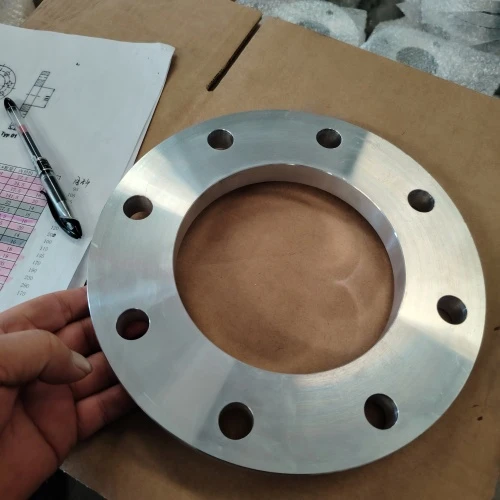

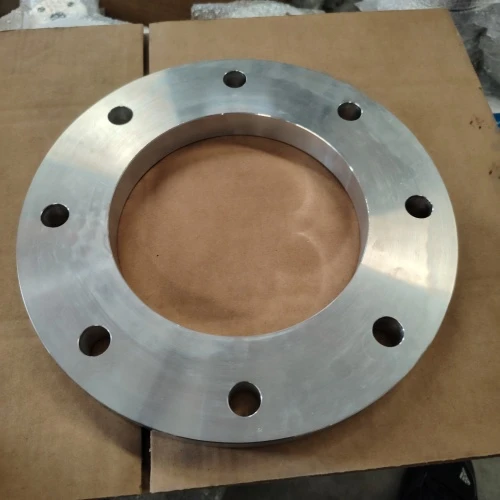
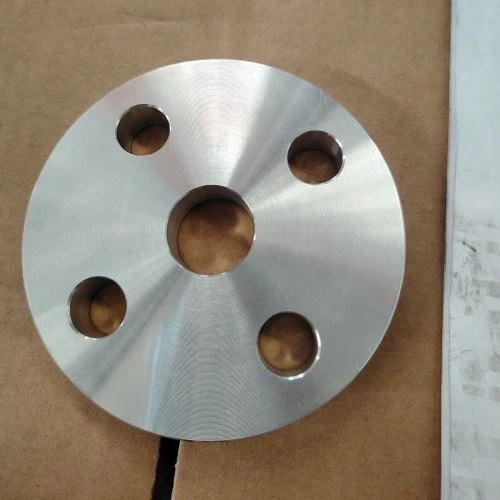
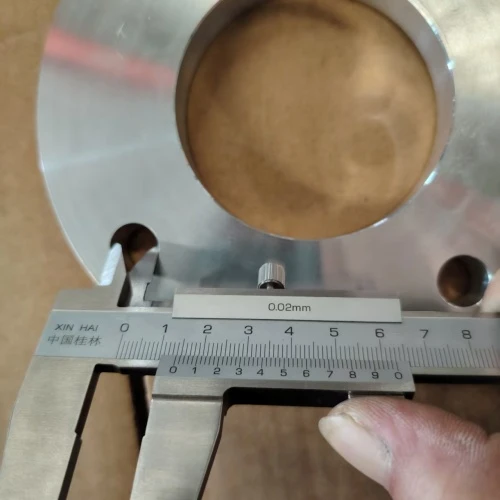
ASME B16.5 5086 Aluminum Slip On Flanges
Section shape: flange ring with short hub and slip-on bore
Alloy and temper: 5086 H116 / H112 / H32
Standard: to customer drawing; ASME B16.5 / EN 1092-4:2002 as dimensional references only
Technique: plate or forging blank plus CNC machining
Surface treatment: natural finish or clear anodizing as specified
MOQ: flexible; small trial orders and full containers both accepted
Lead time: 15-30 days
Certificate: EN 10204 3.1, with 3.2 and third-party inspection available
HS code: 7609, subject to final classification by destination customs
Transport package: export crate, facing protected, sealed against moisture
Customer service is online. Enter the chat to get the latest quotation.
 Spot stock
 Customize
 Factory direct sale
 7 days delivery
GNEE has supplied aluminum slip on flanges since 2008 and exports to more than 100 countries and regions. These 5086 aluminum flanges are machined from 5086 plate or forging stock and ship with an EN 10204 3.1 mill test certificate.
A 5086 aluminum slip on flange slides over the pipe outside diameter and is fixed with a fillet weld at the bore and a second fillet weld at the back of the ring.
5086 is selected where weldability and seawater corrosion resistance govern the material choice. GNEE supplies these flanges to the nominal size, class, facing and bolt pattern of the project drawing or dimensional reference, with custom bore and drilling to drawing.
We reply within 24 hours with the specification, lead time and documentation plan.
5086 Aluminum Slip On Flange Reference Price
5086 aluminum slip on flanges are quoted as an SMM metal base plus a conversion charge. The figures below use the SMM A00 spot settlement of 22,950 CNY/t (about 3,441 USD/t at 6.67 CNY per USD) on 17 November 2026. The conversion covers blank cutting, CNC machining, drilling, facing and inspection for each line, and the reference total adds the two.
| Alloy & temper | Size / class | Form | Facing | SMM base, CNY/t | Conversion, CNY/t | Reference, CNY/t | Reference, USD/t |
|---|---|---|---|---|---|---|---|
| 5086-H116 | NPS 2, Class 150 | Slip on | Raised face | 22,950 | 13,500 | 36,450 | 5,465 |
| 5086-H112 | NPS 4, Class 150 | Slip on | Flat face | 22,950 | 11,200 | 34,150 | 5,120 |
| 5086-H116 | NPS 6, to drawing | Slip on, custom bore | Raised face | 22,950 | 9,800 | 32,750 | 4,910 |
Conversion charges are indicative and market-dependent and move with order size, tolerance and finish. CNY figures include 13% VAT. They are given for comparison only - a contract in USD is converted at the exchange rate on the contract date, so the settled amount can differ from the figures shown here.
Raised Face and Flat Face Options for 5086 Slip On Flanges
A 5086 raised face slip on flange has a raised sealing ring around the bore, so the gasket bears on a narrow annulus and seals with lower bolt load. A 5086 flat face slip on flange uses the full ring as the sealing surface with a full-face gasket. Both follow the facing dimensions of the selected standard and share the same bore and drilling for a given size and class.
Select RF or FF aluminum slip on flange facing to match the mating equipment and the gasket specified for the line. GNEE machines the raised face height or the full flat face to the standard and confirms the facing on the drawing before production.

Specification of 5086 Aluminum Slip On Flanges
| Parameter | Specification |
|---|---|
| Product name | 5086 aluminum slip on flange |
| Alloy | 5086, UNS A95086 |
| Temper | H116, H112 or H32, stated on the mill test certificate for the delivered lot |
| Manufacturing method | Plate or forging blank, CNC turning, facing and drilling |
| Size range | NPS 1/2 to 24 (DN15 to DN600) as the standard range; custom sizes to drawing |
| Pressure class | Class 150 / 300 / 600 (inch) or PN (EN) as a dimensional reference for the 5086 aluminum slip-on; working rating fixed at order review with the piping designer |
| Flange facing | Raised face or flat face, selected to match the mating flange and gasket |
| Flange basis | To customer drawing; ASME B16.5 / EN 1092-4:2002 as inch / PN dimensional references only; the 5086 aluminum slip-on is not certified under either, rating set at order review |
| Bolt hole pattern | Per the selected interface reference or customer drawing |
| Surface finish | Machined natural finish; clear anodizing available on request |
| Material certificate | EN 10204 3.1; 3.2 and third-party inspection available |
| HS code | 7609, subject to final classification by destination customs |
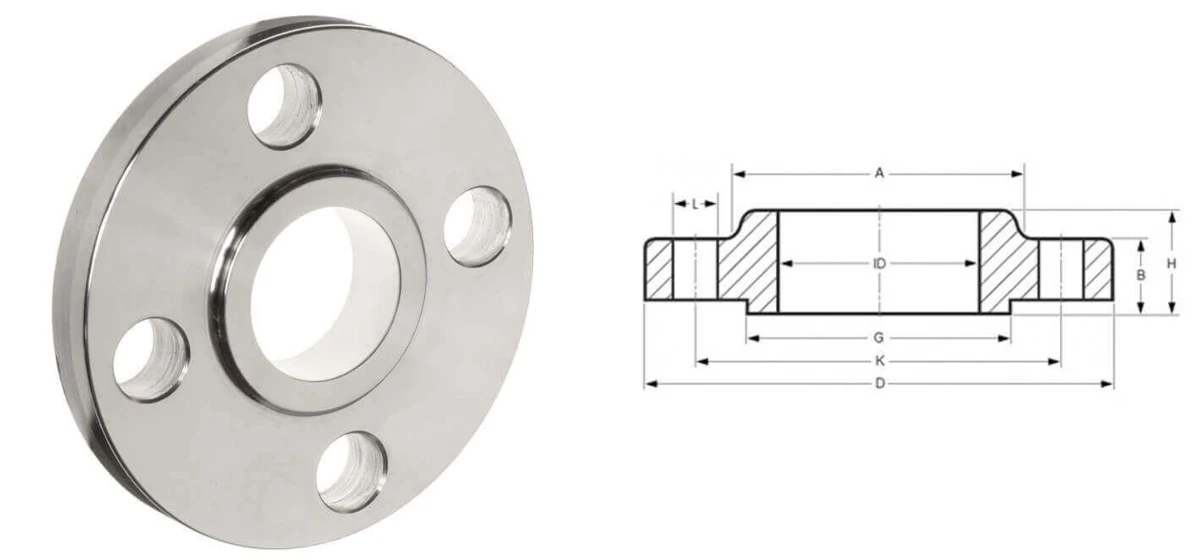
The size range, class and facing above describe manufacturing scope. The temper, standard and pressure-temperature basis are fixed at order review against the piping design.
Chemical Composition of 5086 Aluminum
| Element | Typical limit, wt% |
|---|---|
| Magnesium, Mg | 3.5 - 4.5 |
| Chromium, Cr | 0.05 - 0.25 |
| Silicon, Si | 0.40 max |
| Zinc, Zn | 0.25 max |
| Manganese, Mn | 0.20 - 0.70 |
| Copper, Cu | 0.10 max |
| Iron, Fe | 0.50 max |
| Titanium, Ti | 0.15 max |
| Aluminum, Al | Remainder |
| Others, each | 0.05 max |
Magnesium is the principal alloying element and gives 5086 its solid-solution strength and corrosion behaviour. Manganese and chromium refine the grain structure. The certificate issued for each lot is the controlling document for that lot.
Mechanical Properties of 5086 Aluminum
| Condition | Tensile strength, MPa | Yield strength, MPa | Elongation, % | Density, g/cm3 |
|---|---|---|---|---|
| 5086-H116 | 260 | 185 | 10 | 2.66 |
| 5086-H112 | 240 | 165 | 12 | 2.66 |
| 5086-H32 | 260 | 190 | 10 | 2.66 |
These values are typical reference figures for material selection. The measured properties of a delivered flange follow the temper and thickness on its mill test certificate, and design values come from the governing code for that alloy and condition.
Corrosion Resistance of 5086 Aluminum in Marine Service
5086 aluminum is used in marine and coastal equipment because it forms a stable oxide film and resists seawater attack in flowing conditions. It keeps useful strength after welding, which matters for a flange that will be fillet welded to a pipe. That combination explains its use in hull structures, tanks and piping on vessels and in coastal plant.
Corrosion resistance depends on the service. Stagnant seawater, shielded crevices under gaskets, deposits and contaminated atmospheres can produce pitting or crevice corrosion. Flange faces and bolt holes are areas where water can collect, so the joint design, gasket selection and inspection interval belong in the specification alongside the alloy grade.
Dimensions and Tolerances of 5086 Aluminum Slip On Flanges
| Dimension | Basis |
|---|---|
| Outside diameter | Customer drawing, or ASME B16.5 / EN 1092-4:2002 as mating reference for the 5086 aluminum slip-on only |
| Bore diameter | Customer drawing and pipe schedule |
| Flange thickness | Dimension reference table or drawing |
| Bolt circle and hole diameter | Dimension reference table or drawing |
| Facing | Dimension reference table or drawing |
| Dimensional tolerance | Machining drawing; ASME B16.5 / EN 1092-4:2002 as mating reference for the 5086 aluminum slip-on |
Slip on bores are machined to fit the pipe outside diameter with a small assembly gap for welding.
Material Standards and Flange Design Standards for 5086 Aluminum
Buyers often see several standard numbers attached to one flange and assume they are interchangeable. They cover different things. Material standards describe the plate or forging from which the flange is made. Flange design standards describe the dimensions, facing, drilling and rating of the finished flange. Both belong on a complete enquiry.
Material Standards for 5086 Aluminum Plate and Forgings
ASTM B209 covers aluminum plate and sheet and is the common material basis when a slip on flange is cut from plate. AMS-QQ-A-250/19 is a material specification for 5086 plate and sheet; it defines the material form and condition and is not a finished flange standard. ASTM B247 and B247M cover aluminum die and hand forgings and apply where the flange blank is a qualifying forging. The certificate identifies which of these material forms was supplied.
Flange Design Standards for 5086 Aluminum Slip On Flanges
ASME B16.5 gives the dimensions, facing and bolt patterns for the inch series, and EN 1092-4 gives the corresponding PN series for aluminum flanges. Pressure-temperature ratings for aluminum flanges are addressed in ASME B31.3 Appendix L for the alloys and tempers listed there. Confirm the rating basis for the ordered 5086 temper with the piping designer, since dimensional compatibility with a standard does by itself establish a working rating.
Slip On and Weld Neck Aluminum Flange Design Comparison
| Item | Slip on aluminum flange | Weld neck aluminum flange |
|---|---|---|
| Connection to pipe | Pipe inserted through the bore | Hub butt welded to the pipe end |
| Weld type | Fillet weld at the bore and at the rear of the ring | Single butt weld at the hub end |
| Hub geometry | Short hub, straight bore | Long tapered hub |
| Bore preparation | Machined to pipe outside diameter with assembly clearance | Machined to pipe inside diameter with a weld bevel |
| Alignment | Pipe positioned through the ring before welding | Hub aligned to the pipe end before welding |
| Selection basis | Piping design, joint access and applicable standard | Piping design, loading and applicable standard |
Both 5086 aluminum flanges and weld neck forms provide a bolted connection in piping, and the choice follows the piping design, the joint loading and the system standard.
Applications of 5086 Slip On Flanges
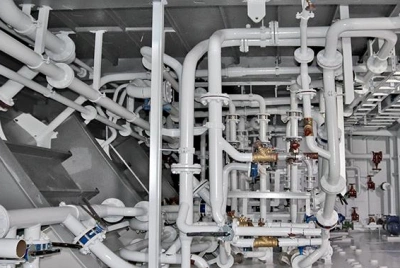
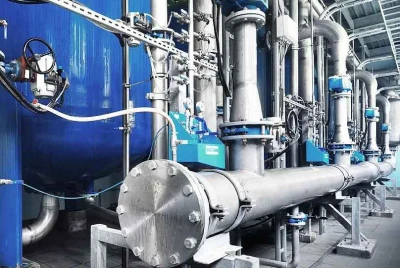
Marine piping systems use these flanges on seawater lines, ballast and cooling circuits where the welded connection and the corrosion behaviour of 5086 both matter. The slip on form is fitted around the pipe and welded in place, which suits the shop fabrication of spool pieces and the connection of equipment nozzles.
Shipboard tanks and piping use 5086 aluminum for tank walls and the associated lines, so a flange in the same alloy keeps the material compatible at the interface. Industrial tanks and reservoirs use the flanges at inlet, outlet and drain connections where a bolted joint allows the line to be removed for cleaning or maintenance.
Corrosion-resistant piping in coastal plant and process equipment is the fourth application group. In each case the medium, pressure, temperature and any classification-society requirement are confirmed separately from the alloy selection. The flange is a component in the piping design, and the design owner sets the service limits.
Material Standards and Flange Design Standards for 5086 Aluminum
Material standards describe the plate or forging from which the flange is made. Flange design standards describe the dimensions, facing, drilling and rating of the finished flange. Both belong on a complete enquiry.
Material Standards for 5086 Aluminum Plate and Forgings
| Standard | Scope and role for 5086 aluminum slip on flanges |
|---|---|
| ASTM B209 | Aluminum plate and sheet; material basis when the flange is cut from plate |
| AMS-QQ-A-250/19 | 5086 plate and sheet specification; defines form and condition, not a finished flange standard |
| ASTM B247 / B247M | Aluminum die and hand forgings; applies when the blank is a qualifying forging |
| Mill test certificate | Identifies the material form supplied for the delivered lot |
Flange Dimensional References and Rating Basis for 5086 Aluminum Slip On Flanges
| Reference or basis | Scope for 5086 aluminum slip on flanges |
|---|---|
| ASME B16.5 | Dimensional and mating reference for the inch series (OD, facing, bolt pattern, tolerances), called up by B31.3 Appendix L; aluminum is not in the B16.5 material list, so B16.5 ratings do not apply to the 5086 aluminum slip-on |
| EN 1092-4:2002 | Covers PN blind (Type 05) and weld-neck (Type 11) aluminum flanges with B/C/D facings; for the 5086 aluminum slip-on it is a mating-dimension reference only, with no certification of the slip-on form |
| ASME B31.3 Appendix L | Ratings only for ASTM B247 forgings in 3003-H112 and 6061-T6 (Class 150/300/600, NPS 1/2-24); 5086 and plate-cut slip-on are outside that scope, so rating is set by project calculation |
| Order review | Confirm the rating basis for the ordered 5086 temper with the piping designer; dimensional compatibility with a standard does not by itself establish a working rating |
Welding and Fabrication of 5086 Slip On Flanges
Set the flange on the pipe, check that the face is square to the pipe axis, and tack the assembly before the final weld. Remove the oxide layer from the aluminum surfaces immediately before welding. Gas tungsten arc welding with a compatible 5xxx filler such as ER5356 is common for 5086, and the filler choice follows the welding procedure for the project.
Apply the fillet weld at the bore and at the rear of the ring as required by the joint design. Control heat input so the flange face stays flat and the pipe does not distort, and sequence the weld around the circumference to limit movement. Post-weld cleaning removes discoloration from the heat-affected zone before inspection and before the flange is put into service.
Processing Services for 5086 Aluminum Slip On Flanges
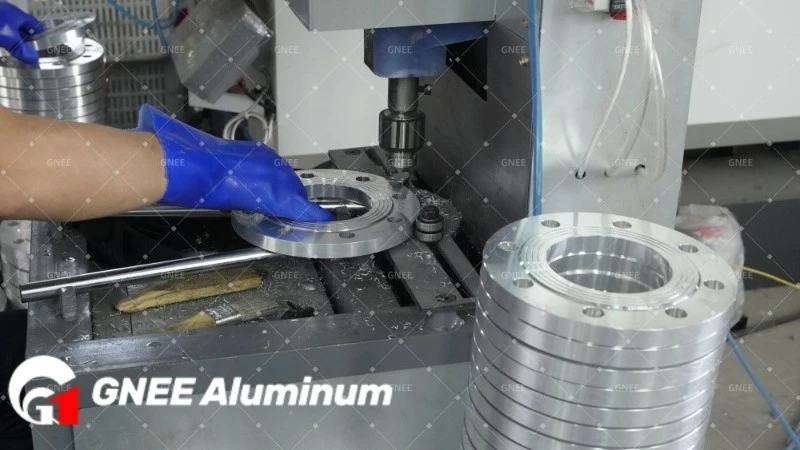
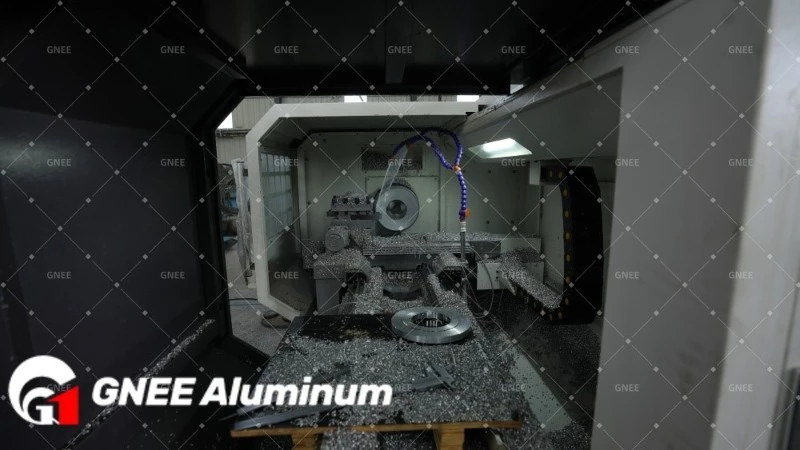
GNEE cuts blank rings from 5086 plate or forging stock, turns the outside diameter and facing on CNC equipment, and machines the bore to the mating pipe. Bolt holes are drilled to the standard pattern or to the customer drawing, including non-standard hole counts and bolt circles where the project requires them.
Custom work includes special bore diameters, non-standard outside diameters, altered flange thickness and facing preparation. Send the drawing with the enquiry and the machining scope is confirmed before production. Cut-to-size and small-batch machining are available alongside container quantities.
Inspection and Testing of 5086 Aluminum Slip On Flanges
- Material test certificate to EN 10204 3.1 matched to the melt and lot, with chemical composition and mechanical properties recorded.
- Chemical composition verification against the 5086 limits before the blank is released to machining.
- Mechanical property verification against the ordered temper and the delivered thickness.
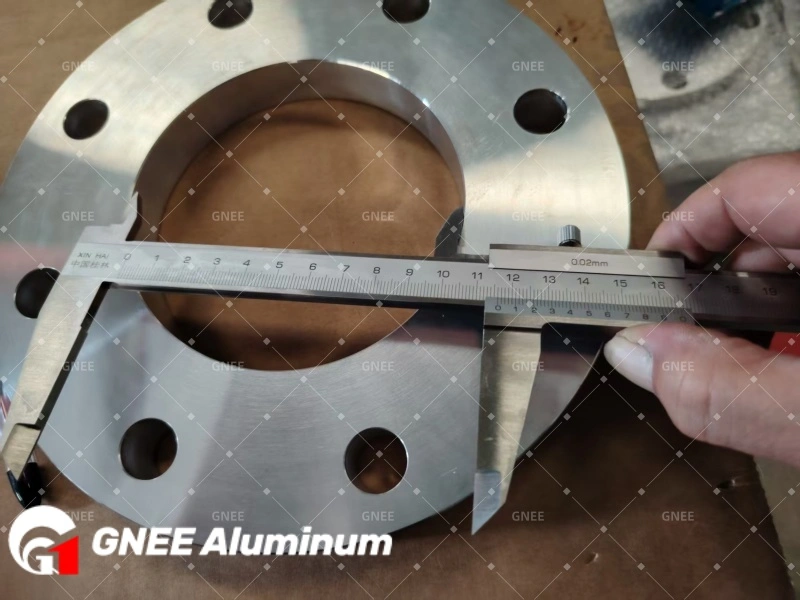
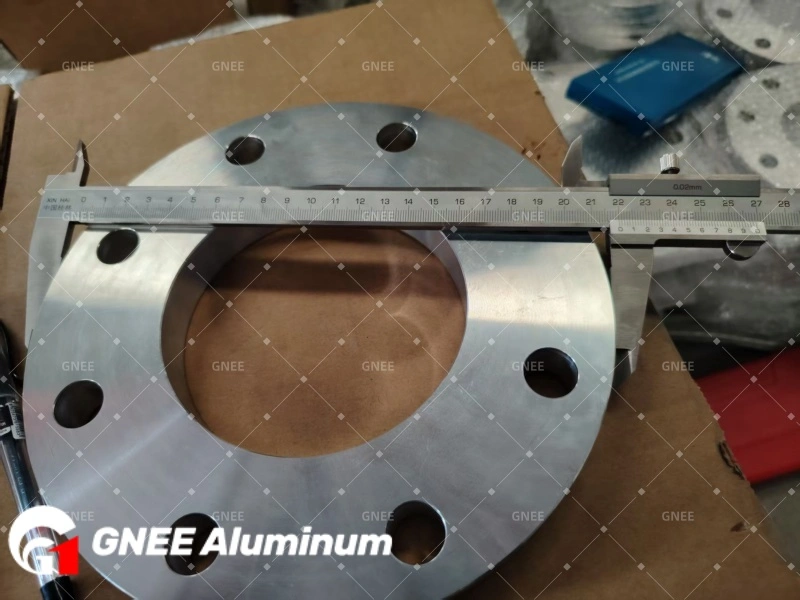
- Dimensional inspection of OD, bore, thickness and hub length against the drawing.
- Facing and bolt-hole inspection covering raised face height, hole count, hole diameter and bolt circle.
- Visual and surface inspection for machining marks, edge damage and contamination before packing.
EN 10204 3.2 certificates and third-party inspection can be arranged when the project specification calls for them. Inspection records are issued with the shipment and linked to the heat number of the delivered flanges.

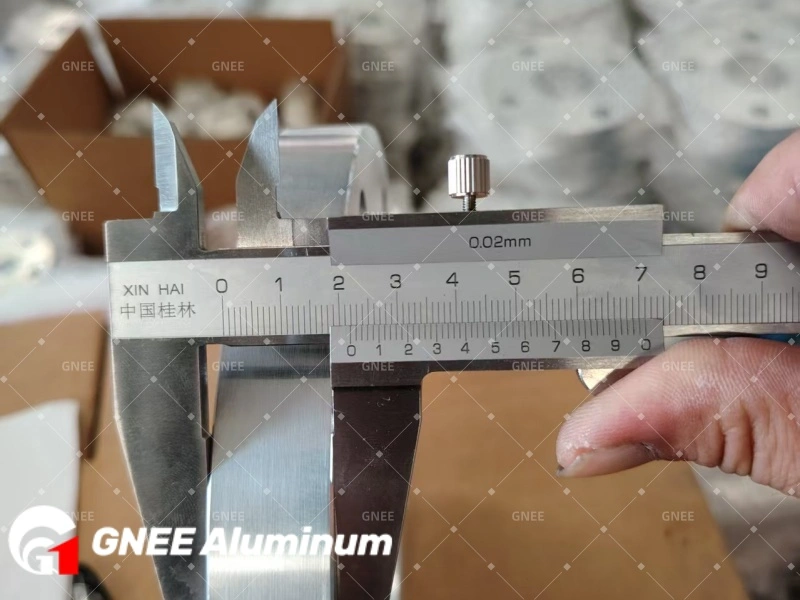
Packaging of 5086 Aluminum Slip On Flanges
Each flange face is protected against contact damage with a facing cover or separator before packing. Flanges are stacked or crated by size and heat number, secured against movement, and wrapped to keep moisture out during sea freight. Each package carries a label with alloy, temper, size, class, quantity and heat number.
The packing list, commercial invoice, bill of lading and mill test certificates are prepared for customs clearance. Packing photographs can be shared before loading.
About GNEE
GNEE was established in 2008 and exports to more than 100 countries and regions.
The supply range covers plate, sheet, coil, foil, bar, tube, profile and aluminum flanges from one source.
CNC turning, facing and drilling lines machine flange dimensions and bolt patterns to customer drawings.
Consignments ship with EN 10204 3.1 certificates; 3.2 certificates and third-party inspection are available on request.
Technical staff review alloy, temper, dimensions and documentation at the enquiry stage.
Request a Quote for 5086 Aluminum Slip On Flanges
Commercial terms are kept simple: MOQ flexible, with small trial orders and large-volume orders both accepted; lead time 15-30 days; EN 10204 3.1 mill test certificate with each lot; pricing anchored to SMM; FOB and CIF terms with T/T or L/C; and we reply within 24 hours.
Request a quote for 5086 aluminum slip on flanges: send the nominal pipe size, pressure class, facing type, temper, flange standard, bolt-hole pattern, quantity and application.
We reply within 24 hours with the specification and documentation plan.
FAQ
Q: What is a 5086 aluminum slip on flange?
A: A 5086 aluminum slip on flange is a flange ring machined from 5086 aluminum alloy that slips over the outside of a pipe and is joined to it with fillet welds on the inside and outside. It provides a bolted connection point in a piping system while the aluminum alloy brings weldability and marine corrosion resistance to the joint.
Q: Is 5086 aluminum suitable for marine applications?
A: 5086 aluminum is widely used in marine and coastal service because it resists seawater corrosion well and keeps useful strength after welding. It is not immune to corrosion: pitting and crevice corrosion can occur in stagnant, shielded or contaminated areas, so surface preparation, joint design and inspection remain part of the specification.
Q: Can 5086 aluminum slip on flanges be welded?
A: Yes. 5086 is a weldable 5xxx series alloy and slip on flanges are attached to the pipe with two fillet welds. Remove the oxide layer before gas tungsten arc welding, use a compatible 5xxx filler such as ER5356, and control heat input so the flange face stays flat and the pipe remains aligned.
Q: What is the difference between 5086 and 6061 aluminum flanges?
A: 5086 is a non-heat-treatable 5xxx alloy with a density near 2.66 g/cm3 and typical H116 tensile strength around 260 MPa. 6061 is a heat-treatable 6xxx alloy near 2.70 g/cm3 whose T6 condition reaches roughly 290 MPa. 5086 keeps more strength in the weld zone and is preferred for marine exposure; 6061-T6 offers higher base strength.
Q: Are 5086 aluminum slip on flanges available in Class 150?
A: Class 150 is a common request for aluminum slip on flanges, and the flange geometry follows the dimensional tables of the chosen standard. The pressure-temperature rating for aluminum depends on the alloy and temper, so confirm the rating basis for the ordered 5086 temper with the piping designer before release.
Q: Can custom dimensions and bolt-hole patterns be supplied?
A: Yes. Besides standard dimensions, GNEE machines bore diameter, outside diameter, flange thickness, facing and bolt-hole patterns to customer drawings. Send the nominal pipe size, class, facing type, hole count, hole diameter, bolt circle and any project standard with the enquiry for a written quotation.
Hot Tags: asme b16.5 5086 aluminum slip on flanges, China asme b16.5 5086 aluminum slip on flanges manufacturers
You Might Also Like


Send Inquiry