


ASTM B209 - Aluminum And Aluminum-Alloy Sheet And Plate
What is ASTM B209
ASTM B209 (full title: Standard Specification for Aluminum and Aluminum-Alloy Sheet and Plate) is the ASTM International specification that defines the requirements for flat-rolled aluminum products supplied in the United States and widely referenced in global tenders. This page explains what the standard covers, which alloys and tempers apply, and how it relates to the EN, JIS, and Chinese GB standards.
ASTM B209 / B209M sets the chemical-composition limits, temper designations, mechanical-property minimums, dimensional tolerances, and inspection rules for aluminum and aluminum-alloy sheet, coiled sheet, and plate. The "M" suffix means the values are expressed in metric (SI) units; the un-suffixed B209 uses inch-pound units. Both are dimensionally equivalent for procurement.
ASTM B209 covers flat-rolled products only. Bar, rod, tube, and extruded shapes are governed by other specs - most commonly ASTM B221 (extruded bar/rod/tube/profile) and ASTM B211 (drawn bar/rod/wire). Do not quote B209 for those forms.
Scope and product definitions
The standard distinguishes product forms by thickness:
Sheet - flat-rolled product with thickness generally ≤ 6.35 mm (0.250 in) and width ≥ 152 mm (6 in).
Coiled sheet - sheet supplied in coil form; same thickness envelope as sheet.
Plate - flat-rolled product with thickness ≥ 6.35 mm (0.250 in).
Thickness is measured at least 25 mm (1 in) in from any edge. Width and length tolerances, flatness, and edge condition are defined by thickness class and ordered width.
Aluminum alloys covered by ASTM B209
The specification lists alloys across the 1xxx, 3xxx, 5xxx, 6xxx, and 8xxx series. The most commonly procured grades are shown below.
| Series | Typical grades in B209 | Principal alloying element | General character |
|---|---|---|---|
| 1xxx | 1050, 1060, 1100 | ≥ 99.0% Al | Excellent corrosion resistance, high formability, low strength, good conductivity. |
| 3xxx | 3003, 3004, 3105 | Manganese | Moderate strength, very good workability; the work-horse general-purpose group. |
| 5xxx | 5005, 5052, 5083, 5086, 5154, 5251, 5454, 5754 | Magnesium | Good-to-high strength, excellent marine/corrosion resistance, weldable. |
| 6xxx | 6061, 6063 | Mg + Si | Heat-treatable; good strength and weldability for structural use. |
| 8xxx | 8011, 8006 | Other (Fe, Si) | Cladding and specialty sheet/foil applications. |
Export-control note: High-strength 2xxx- and 7xxx-series alloys (for example 2024, 7075) are covered under China's dual-use export-control list. Their export, re-export, or transfer requires a license from the Ministry of Commerce; Confirm licensing before quoting any 2xxx/7xxx item.
Temper designations in ASTM B209
A "temper" describes the strain-hardening or heat-treatment condition. ASTM B209 uses the standard ANSI H35.1 temper system:
O - annealed (softest, maximum ductility).
F - as-fabricated (no mechanical-property limit).
H1x - strain-hardened only (e.g., H14, H18).
H2x - strain-hardened then partially annealed.
H3x - strain-hardened then stabilized.
H4x - strain-hardened then painted/lacquered.
T6 - solution heat-treated and artificially aged (used for 6061 plate).
The second digit shows the degree of hardening: H12 / H14 / H16 / H18 represent increasing strength; H22 / H24 / H26 / H28 are the corresponding partially-annealed temps with better ductility.
Mechanical properties (indicative minimums)
The table lists typical minimum tensile (UTS) and yield strengths and elongation per ASTM B209. Actual values on a Mill Test Certificate (MTC) govern the shipment; the figures below are for grade comparison, not for design sign-off.
| Alloy – Temper | UTS, MPa (min) | Yield, MPa (min) | Elongation, % (min) |
|---|---|---|---|
| 1100-O | 90 | 30 | 25 |
| 3003-O | 110 | 42 | 25 |
| 3003-H14 | 150 | 125 | 8 |
| 5052-O | 170 | 65 | 19 |
| 5052-H32 | 215 | 160 | 10 |
| 5083-O | 275 | 125 | 16 |
| 5083-H32 | 315 | 230 | 12 |
| 5754-H22 | 215 | 130 | 12 |
| 6061-T6 (plate) | 290 | 240 | 8 |
| 6063-T6 | 215 | 170 | 8 |
All values above are minimums for the stated temper and thickness bracket. Thinner gauges often carry lower elongation minimums; always read the temper-and-thickness row on the actual MTC. GNEE supplies material with EN 10204 3.1 MTC (3.2 and third-party inspection available on request).
Chemical composition notes
B209 defines strict element limits per alloy. In plain terms:
1xxx (1050, 1060, 1100): minimum aluminum content 99.0 %; almost no intentional alloying.
3xxx (3003, 3004, 3105): manganese up to ~1.2 % (3004 also adds ~1 % Mg) for strength without losing formability.
5xxx (5052, 5083, 5754, 5454): magnesium 2.2–4.9 %; 5083 is the highest-Mg marine plate grade.
6xxx (6061, 6063): magnesium + silicon forming Mg₂Si; heat-treatable to T6.
8xxx (8011): iron- and silicon-balanced for cladding/foil use.
Dimensional tolerances
B209 tables thickness tolerance by the ordered thickness and width class. Key points buyers should specify:
Thickness - tighter bands for thinner sheet; plate tolerances step by thickness and width.
Width / length - plus tolerances by ordered dimension; squareness and camber limits apply.
Flatness - specified for plate; special flatness (e.g., for laser/plasma cutting) can be agreed.
Edges - square, sheared, or slit edges; dedicate edge type in the PO.

Equivalence with EN, JIS, and GB standards
For cross-market quoting, the four-digit international alloys line up as follows:
United States - ASTM B209 / B209M.
Europe - EN 485 (sheet) and EN 573 (composition); the EN AW-xxxx designation maps to the same 4-digit number.
Japan - JIS H4000 (sheet/plate) and JIS H4040 (composition).
China - GB/T 3880 (sheet/plate).
Important for MTCs: For the four-digit international alloys (3003, 5052, 6061, 6063, 6082, etc.), GB/T 3880 adopts the mechanical-property values of ASTM B209 directly. The UTS and yield ranges printed on an MTC are therefore identical under ASTM B209, GB/T 3880, and JIS H4000 for these alloys - there is no hidden strength difference between the standards. (This applies to flat-rolled 1xxx–8xxx four-digit alloys; verify any non-listed or national-only grade case by case.)
Typical applications by alloy
| Grade | Where it is used |
|---|---|
| 1050 / 1060 / 1100 | Chemical equipment, decorative trim, cookware, heat exchangers, signage. |
| 3003 / 3004 | Roofing, gutters, storage tanks, HVAC, general fabrication, can body stock (3004). |
| 5052 | Marine hardware, electronics enclosures, vehicle panels, appliances. |
| 5083 | Shipbuilding plate, pressure vessels, cryogenic tanks, welded structures. |
| 5754 | Automotive body panels, flooring, tread plate, architectural cladding. |
| 6061 | Structural plate, machine bases, bridges, frames, general engineering. |
| 8011 | Cladding, fin stock, conversion foil feedstock. |


Sourcing and documentation
When you request ASTM B209 material from GNEE, each shipment is backed by:
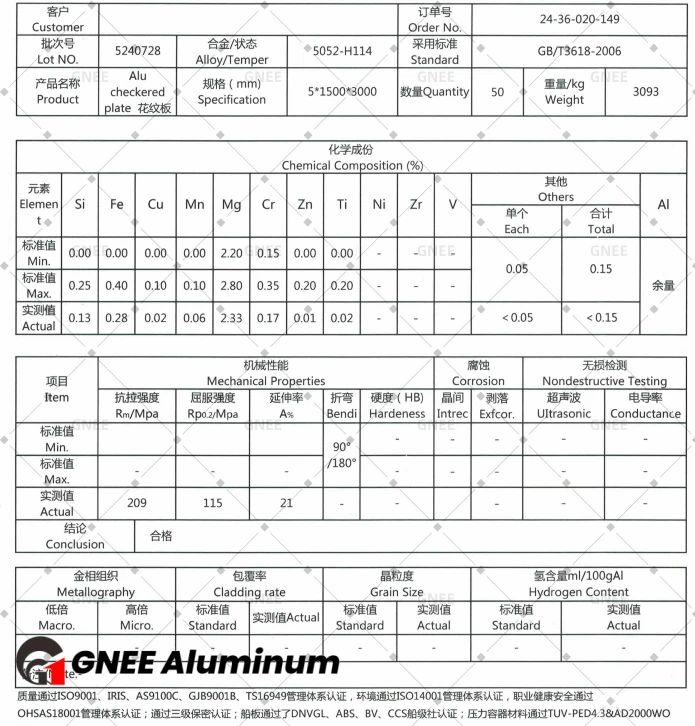
Mill Test Certificate to EN 10204 3.1 (3.2 and third-party inspection arranged on request).
Origin, heat/lot number, and full mechanical + chemical readout traceable to the coil/plate.
Flexible MOQ and small trials supported; standard lead time 15–30 days.
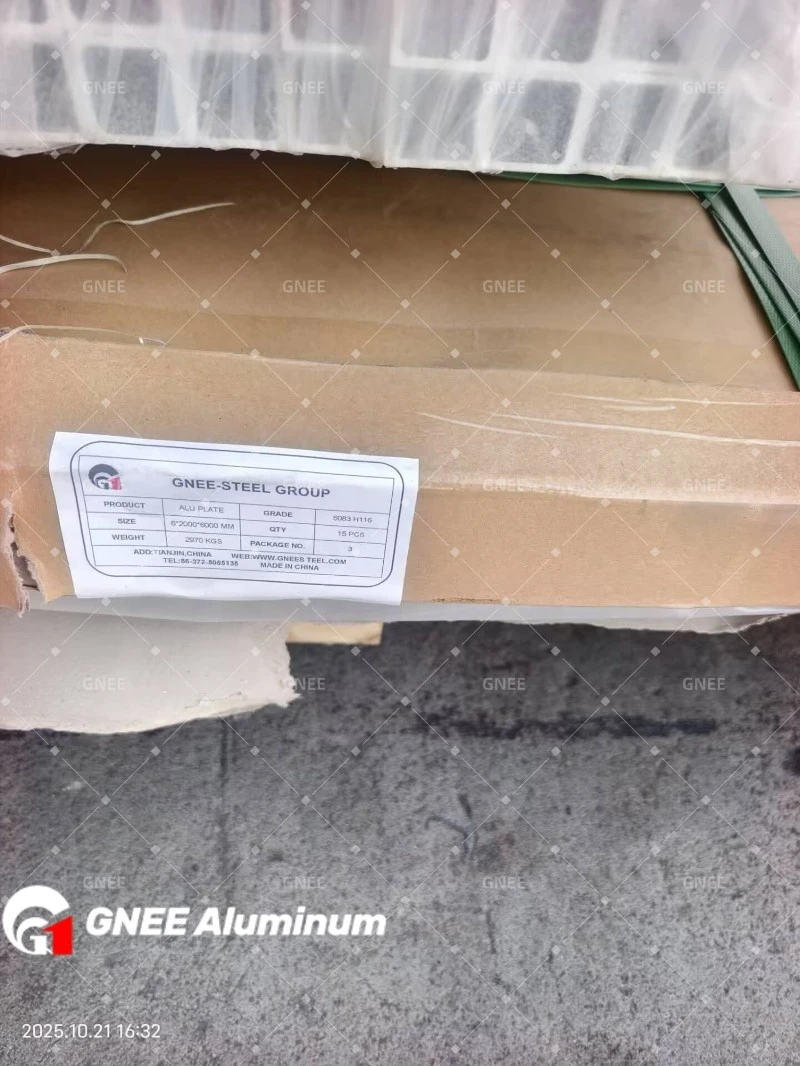
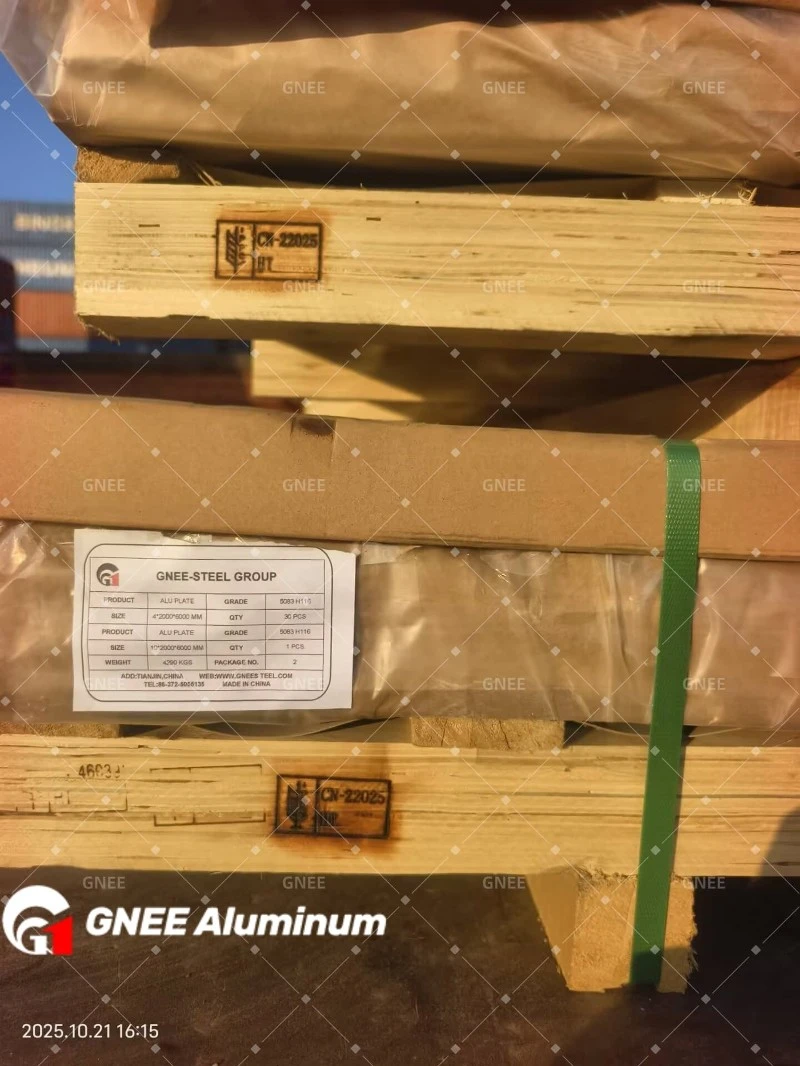
Export packing (seaworthy, VCI paper, wooden cases/pallets) per Incoterms agreed in the PO.



Processing and fabrication services
Beyond supplying ASTM B209 material, GNEE provides in-house and partnered downstream processing so your order arrives cut-to-size and ready to assemble. Typical services:
Cutting-shear, circular saw, laser, plasma, and waterjet cutting to length, width, and simple profiles on sheet and plate.
CNC machining - CNC milling and turning for holes, slots, pockets, and tight-tolerance parts machined from plate and bar.
Perforation/punching-standard and custom perforated patterns, louvers, and embossing on sheet and coiled sheet.
Chamfering/deburring-edge chamfer, rounding, and deburring for safe handling and clean fit-up.

Bending-press-brake bending and roll forming for angles, channels, and curved sections; springback accounted for by alloy and temper.
Welding - TIG/MIG welding of 5xxx and 6xxx alloys such as 5083 and 6061; filler selection and weld procedure advised per application (5083 is typically welded with 5xxx fillers, not 4043).
Surface treatment-mill finish, brushed, anodizing, powder coating, PVDF, and electrophoresis for 1xxx / 3xxx / 5xxx / 6xxx grades.
Exact capacities-max thickness, achievable tolerance, bed/table size, anodizing thickness, coating spec, etc.-are confirmed against your drawing and the required alloy/temper. Send the drawing or specification and we will quote the feasible process route and lead time.

About GNEE
GNEE is an aluminum exporter established in 2008, supplying aluminum sheet, plate, coil, foil, bar, tube, profile, flange, and fittings to 100+ countries and regions. We keep common-spec aluminum stock for fast delivery, accept both large and small orders (flexible MOQ), and ship within 15–30 days. Every order ships with EN 10204 3.1 MTC, and our technical team helps select the right alloy and temper for your working condition.

Frequently asked questions
Is ASTM B209 the same as GB/T 3880?For the common four-digit alloys they use the same mechanical-property values - GB/T 3880 adopts ASTM B209's UTS/yield ranges directly. Composition and temper labels also align. So an MTC to either standard shows identical strength numbers for grades like 3003, 5052, or 6061. Always confirm the exact thickness/temper row, since tolerance tables differ slightly between standards.
What is the difference between sheet and plate in B209?
The dividing line is thickness: ≤ 6.35 mm (0.250 in) is sheet; ≥ 6.35 mm is plate. Plate is typically ordered to specific length and flatness; sheet is usually supplied in standard or coiled widths. The alloy and temper options overlap, but some tempers (e.g., T6) are more common in plate.
Does ASTM B209 cover 7075 or other aerospace alloys?
Some high-strength alloys appear in related specs, but 2xxx/7xxx grades (2024, 7075, 7050, etc.) are China dual-use export-controlled. GNEE supplies them only with a valid license and end-use/end-user verification; we do not export to sanctioned parties or destinations. Quote these grades only after compliance clearance.
How do I read a B209 temper like H32 or T6?
The first letter is the process: O = annealed, H = strain-hardened, T = heat-treated. The digits show degree/stage - H32 is strain-hardened then stabilized at 1/4 hard; T6 is solution heat-treated and artificially aged. Harder tempers (higher digit) mean higher strength but lower ductility.
ASTM B209 is a published ASTM International standard; property figures on this page are indicative minimums for comparison. Always rely on the shipment's EN 10204 MTC for contractual values.


